On this page
Many school corridors, store rooms and factory floors have no windows. One way to light them by day is a light pipe: a clear dome on the roof, a straight tube lined with a mirror film, and a frosted diffuser in the ceiling below. Sunlight bounces down the tube and spreads into the room, using nothing but the law of reflection, over and over.
How much light arrives depends on how many times each ray bounces and what fraction the mirror keeps at each bounce.
How does a light pipe carry sunlight down a tube?
A ray of sunlight enters the top of a vertical tube at some angle θ from the tube's axis. For a vertical pipe, θ is the Sun's angle from the zenith (straight overhead). The ray travels across the tube, hits the mirror wall, reflects with the angle of reflection equal to the angle of incidence, and crosses again. It zigzags down without ever changing its angle to the axis.
This is guiding by ordinary metal-type reflection, not by total internal reflection. In an optical fibre, total internal reflection keeps essentially all the light at each bounce, which is why fibres can be long and thin; see Narinder Singh Kapany and images carried through glass fibres. A mirror always absorbs a little at every bounce. How a metal surface reflects light is covered in why a mirror needs a silver backing behind glass.
How many times does light bounce in a light pipe?
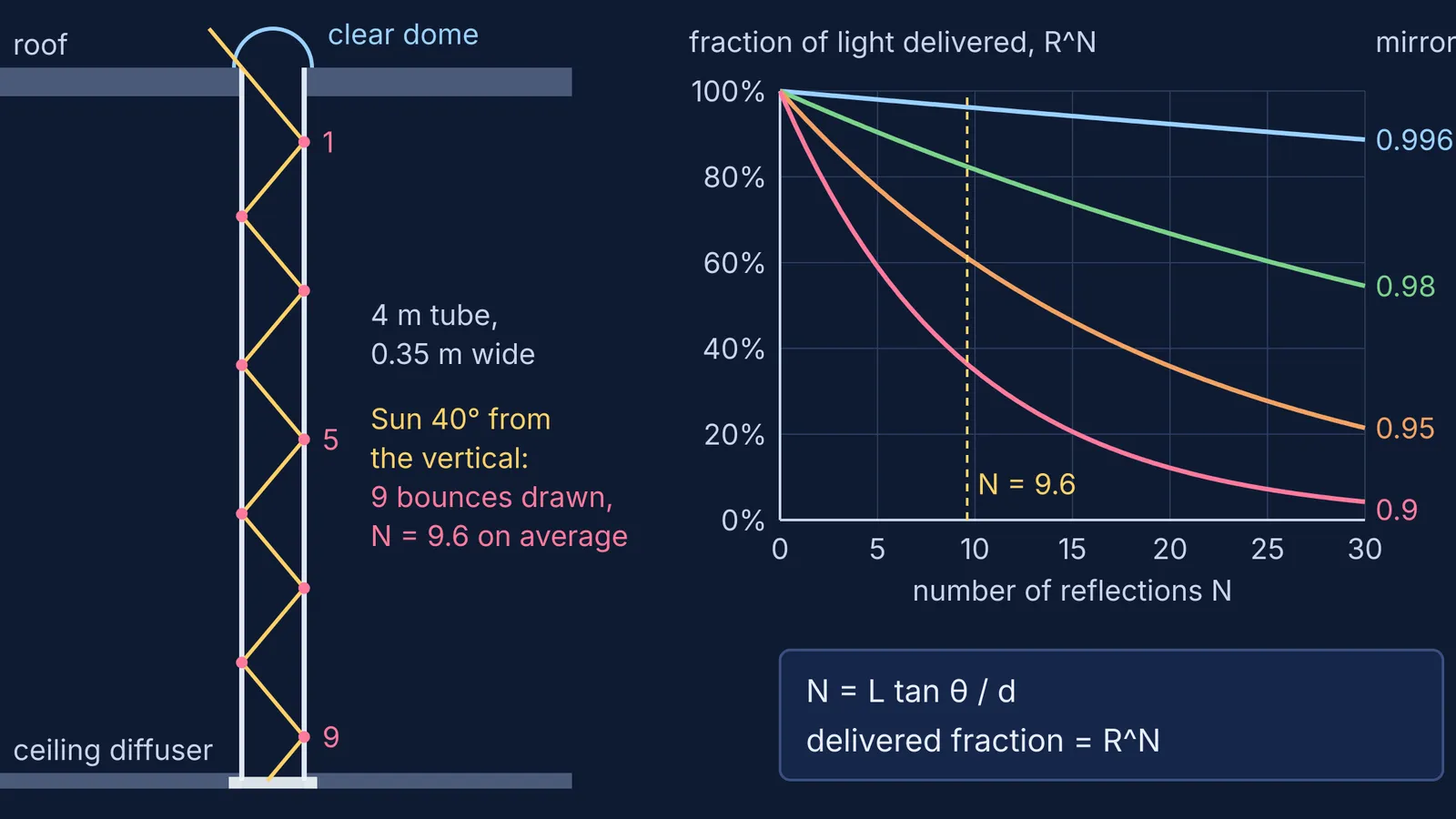
Take a ray that passes through the tube's axis. Between two reflections it crosses the full diameter d. While moving sideways by d, it moves down by d/tan θ. So in a pipe of length L the number of reflections is about:
N = L tan θ / d
Each reflection keeps a fraction R of the light (R is the mirror's reflectance). After N reflections the fraction that arrives is:
delivered fraction = R^N
A long pipe and a low Sun raise N; a wide pipe lowers it. The same idea of counting repeated reflections between mirrors appears in the number of images between two inclined mirrors.
N is an average. A ray that enters near one edge may make one more or one fewer bounce than the formula says, and rays that do not pass through the axis (skew rays) spiral down with a different spacing between bounces.
How good do the mirrors need to be?
Because the losses multiply, a small change in R makes a large change in R^N. A review of tubular daylight guidance systems by David Carter in Lighting Research & Technology (2014) reports that commercial guides use materials with a specular reflectance of about 99.6%. It also states that guides with a specular reflectance below 99.6% are unlikely to prove satisfactory in use.
To see why, compare that 99.6% film with three lower values. The values 98%, 95% and 90% below are illustrative, chosen to show the trend, not measured figures for any product.
Worked example: how much sunlight reaches the room?
Take a pipe d = 0.35 m wide.
Short pipe, high Sun. L = 1.5 m, Sun 20° from the zenith. N = 1.5 × tan 20° / 0.35 = 1.5 × 0.364 / 0.35 = 1.56. With R = 0.98, R^N = 0.98^1.56 = 0.97. With R = 0.90, 0.90^1.56 = 0.85.
Same pipe, low Sun. θ = 60°, tan 60° = 1.732, so N = 7.4. Now 0.98^7.4 = 0.86, but 0.90^7.4 = 0.46.
Longer pipe. L = 4 m, θ = 40°, tan 40° = 0.839. N = 4 × 0.839 / 0.35 = 9.6. The ray reflects about once for every 0.42 m of pipe.
R = 0.996: 0.996^9.6 = 0.96
R = 0.98: 0.98^9.6 = 0.82
R = 0.95: 0.95^9.6 = 0.61
R = 0.90: 0.90^9.6 = 0.36
Narrow pipe, low Sun. d = 0.25 m, L = 4 m, θ = 60°. N = 4 × 1.732 / 0.25 = 27.7. Now 0.996^27.7 = 0.90, 0.98^27.7 = 0.57 and 0.90^27.7 = 0.05. With poor mirrors, almost nothing arrives.
Now turn the fractions into light in the room. Take 100,000 lux as a round figure for direct sunlight on a clear day. This is an illustrative value: NIST Technical Note 1148 gives a measured average of 105 lumens per watt for direct sunlight, and a clear-sky beam of around 1,000 W/m² then gives roughly this figure. Real values change with the Sun's height and the haze in the air.
Light entering the pipe. The opening is a circle of area π × 0.175² = 0.0962 m². With the Sun 40° from the zenith, the illuminance on a horizontal opening is 100,000 × cos 40° = 76,600 lux. Flux in = 76,600 × 0.0962 = 7,370 lumens.
Light leaving a 4 m pipe. With R = 0.98: 7,370 × 0.824 = 6,070 lm. With R = 0.90: 7,370 × 0.364 = 2,680 lm.
Average illuminance on a 10 m² floor. E = Φ/A gives about 600 lux with the 98% film and 270 lux with the 90% film.
These are upper limits for the direct beam alone. The dome, the diffuser and the room's walls all lose some light, and bends in a pipe add further losses. On the other side, skylight from the rest of the sky also enters the dome; Carter's review puts a horizontal dome's capture at around 80% of the global illuminance (sunlight plus skylight).
Why are light pipes short and wide?
Halving the length halves N, and so does doubling the width. A short, wide pipe keeps N small, so even a slightly imperfect mirror delivers most of the light.
The Sun's position matters too. In the morning and evening θ is large, so N goes up and the pipe delivers less, on top of the weaker sunlight.
An optical fibre can be thin and kilometres long only because total internal reflection loses almost nothing per bounce. A mirror pipe cannot copy that.
Where can you practise this?
The pieces here are Class 12 ray optics: the law of reflection, a ray's path traced by geometry, and E = Φ/A from photometry. If you want to see how a ray's zigzag changes as you tilt it or widen a tube, the Simulation Lab has interactive simulations for ideas that are easier to see than to read. For a refresher on reflection and illuminance, the Concept Library covers every concept in physics, chemistry, biology, mathematics and computing.
Quick checklist
Never look at the Sun or its reflection; study light pipes from diagrams.
Bounces in a straight pipe: N = L tan θ / d.
Fraction delivered after N bounces: R^N.
Commercial guides use mirrors of about 99.6% specular reflectance.
A 4 m, 0.35 m pipe at 40° gives N = 9.6: 82% delivered with R = 0.98, 36% with R = 0.90.
Short, wide pipes and a high Sun mean fewer bounces and more light.