

On this page
Have you ever looked at a window at night and seen your faint reflection? Glass has a naturally smooth surface, but it is transparent. To turn that glass into a perfect mirror, you need to block the light from passing through and bounce it back to your eyes.
Why does a mirror need a silver backing behind glass?
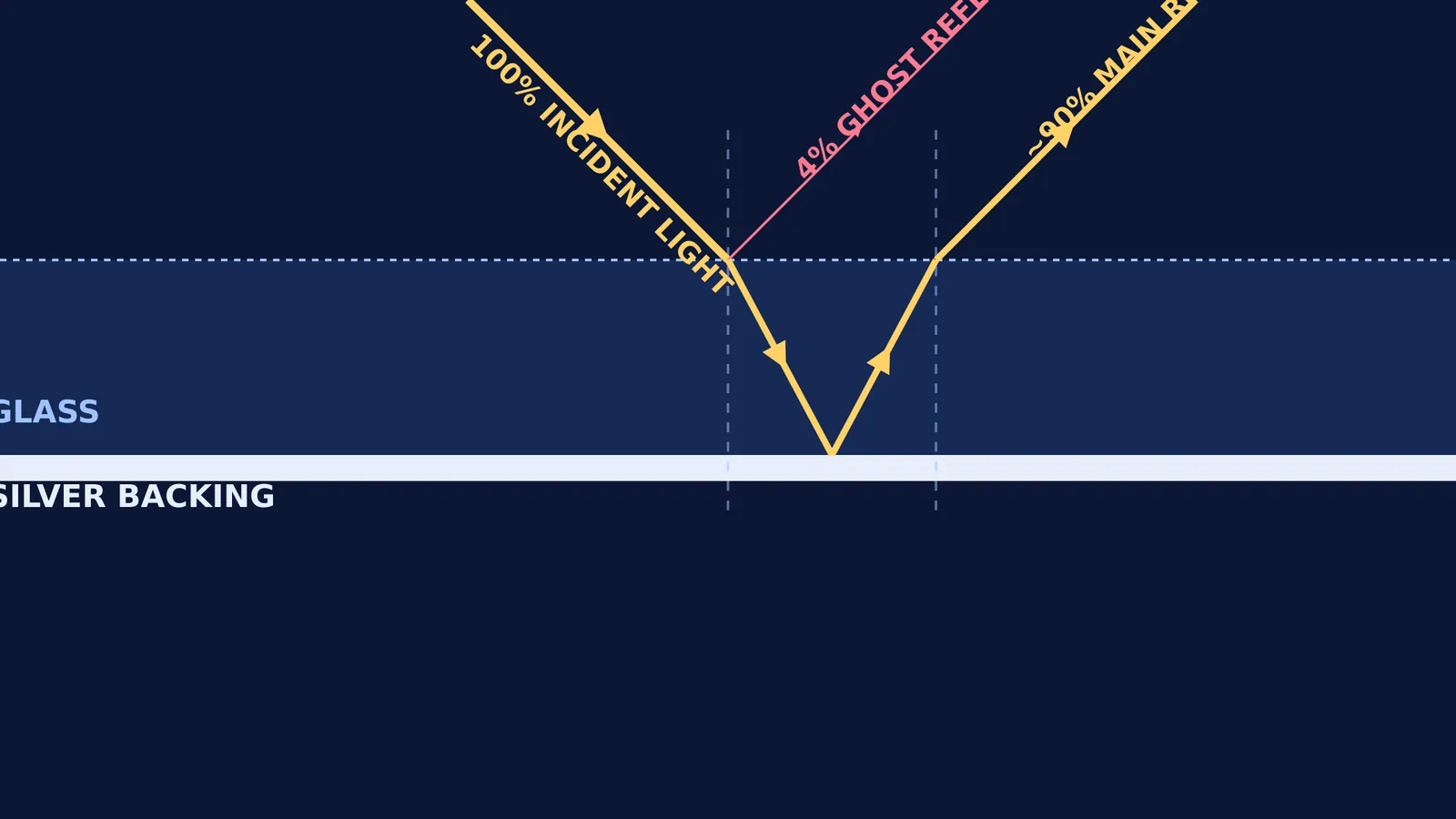
The answer comes down to how much light glass actually reflects. According to the Fresnel equations, when light hits the surface of common glass straight on, only about 4% of the light is reflected. The remaining 96% travels right through the pane. If you stand in front of plain glass, you only get a very weak image.
To see yourself clearly, a mirror needs a material with high reflectivity. Metals are excellent reflectors. Most common mirrors use a thin coating of silver or aluminium, which reflects 90% to 95% of incoming light when new. The metal does the actual work of bouncing the image back to you, while the glass acts as a perfectly flat canvas to hold it.
Why are metals so good at reflecting light while glass is not? Glass is an electrical insulator. Its electrons are tightly bound to their atoms, meaning they cannot easily move to interact with the electromagnetic waves of visible light. The small 4% reflection at the surface happens merely because of the sudden change in the medium's density (its refractive index). Metals, however, are packed with a 'sea' of free electrons. When light hits a metal, these free electrons vibrate in sync with the wave, generating a new electromagnetic wave that travels back the way it came.
Why not just use a solid metal sheet?
Before the invention of glass-backed mirrors, ancient people did exactly that. They used highly polished discs of bronze or copper. While these worked, they required constant maintenance.
The problem is that exposed metal degrades quickly. Silver reacts with trace amounts of sulphur in the air to form a dark, dull tarnish. Aluminium oxidises and is easily scratched by everyday cleaning. By coating the metal onto the *back* of a glass pane — creating what is called a "second-surface" mirror — the fragile metal is sealed away from the air and protected from scratches.
Seeing it in the Fermi Simulation Lab
When studying optics, drawing ray diagrams helps make sense of reflection and refraction. You can set up virtual blocks of glass and metal in the Fermi Simulation Lab to see exactly where the light goes.
If you aim a light beam at a plain glass block, you will see a faint reflected ray and a bright refracted ray bending into the glass, just as you would when tracing a ray through a glass slab. When you add a silver backing in the simulation, the light travels through the glass, hits the silver, and reflects powerfully back out. The simulation helps you understand the angles involved, which is especially useful when solving problems about rotating a plane mirror by θ.
What about precision telescope mirrors?
If you have ever touched the tip of your finger to a bathroom mirror, you will notice a small gap between your finger and its reflection. That gap is the thickness of the glass. Because the light must travel through the glass to hit the metal and come back out, you are seeing the ghost image at the surface and the main image deeper inside.
In everyday life, this double reflection is too faint to be a problem. But if you are pointing a telescope at a distant galaxy, a ghost image would completely ruin the data. To solve this, telescopes and high-end lasers use "first-surface" mirrors. In these, the metal coating is on the front of the glass, facing the light directly.
Because the delicate metal is exposed, telescope mirrors are kept inside protective observatory domes, sealed tubes, or the vacuum of space. Whether you are figuring out the minimum mirror height to see your full image or calculating focal lengths, remember that the glass in a daily mirror is just a transparent shield for the thin layer of metal doing the heavy lifting.


