On this page
The number of lumens printed on an LED bulb's box is the lamp's total light output in every direction at once. You cannot get it by pointing a light meter at the bulb, because a bulb throws more light one way than another. Test labs put the lamp inside a large hollow ball painted matt white, called an integrating sphere, and read one small detector in the wall. The trick works because of a neat geometric fact about spheres and a geometric series you already know: 1 + ρ + ρ² + … = 1/(1 − ρ).
What is an integrating sphere?
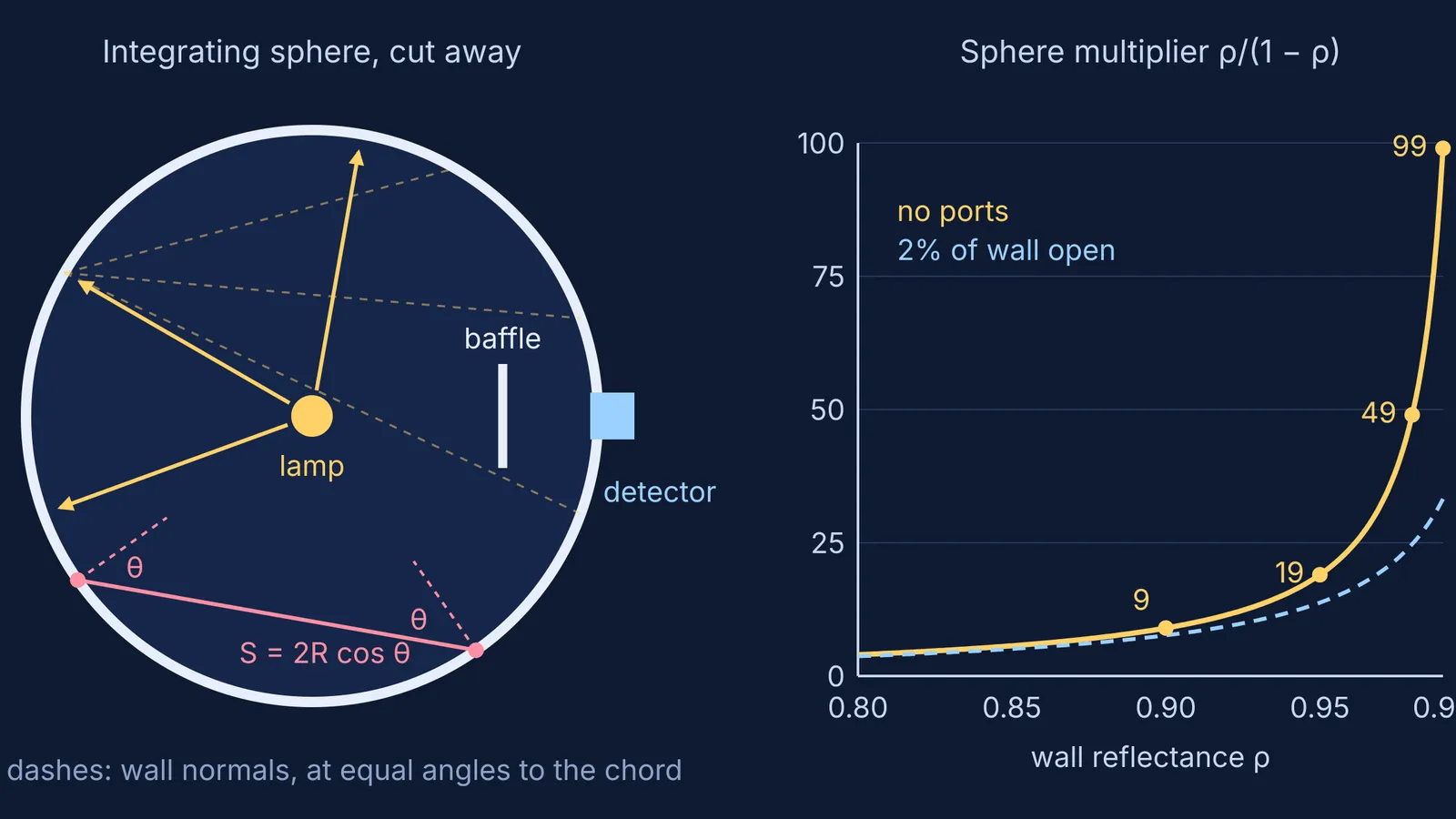
It is a hollow sphere whose inside is coated with a very white, perfectly matt paint. The lamp sits at the centre. A light detector looks into the sphere through a small port in the wall, and a small white screen, called a baffle, sits between the lamp and the detector so that no light reaches the detector straight from the lamp.
Light from the lamp strikes the wall, scatters, strikes the wall again, scatters again, and so on, many times. After a few bounces the wall glows almost evenly all over, whatever direction the lamp first sent its light. The detector reads that glow.
This is a different idea from the grease-spot photometer, which compares two lamps by the inverse-square law. The sphere needs no distances at all.
Why does light reflected inside a sphere spread evenly?
Take two small patches of the wall, dA₁ and dA₂. For a matt (Lambertian) surface, the fraction of light leaving dA₁ that lands on dA₂ is
dF = cos θ₁ cos θ₂ dA₂ / (π S²)
where S is the distance between the patches and θ₁, θ₂ are the angles the line joining them makes with each surface's normal. Inside a sphere, the chord joining two points makes equal angles with both normals, so θ₁ = θ₂ = θ, and its length is S = 2R cos θ. Put those in:
dF = cos²θ dA₂ / (π × 4R² cos²θ) = dA₂ / (4πR²)
The cos²θ cancels. Every patch of a matt sphere sends the same fraction of its scattered light to every other patch, no matter how near or far they are. That fraction is just the patch's share of the total wall area. Labsphere's technical guide, Integrating Sphere Theory and Applications, derives exactly this, and it is why the reflected light comes out uniform.
The direct light from the lamp is not uniform, because the lamp is not. That first-strike light is what the baffle hides from the detector.
How much brighter do the reflections make the wall?
Let the lamp give a total flux Φ, the wall have area A = 4πR² and reflectance ρ (the fraction of light it scatters back). How well ordinary surfaces reflect is discussed in why a mirror needs a metal backing; here the surface scatters rather than mirrors.
Direct light. All of Φ strikes the wall once. Averaged over the wall, that is Φ/A.
First reflection. ρΦ is scattered, and by the sphere property it lands evenly: ρΦ/A everywhere.
Second reflection. ρ²Φ/A, also even. Then ρ³Φ/A, and so on.
Add the reflected terms, a geometric series:
E(reflected) = (Φ/A)(ρ + ρ² + ρ³ + …) = (Φ/A) × ρ/(1 − ρ)
The factor ρ/(1 − ρ) is called the sphere multiplier. It is the same at every point on the wall, and the detector reading is proportional to Φ, the lamp's total output.
How big is the gain in a real sphere?
Take an illustrative 1,000-lumen lamp in a sphere 1 m across.
Radius and area. R = 0.5 m, so A = 4π × 0.5² = 3.14 m².
Direct light, averaged. Φ/A = 1,000 ÷ 3.14 = 318 lux (1 lux = 1 lm/m²).
Multiplier at ρ = 0.90. 0.90 ÷ 0.10 = 9, so the reflected light gives 9 × 318 = 2,860 lux.
At ρ = 0.95. 0.95 ÷ 0.05 = 19, giving 6,050 lux.
At ρ = 0.98. 0.98 ÷ 0.02 = 49, giving 15,600 lux.
At ρ = 0.99. 99, giving 31,500 lux.
With a 98% coating, the wall is lit 49 times more by reflections than by the lamp's direct light. Labsphere's guide gives over 95% for its two standard sphere coatings from 350 nm to 1,350 nm, a band that covers the visible range.
Look at how sensitive the multiplier is. Going from 0.95 to 0.98 changes the reflectance by about 3%, but changes the reading by 49 ÷ 19 = 2.6 times. Labsphere's guide makes the same point when it compares two coatings: a reflectance gain of 2% to 15% can raise the sphere's radiance by 40% to 240%.
Why do holes in the sphere matter so much?
A real sphere needs ports for the detector and for getting the lamp in. Light that falls on an open port is lost from the sphere. If the ports make up a fraction f of the wall, each bounce keeps only ρ(1 − f) of the light, and the multiplier becomes
M = ρ / [1 − ρ(1 − f)]
This is the form in Labsphere's guide, which assumes the input light first strikes the wall. With ρ = 0.98 and only 2% of the wall open (f = 0.02):
M = 0.98 ÷ (1 − 0.98 × 0.98) = 0.98 ÷ 0.0396 = 24.7
That is half of 49, so the reading falls to about 7,880 lux. Two per cent of open wall halves the signal. Labsphere's rule of thumb is that most real spheres, with reflectance between 0.94 and 0.99 and port fractions between 0.02 and 0.05, have multipliers of about 10 to 30.
How does a lab turn the reading into lumens?
Because ρ and f are never known exactly, labs do not calculate Φ from the formula. Labsphere describes the usual method: the detector is first calibrated with a standard lamp of known luminous flux, traceable to a national standards laboratory, and then the test lamp is put in its place. Since the reading is proportional to Φ, the ratio of the two readings gives the test lamp's lumens. An extra lamp inside the sphere can correct for the fact that the two lamps themselves absorb slightly different amounts of light.
Lumens also depend on how the eye weighs each colour, which links to what 2,700 K on a bulb box means. Photometry itself is outside the current NCERT syllabus, so treat this as an application of reflection and of geometric series. To practise series sums and ray-optics problems, try the Fermi Problem Library, which has a step-by-step solver that explains the reasoning, or revise the ideas in the Concept Library.
Quick checklist
On a matt sphere, each patch sends the fraction dA/(4πR²) of its scattered light to any other patch.
Reflected light: E = (Φ/A) × ρ/(1 − ρ), the same everywhere.
1,000 lm in a 1 m sphere: 318 lux direct, 15,600 lux reflected at ρ = 0.98.
With ports: M = ρ/[1 − ρ(1 − f)]; 2% open wall halves the reading at ρ = 0.98.
A baffle hides the uneven first-strike light from the detector.
Labs calibrate with a standard lamp and substitute the test lamp.