

On this page
Pick up an LED bulb in a shop and the box says "2700 K warm white" or "6500 K cool daylight". No part of that bulb is anywhere near 2,700 K. The number is borrowed from black-body radiation, and once you see where it comes from you can also answer a better question: why does a filament glowing at that temperature turn only about 5% of its power into visible light?
What does "2,700 K" on a bulb box actually mean?
A lamp's colour temperature is the temperature of a black body whose glow looks the same colour as the lamp. A black body at 2,700 K glows yellowish orange, so a lamp that looks that colour is labelled 2,700 K.
For a filament bulb this is close to literal, because the tungsten filament really is near that temperature. For an LED it describes the colour only. The US Department of Energy's page on LED basics explains that white LEDs usually make their light by phosphor conversion, where a phosphor on or near the LED converts its coloured light to white, and that the colour is then summed up as a correlated colour temperature (CCT). "Correlated" means "the nearest black-body colour", because the LED's spectrum is not a black-body curve at all.
Why is a higher colour temperature sold as "cool white"?
This is the opposite of everyday language, and it trips people up. Wien's law, λmax = b/T with b = 2.898 × 10⁻³ m K (NIST value), says a hotter body peaks at a shorter wavelength. So:
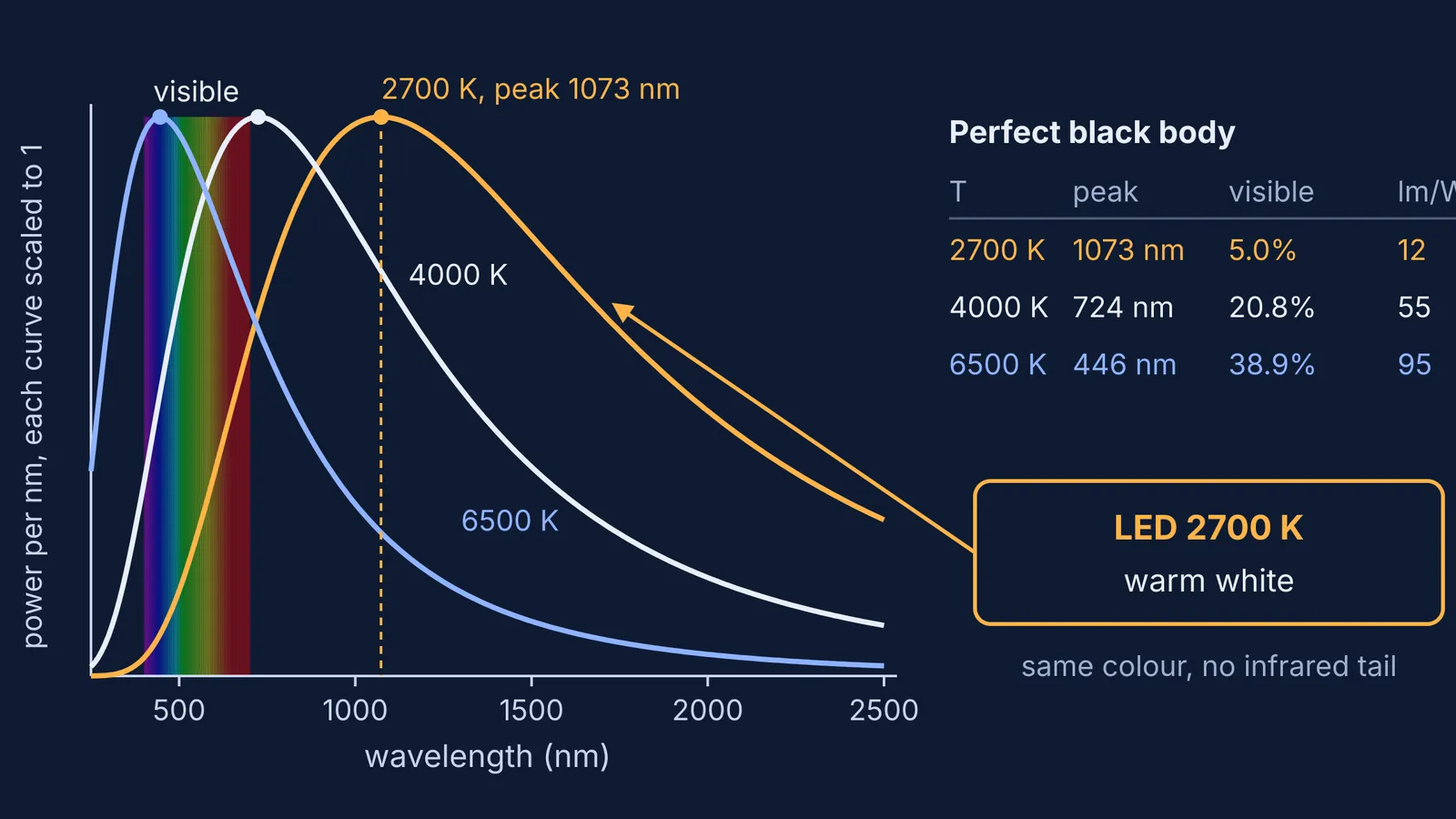
2,700 K peaks at 1,073 nm and looks orange-yellow: sold as "warm white".
4,000 K peaks at 724 nm and looks neutral white.
6,500 K peaks at 446 nm and looks bluish: sold as "cool daylight".
"Warm" and "cool" describe how the colour feels to people, not the temperature. The hotter source looks cooler. If you need a refresher on Wien's and Stefan's laws themselves, our post on Stefan's law and Wien's law problems works through them.
How much of a 2,700 K glow is visible light?
Here is the worked example. Treat the source as a perfect black body and take visible light as 400 nm to 700 nm.
Find the peak. λmax = b/T = 2.898 × 10⁻³ / 2,700 = 1.073 × 10⁻⁶ m, or 1,073 nm. That is in the infrared, well beyond the red end at 700 nm. Most of the curve lies to the right of the visible band before you calculate anything.
Find the total power per square metre. Stefan's law gives σT⁴ = 5.670 × 10⁻⁸ × 2,700⁴ ≈ 3.01 × 10⁶ W/m², about 301 W per square centimetre of surface.
Find the visible part. Add up Planck's law, the power per unit wavelength, from 400 nm to 700 nm. There is no neat formula for a slice of the curve, so it is done numerically in small steps. The result is about 1.5 × 10⁵ W/m².
Divide. Visible share = 1.5 × 10⁵ / 3.01 × 10⁶ ≈ 5.0%.
So about 95% of what a 2,700 K black body radiates is infrared; the ultraviolet share is under 0.1%. Our post on how an incandescent bulb works quotes the "under 5% becomes light" figure; this is where it comes from.
Repeat the same calculation at other temperatures (all numbers computed from Planck's law):
3,000 K: peak 966 nm, 8.1% visible.
4,000 K: peak 724 nm, 20.8% visible.
5,800 K (about the Sun's surface): peak 500 nm, 36.8% visible.
6,500 K: peak 446 nm, 38.9% visible.
Raising the filament from 2,700 K to 3,000 K, only 11% hotter, raises the visible share by more than half. That steep rise is why designers run a filament as hot as its lifetime allows: hotter tungsten evaporates faster.
How many lumens should a 60 W filament bulb give?
Watts of visible light are not what your eye measures. The eye is most sensitive near 555 nm and much less sensitive at 420 nm or 680 nm. The International Commission on Illumination (CIE) publishes the standard photopic luminous efficiency curve V(λ), and the SI defines 683 lumens per watt at the eye's peak. Multiply the black-body spectrum by V(λ) and by 683, add it up, and divide by the total power:
At 2,700 K a perfect black body gives about 12.4 lumens per watt.
A 60 W source at that efficacy gives 60 × 12.4 ≈ 740 lumens.
The US Federal Trade Commission's guide to shopping for light bulbs says a traditional 60 W incandescent bulb gives about 800 lumens. Our 740 lumens is close. The gap is expected: a real filament is not a perfect black body, its exact temperature varies from bulb to bulb, and tungsten emits relatively less in the far infrared than a black body, which nudges its efficacy up. Treat the black-body figures as estimates of the right size, not exact bulb ratings.
Why does a 2,700 K LED use so much less power for the same colour?
The same FTC guide says an LED bulb can give the same 800 lumens using only about 9 W. That is 800 / 9 ≈ 89 lumens per watt, roughly seven times the filament bulb's 800 / 60 ≈ 13 lumens per watt.
The reason is in the spectrum, not just "less heat". A filament has to be hot to glow, and at 2,700 K a hot body cannot avoid putting 95% of its power into the infrared. An LED's light is made by electrons crossing a junction, not by heat, so it can put almost all its output between 400 and 700 nm and almost nothing beyond 800 nm. It copies the colour of a 2,700 K glow without copying the infrared tail. How the junction makes light is covered in why LED bulbs use less electricity.
One more number puts this in perspective. Repeat the lumens calculation over every temperature and a perfect black body never does better than about 95 lumens per watt, reached near 6,600 K. Even an ideal glowing body at the ideal temperature would only roughly match an ordinary 9 W LED bulb. To watch the peak move and the visible share grow as you drag the temperature up, try the black-body model in the Simulation Lab.
What mistakes cost marks on colour temperature questions?
Saying a 2,700 K LED is at 2,700 K. Only the colour matches.
Calling 6,500 K "warmer" because the number is bigger. It looks cooler and bluer.
Using Wien's law to say a 2,700 K body "emits mostly red light". Its peak is in the infrared, and only 5% is visible at all.
Mixing the per-wavelength peak (1,073 nm) with the per-frequency peak (about 1,890 nm).
Treating visible watts as lumens. Lumens weight each wavelength by the eye's sensitivity.
Quick checklist
Colour temperature = temperature of the black body with the same colour.
Higher K looks bluer and is sold as "cool"; lower K looks orange and is sold as "warm".
2,700 K: peak 1,073 nm, about 5% visible, about 12 lm/W as a perfect black body.
A 60 W filament bulb gives about 800 lm; a 9 W LED gives the same.
No black body beats about 95 lm/W, at any temperature.


