

On this page
If you look at the ceiling of an older classroom or house, you might still find traditional filament bulbs. For decades, they were the standard way to light a room. Today, they have been almost entirely replaced by light-emitting diodes (LEDs).
The shift is driven by one fundamental difference: how they use electricity to generate light. Traditional incandescent bulbs create light by heating a wire, while LEDs create light directly within a semiconductor material. This difference in physics means a massive difference in both your electricity bill and the environmental impact of your lighting.
Why do old bulbs waste so much energy?
A traditional incandescent bulb works on the simple principle of thermal radiation. Inside the glass vacuum is a thin tungsten filament. When you flip the switch, an electric current is forced through this filament. Because the tungsten has high electrical resistance, it heats up to extreme temperatures until it glows white-hot.
This process is incredibly inefficient because it relies heavily on the heating effect of current. An incandescent bulb releases 90% of its energy as heat, according to ENERGY STAR (ENERGY STAR, 2024). Only a tiny fraction of the electricity you pay for actually becomes visible light. The rest is wasted warming up the room, which can even force your air conditioning to work harder during the summer.
How do LEDs make light without heat?
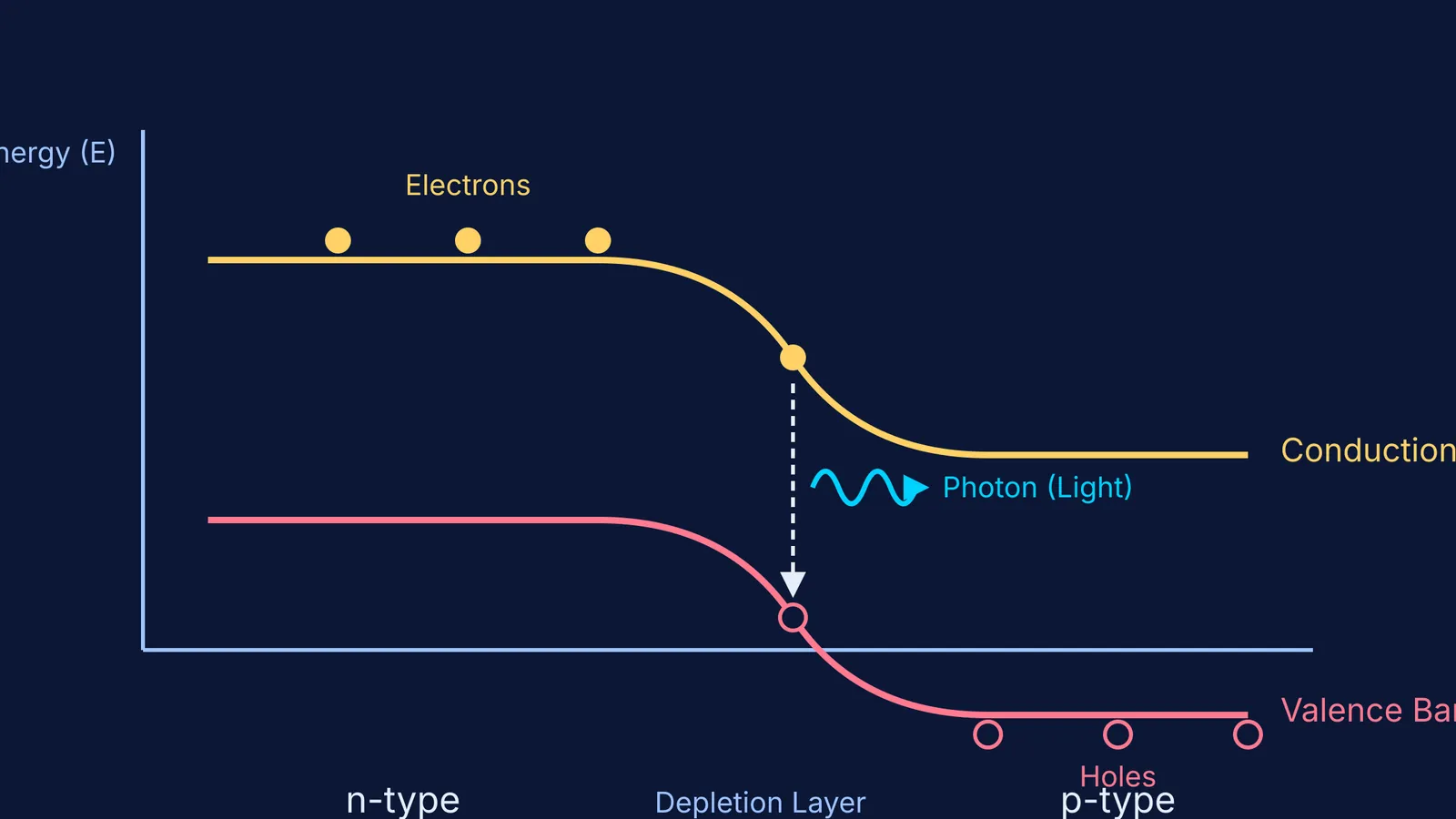
LEDs do not use a glowing filament. Instead, they use a highly efficient process called electroluminescence. An LED is a solid-state device made of two different types of semiconductor material joined together. One side is the n-type, which contains extra negatively charged electrons. The other side is the p-type, which contains positive "holes" where electrons can naturally fit.
When voltage is applied across this junction, the electrons are pushed from the n-type side toward the p-type side. As an electron drops into a hole, it falls from a higher energy state in the conduction band to a lower energy state in the valence band. It sheds this extra energy instantly by releasing a photon, which is a fundamental particle of light. You can explore how energy bands in semiconductors govern this behaviour to understand why different materials emit different colours.
Because this quantum drop creates a photon directly, the LED generates almost no heat in the light beam. If you struggle to picture how electrons move and recombine across a physical junction, you can interact with semiconductor circuits in the Fermi Simulation Lab.
Why do LED bulbs use less electricity than old bulbs?
Because LEDs skip the heating step entirely, nearly all their electrical power goes directly toward illumination. This direct conversion is why LED lighting products produce light up to 90% more efficiently than traditional incandescent bulbs (ENERGY STAR, 2024).
To produce the exact same brightness as an old incandescent bulb, a modern LED only needs to draw a fraction of the power from the grid. Furthermore, because there is no delicate filament to slowly burn away and break over time, high-quality LED bulbs last significantly longer than their traditional counterparts.
Another efficiency benefit comes from the shape of the light. Traditional bulbs emit light in all directions, which means a lot of light gets trapped inside the lamp housing. LEDs naturally emit light in a specific direction. This makes them significantly more efficient for studying or reading, as the light is focused exactly on your desk rather than bouncing around the ceiling.
Checklist: How to spot bulbs that waste electricity
If you want to cut down on energy waste at home or ensure your study space is optimally lit, check your light fixtures using this simple framework:
Feel the ambient temperature. If a bulb is radiating noticeable heat after being on for a few minutes, it is likely an incandescent or halogen bulb wasting electricity as thermal energy.
Read the wattage rating. Take the bulb out safely when it is cool and look at the printed text on the base. High wattage numbers mean it is an older, inefficient model. Modern LEDs draw significantly less power for a standard room light.
Look for a physical filament. Clear glass bulbs that show a delicate, glowing wire inside are incandescents.
Check the directionality. If your desk lamp requires a large metal reflector to redirect the light downward, you are losing energy. Upgrading to a directional LED ensures every photon helps you read.


