

On this page
A filament bulb is a resistor that gets hot enough to glow. School questions about it follow from two ideas: heating depends on current and resistance, and current needs a complete path.
What are the parts of an incandescent bulb?
The incandescent light bulb entry on Wikipedia lists the main parts, and each one has a job:
Glass envelope: seals the filament away from the air in the room.
Gas fill: commonly argon (93%) and nitrogen (7%) at about 70 kPa, which slows evaporation of the filament and stops it oxidising.
Tungsten filament: a very fine wire wound into a coil, and that coil wound again (a "coiled coil").
Support wires: hold the filament in place.
Lead-in wires: carry current from the base, through a glass stem, to the two ends of the filament.
Base (cap): the screw or bayonet part whose electrical contacts connect the bulb to the mains.
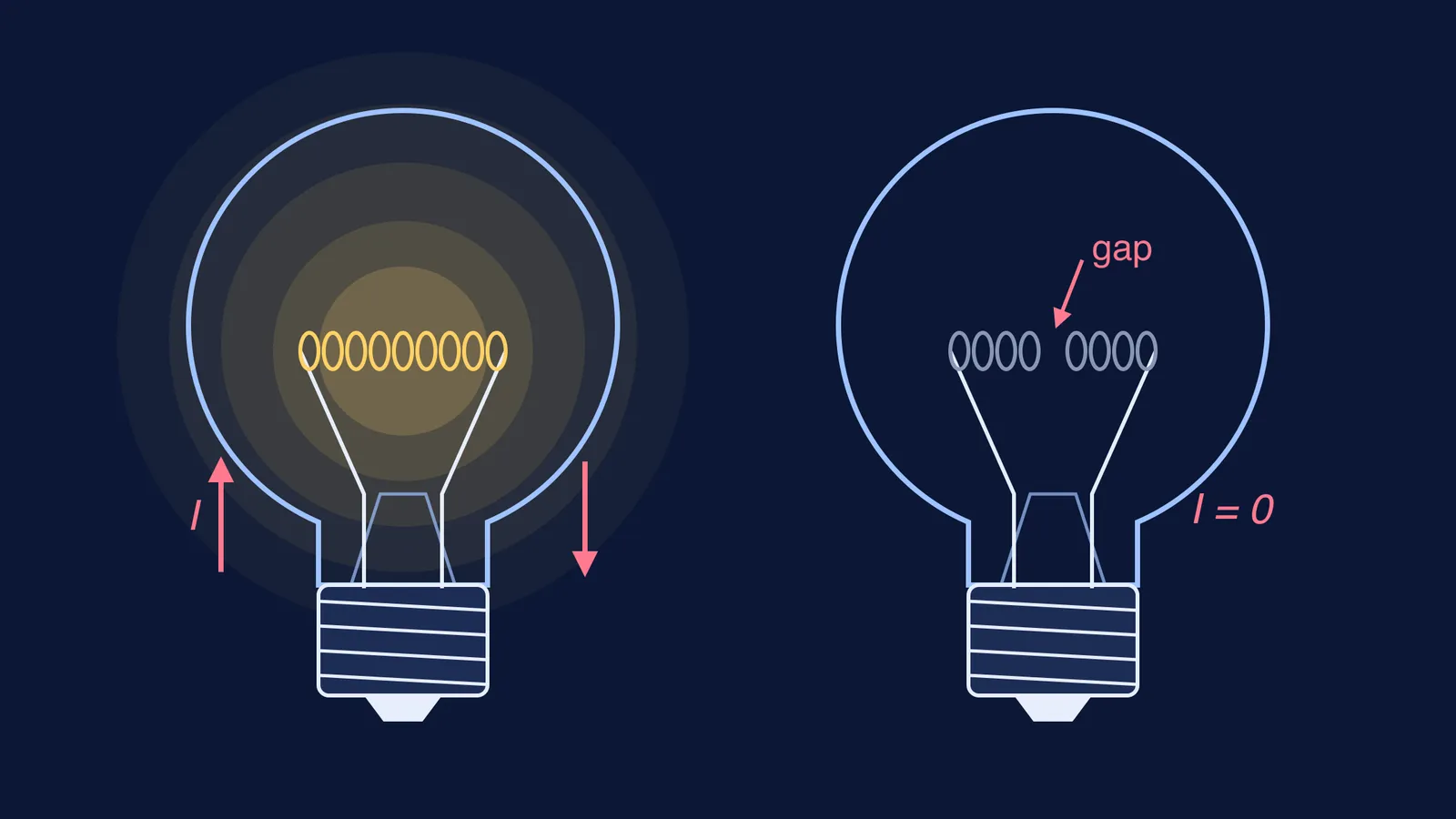
Follow the current: in at one contact, up one lead-in wire, through the filament, down the other wire and out. The filament is the only path inside the bulb.
How does an incandescent bulb work?
An incandescent bulb produces light by Joule heating a filament until it glows, according to Wikipedia's incandescent bulb article. The heat produced in a resistor is H = I²Rt, so for a given current, a wire with more resistance gets hotter.
That is why the filament is thin and long. Resistance is R = ρL/A, so a long wire with a tiny cross-section has a high resistance. Coiling it twice packs that length into a short coil and, as the same article explains, reduces gas flow along the wire, so it loses less heat and evaporates more slowly.
The current heats the filament to typically 2,000 to 3,300 K, well below tungsten's melting point of 3,695 K (Wikipedia). Most of the energy it radiates is infrared. Less than 5% of the energy an incandescent bulb uses becomes visible light; the rest is released as heat (Wikipedia). For why this metal and not another, see why tungsten is used in bulbs and nichrome in heaters.
Why does the bulb fuse when the filament breaks?
When the filament breaks, the bulb's only conducting path has a gap. The circuit is open, so current stops, I = 0, the heating I²R drops to zero and the light goes out. That is what "the bulb has fused" means.
Why does it break? Hot tungsten slowly evaporates, and Wikipedia's account of filament notching explains that small variations in resistivity along the filament create hot spots where the resistance is higher. The same current flows through the whole filament, so the higher-resistance spot dissipates more power (I²R), gets hotter, evaporates faster and thins further: a positive feedback loop. The same source says a variation in diameter of only 1% can cut service life by 25%.
If the bulb is one of several in series, the gap stops the current everywhere. Our post on why all bulbs go off when one fuses in series works through that case.
How much current flows when you switch a bulb on?
Tungsten's resistance rises a lot as it heats up. In OpenStax College Physics, a tungsten filament with a resistance of 0.350 Ω at 20 °C reaches 4.8 Ω at 2,850 °C, using R = R₀(1 + αΔT) with α = 4.5 × 10⁻³ per °C. That is about 14 times the cold value.
Now try it on a bulb at home. Take a 100 W bulb on a 230 V supply (using rms values):
Hot resistance: R = V²/P = 230² / 100 = 529 Ω.
Normal running current: I = P/V = 100 / 230 ≈ 0.43 A.
Cold resistance, using the OpenStax ratio: 529 / 13.7 ≈ 39 Ω.
Current at the instant of switch-on: 230 / 39 ≈ 5.9 A, roughly 14 times the running current.
It is only a linear estimate, but the surge hits any weak spot hardest, which helps explain why bulbs often fail at switch-on. Our explainer on why bulbs usually fuse when switched on goes into this.
How do you write this answer in an exam?
For a three- or four-mark answer, cover these points in order:
Name the effect: the heating effect of current, H = I²Rt.
Say why the filament is thin, long and coiled: high resistance in a small space.
Say why tungsten: a very high melting point, so it can glow without melting.
Say why the bulb is filled with inert gas: to slow evaporation and stop oxidation.
Explain fusing: the filament breaks, the circuit opens and the current becomes zero.
To practise, the Fermi Problem Library has worked problems with a step-by-step solver that explains the reasoning rather than printing an answer. If resistivity or Joule heating still feels shaky, the Fermi Concept Library gives each concept its own lesson.
Next time a bulb fuses at home, look for the gap in the filament.


