

On this page
Put a drop of oil on a sheet of white paper and hold it up to a window. The spot glows brighter than the paper around it. Now look at the same spot from the window side: it looks darker. Light it equally from both sides and it almost disappears. In the 1840s Robert Bunsen turned this into an instrument for comparing two lamps, the grease-spot photometer. With nothing but a metre scale, it gives the ratio of two luminous intensities from the inverse-square law.
What is a grease-spot photometer?
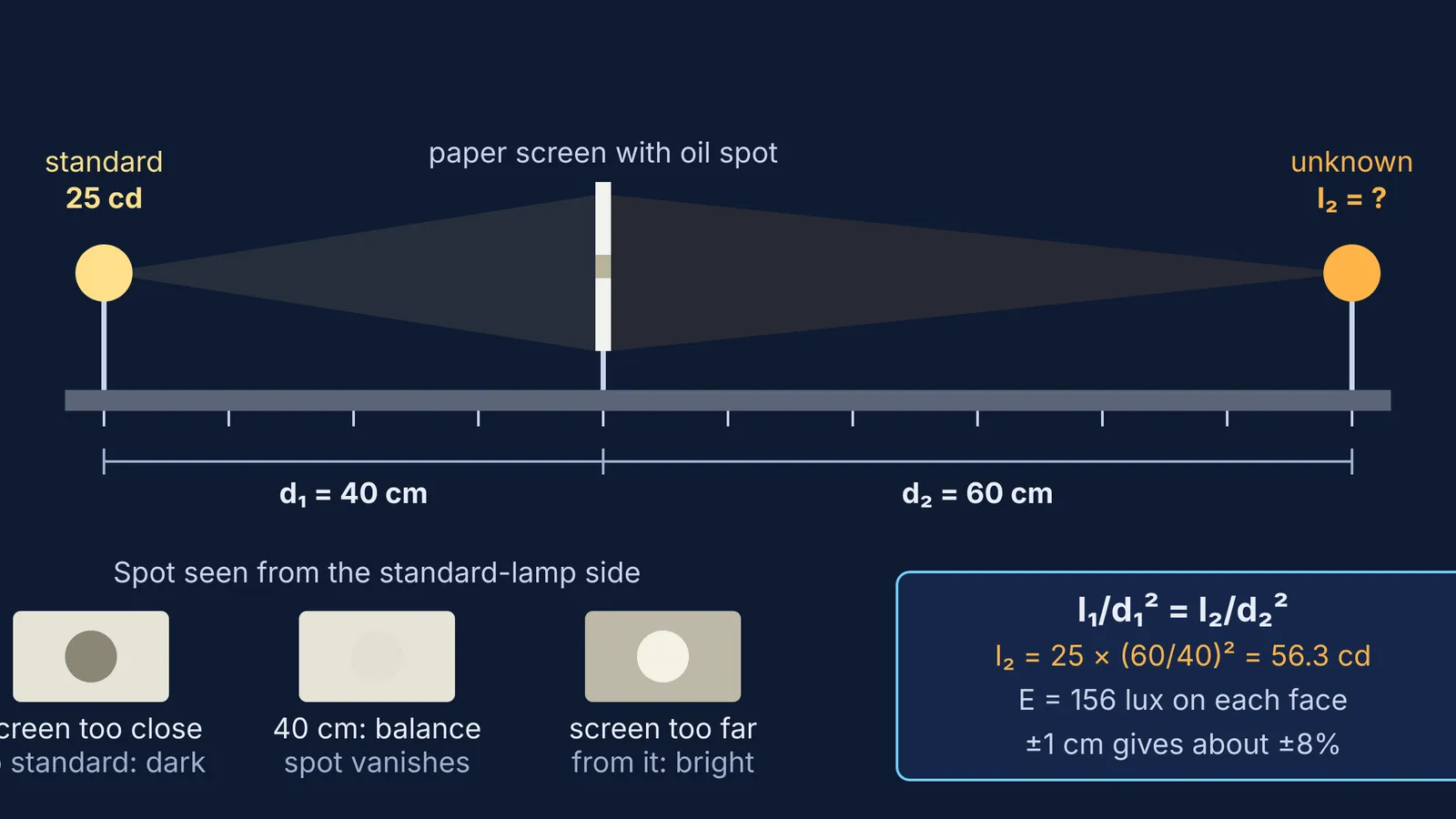
It is a paper screen with an oil or wax spot in the middle, placed on a straight bench between two lamps. You slide the screen along the bench until the spot looks the same as the paper around it, then measure the distance from the screen to each lamp. Encyclopaedia Britannica dates Bunsen's grease-spot photometer to 1844; he designed it to measure the light from the carbon-zinc cell he had built.
Later versions put the screen in a small box with two angled mirrors, so you can see both faces of the spot side by side through one eyepiece. The Bunsen photometer in the University of Toronto Scientific Instruments Collection is built this way.
Why does an oil spot on paper vanish when both sides are equally lit?
Clean paper scatters most of the light that falls on it back towards the source and lets a little through. Oil fills the air gaps between the paper fibres, so there are fewer surfaces to scatter light. The spot transmits more and reflects less.
Look at the screen from side A. What reaches your eye from the clean paper is the light it reflects from lamp A plus the light it transmits from lamp B. The spot reflects less of A's light but transmits more of B's light.
If side A is lit more strongly, the reflection loss wins, and the spot looks dark on side A.
If side B is lit more strongly, the extra transmitted light wins, and the spot looks bright on side A.
If the paper and the spot absorb about the same fraction of light, the loss and gain cancel exactly when the two sides are lit equally. The spot vanishes.
A worked case with illustrative fractions: say clean paper reflects 0.70 and transmits 0.20, while the spot reflects 0.40 and transmits 0.50. With 100 lux on side A and 225 lux on side B, the clean paper seen from A sends 0.70 × 100 + 0.20 × 225 = 115 units, and the spot sends 0.40 × 100 + 0.50 × 225 = 152.5 units. The spot looks brighter. With 156 lux on both sides, both give 0.90 × 156 = 141 units, and the spot disappears.
In practice the spot absorbs a little differently from the paper, so it rarely vanishes completely. That is why the mirror box helps: you set the screen where the spot shows the same contrast on both faces.
How does the balance point give the lamp's brightness?
The quantity the eye matches is the illuminance E on each face of the screen, in lux. For a small lamp of luminous intensity I (in candela) at distance d, shining straight onto the screen, E = I/d². At balance the two faces receive the same illuminance:
I₁/d₁² = I₂/d₂², so I₂ = I₁ × (d₂/d₁)².
Notice what this does not need. You never measure an illuminance in lux. You only compare, and the eye is good at judging when two patches match, even though it is poor at judging absolute brightness. The inverse-square law for light, explored as a simulation, shows the 1/d² fall-off itself; the photometer is how you use it to measure something.
Worked example: a balance at 40 cm and 60 cm
A standard lamp of 25 cd and an unknown lamp sit 1.00 m apart. The spot vanishes when the screen is 40 cm from the standard and 60 cm from the unknown. The lamp values are illustrative.
Write the balance. I₁/d₁² = I₂/d₂², with I₁ = 25 cd, d₁ = 0.40 m, d₂ = 0.60 m.
Solve. I₂ = 25 × (0.60 ÷ 0.40)² = 25 × 1.5² = 25 × 2.25 = 56.25 cd, about 56 cd. The unknown lamp is 2.25 times as intense, not 1.5 times.
Illuminance on the screen. E = 25 ÷ 0.40² = 156 lux on each face. Check from the other side: 56.25 ÷ 0.60² = 156 lux. Units: cd ÷ m² gives lux (strictly cd·sr/m², with the steradian treated as dimensionless).
Effect of a 1 cm judging error. If the true balance could be anywhere from 39 cm to 41 cm, the answer runs from 25 × (61 ÷ 39)² = 61.2 cd down to 25 × (59 ÷ 41)² = 51.8 cd.
Why so large? Moving the screen 1 cm makes one distance shorter and the other longer, and both are squared. The fractional error is 2Δd(1/d₁ + 1/d₂) = 2 × 0.01 × (2.5 + 1.67) = 0.083, about ±8%.
To make the error smaller, put the balance near the middle of a longer bench and take readings with the screen approached from both directions, then average them. If you want more problems that combine illuminance, distance and angle, the Fermi Problem Library has a step-by-step solver that explains the reasoning.
When does the photometer give the wrong answer?
Large lamps close to the screen. The 1/d² rule is for point sources. The Light Measurement Handbook (Ryer, International Light) gives the "five times rule": keep the distance more than five times the largest size of the source. For a uniform disc, a distance of five diameters puts the inverse-square value about 1% too high.
Different colours. A bluish lamp and a yellowish lamp never give a clean match, because the eye sees a colour difference even when the brightness is equal.
Tilted screen. If the light does not fall perpendicularly, E = I cos θ/d², and the two sides may have different angles.
Stray light. Reflections from walls add light to one side. Real photometer benches are used in a darkened room with black screens.
Comparing the wrong thing. The candela is, in the SI definition from the BIPM, luminous intensity in a given direction. A lamp that is brighter sideways than forwards can balance differently when you turn it. That is also why a balance photometer is a different kind of measurement from a detector-based meter such as an LED used as a light sensor, which reads a current instead of matching two patches by eye.
Quick checklist
An oil spot reflects less and transmits more than clean paper.
It looks dark on the more brightly lit side and vanishes when both sides are lit equally.
At balance, I₁/d₁² = I₂/d₂², so I₂ = I₁(d₂/d₁)².
40 cm and 60 cm means a ratio of 2.25, not 1.5.
A small position error counts twice, through both squared distances.
Use small sources far away, lamps of similar colour and a dark room.


