

On this page
Put a light meter 1 m from a small bulb, note the reading, then slide it to 2 m. A common guess is that the reading will halve. The meter shows a quarter. Here are the predictions to make, the numbers you should see, and the everyday case where the rule fails up close: a long tube light.
What does the inverse square law say about light intensity?
For a point source, the light per unit area reaching a surface is E = I/d², where I is the source's intensity and d is the distance, as set out in Alex Ryer's Light Measurement Handbook. A light meter reads this as illuminance, in lux.
The reason is geometry. Light leaving a small bulb spreads over a sphere whose area is 4πd². Double d and the same light covers four times the area, so each square centimetre gets a quarter as much. HyperPhysics puts it plainly: if you know the light per unit area at 1 metre, it will be one fourth as much at 2 metres.
What will the light meter read at double and triple distance?
Write each prediction down before you move the meter.
Worked example, using E = I/d² from the Light Measurement Handbook: suppose the simulated meter reads 360 lux at 1 m from a small bulb.
At 2 m the distance is ×2, so the reading is ÷2², which is ÷4: 360 ÷ 4 = 90 lux.
At 3 m the distance is ×3, so the reading is ÷9: 360 ÷ 9 = 40 lux.
At 0.5 m the distance is halved, so the reading is ×4: 1,440 lux.
Check: E × d² should come out the same at every point. 360 × 1 = 90 × 4 = 40 × 9 = 360.
If E × d stays constant instead, you are not looking at a point source.
Why does a long tube light break the inverse square rule nearby?
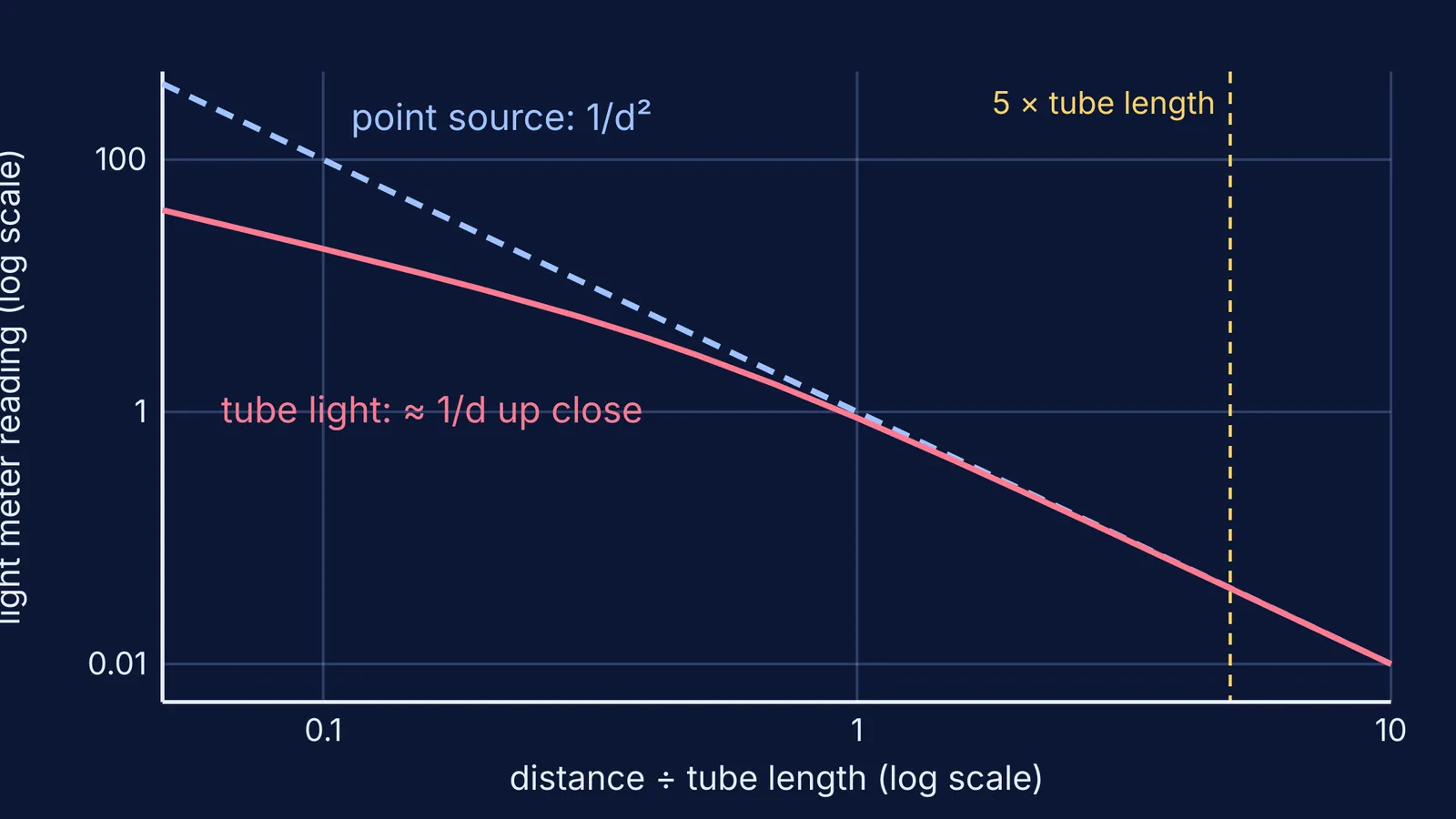
A tube light is not a point. Close up, its light spreads over something like a cylinder rather than a sphere. A cylinder's area grows with d, not d², so the reading falls roughly as 1/d.
Researchers Cecilia Stari, Marcos Abreu, Martín Monteiro and Arturo C. Martí described this in an open-inquiry lab where students measured different light sources with smartphone light sensors and the phyphox app. Their paper, published in Journal of Physics: Conference Series in 2026, reports that the students' readings for linear sources (LED strips) fitted a 1/d model over a reasonable range of distances, while for a flat monitor screen the illuminance stayed roughly constant close up and only began to fall beyond a distance related to the screen's size (full text on arXiv).
You can see the switch in numbers. In a simple model, treat a tube of length L = 1.2 m as a row of tiny emitters and add up their light at a meter facing the tube's middle. The reading is then proportional to 1/(d√(d² + L²/4)). Plugging in:
10 cm to 20 cm: the reading falls to about 48%, close to the 50% of a 1/d rule, not the 25% of the inverse square law.
10 cm to 30 cm: about 30%, not 11%.
6 m to 12 m: about 25.1%, almost exactly the inverse square law's 25%.
Far away, the tube looks like a point again. Ryer's handbook gives a rule of thumb: the distance to a light source should be greater than five times the largest dimension of the source before you rely on the inverse square law. For a 1.2 m tube that means beyond 6 m, where the model above puts the inverse square law within about half a percent.
How do you run this experiment yourself?
Use this checklist in a simulation or with a real lamp:
Start with a small bulb. Record readings at 1, 2, 3 and 4 m.
Work out E × d² for every row. A flat column means inverse square.
Switch to a long source and repeat at short distances. Work out E × d this time.
Move beyond five times the source's largest dimension and check that E × d² goes flat again.
For a real check, use a phone's light sensor in a dark room, with a bare bulb and then a tube light. The Stari study notes that phone sensors read low when light arrives at a steep angle, as it did very close to the ring light the students tested.
You can also write your own physics simulation in Python. For why predicting first matters, see what PhET research says interactive simulations are good for, and for wave intensity with worked numbers, energy density and intensity of an EM wave.
The Fermi Simulation Lab has interactive simulations for ideas that are easier to see than to read. For guided practice, Fermi's AI tutor draws the figure, runs the simulation and checks your understanding as it goes.
Next time you study under a tube light, halve your distance and see whether the page gets twice or four times brighter.


