

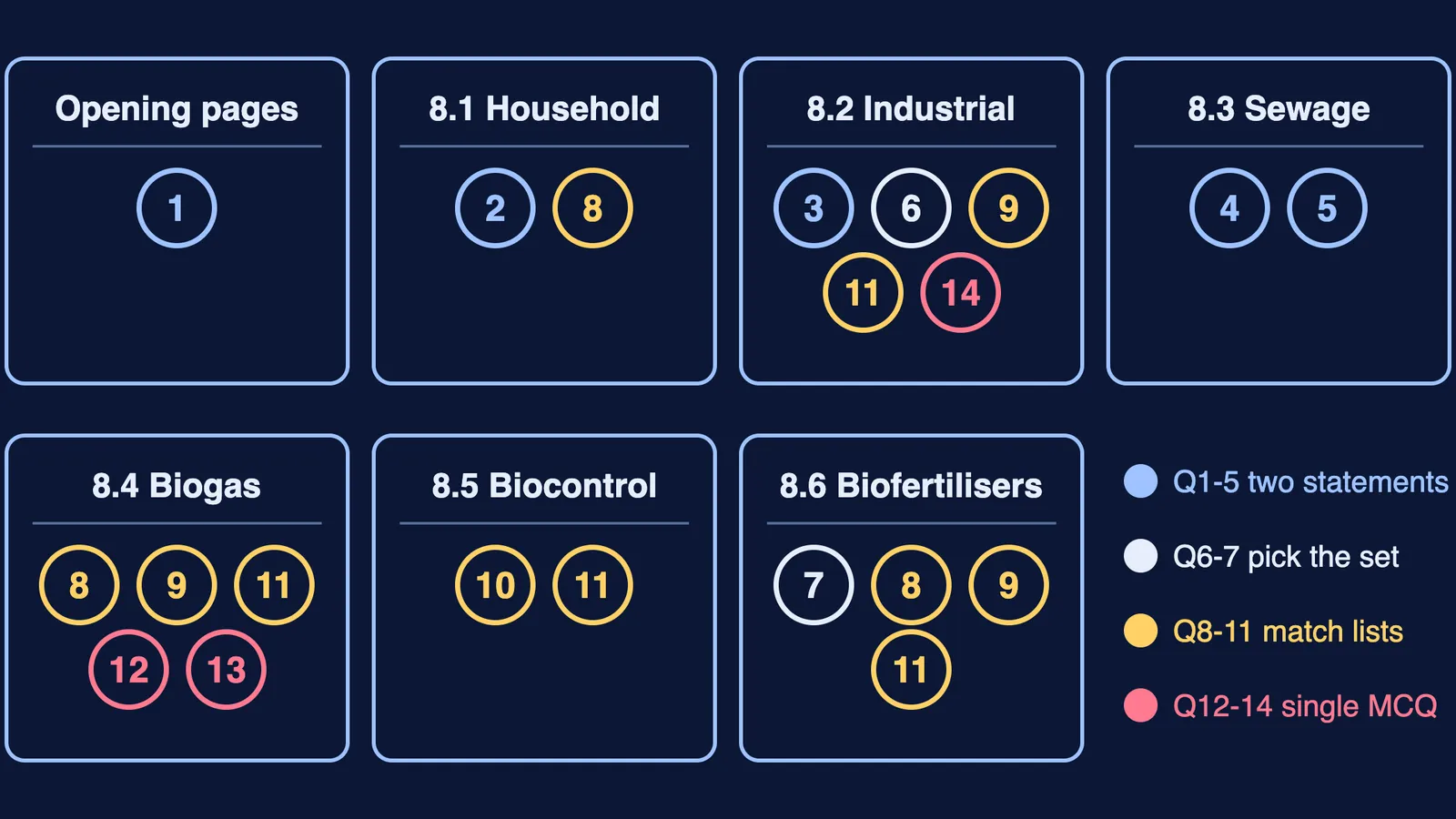
On this page
These 14 original questions cover Microbes in Human Welfare, Chapter 8 of the NCERT Class 12 Biology textbook (Reprint 2026-27). The NEET (UG)-2026 syllabus from the NMC lists it under Unit 8, Biology and Human Welfare, and the NEET (UG)-2026 information bulletin gives Biology 90 of the 180 questions, marked +4 and −1.
Are these microbe statements true or false?
Attack plan: judge each line alone. False lines here keep the right microbe but change what it is, where it lives or what it releases.
Code for Q1 to Q5: (1) I and II both true (2) I and II both false (3) Only I true (4) Only II true
Q1 (easy). Statement I: NCERT counts viroids and prions as microbes; prions are proteinaceous infectious agents. Statement II: Bacterial and fungal colonies on nutritive media need a microscope to be seen.
Answer: (3). NCERT says such colonies are visible to the naked eye.
Q2 (easy). Statement I: Roquefort cheese is ripened by a bacterium that releases much CO2. Statement II: All cheese varieties use the same microbe and differ only in the milk.
Answer: (2). A fungus ripens Roquefort; each cheese's flavour comes from its microbes.
Q3 (medium). Statement I: NCERT names two different yeast species for bread-making and brewing. Statement II: Brewer's yeast ferments malted cereals and fruit juices to give ethanol.
Answer: (4). Baker's and brewer's yeast are one species, *Saccharomyces cerevisiae*.
Q4 (medium). Statement I: Sewage is treated by heterotrophic microbes already present in it. Statement II: The BOD test measures how fast micro-organisms in a water sample take up oxygen.
Answer: (1). Both match section 8.3.
Q5 (hard). Statement I: Sewage treatment plants have kept pace with growing urban sewage. Statement II: The Ganga and Yamuna Action Plans propose many plants so only treated sewage enters these rivers.
Answer: (4). NCERT says plants have not increased enough.
How do you pick the right set of statements?
Attack plan: cross out every option holding the line you are surest is false, then test only the letter still separating the rest.
Q6 (medium). Which statements about antibiotics match NCERT? A. "Anti" is Greek for against; "bio" means life. B. They stop other, disease-causing microbes from growing, or kill them. C. Penicillin was used extensively on soldiers wounded in World War II. D. They have helped treat plague, diphtheria and leprosy. E. Penicillin came from a planned screening of moulds.
(1) A, B, C and D only (2) B, C and E only (3) A and E only (4) B and D only
Answer: (1). NCERT calls penicillin a chance discovery.
Q7 (hard). Which statements about biofertilisers are correct? A. Their main sources are bacteria, fungi and cyanobacteria. B. Cyanobacteria are heterotrophic. C. *Oscillatoria* is a nitrogen-fixing cyanobacterium. D. Blue-green algae add organic matter to soil. E. Mycorrhizal plants resist root-borne pathogens.
(1) A, C and D only (2) A, C, D and E only (3) B, C and E only (4) A, B and D only
Answer: (2). NCERT calls cyanobacteria autotrophic, so only B is false.
Can you match these microbe lists?
Attack plan: tag each List-II entry with its chapter section; a List-I row pairs only within its own section, which usually leaves one code.
Q8 (easy). Where does NCERT place each microbe? List-I: A. *Methanobacterium*; B. *Rhizobium*; C. Lactic acid bacteria; D. *Anabaena*. List-II: I. Paddy fields; II. Cattle rumen, breaking down cellulose; III. Root nodules of legumes; IV. Our stomach, checking disease-causing microbes.
(1) A-III, B-II, C-IV, D-I (2) A-II, B-III, C-I, D-IV (3) A-II, B-III, C-IV, D-I (4) A-IV, B-III, C-II, D-I
Answer: (3). Each pair is in sections 8.1, 8.4 or 8.6.
Q9 (medium). Match each problem with NCERT's microbial answer. List-I: A. Oily stains on laundry; B. Hazy juice before bottling; C. Cattle dung piling up in a village; D. A paddy field short of nitrogen. List-II: I. Lipases in detergents; II. Cyanobacteria such as *Nostoc*; III. Pectinases and proteases; IV. Methanogens in a gobar gas plant.
(1) A-I, B-III, C-IV, D-II (2) A-III, B-I, C-IV, D-II (3) A-I, B-III, C-II, D-IV (4) A-I, B-IV, C-III, D-II
Answer: (1). Dung is rich in methanogens.
Q10 (medium). Match each need with NCERT's biocontrol method. List-I: A. Control aphids; B. Control mosquitoes; C. Kill butterfly caterpillars on brassicas, sparing other insects; D. A crop that resists insect pests itself. List-II: I. Bt toxin genes put into the plant; II. Dragonflies; III. Ladybird beetle; IV. Dried Bt spores sprayed in water.
(1) A-II, B-III, C-IV, D-I (2) A-III, B-II, C-I, D-IV (3) A-III, B-IV, C-II, D-I (4) A-III, B-II, C-IV, D-I
Answer: (4). Bt-cotton carries the toxin genes.
Q11 (hard). Match each term with its meaning. List-I: A. Fermentors; B. Biocontrol; C. Biofertilisers; D. Methanogens. List-II: I. Organisms that enrich soil nutrient quality; II. Very large vessels for industrial-scale microbe growth; III. Anaerobic bacteria on cellulosic material that give off much methane; IV. Biological control of plant diseases and pests.
(1) A-II, B-I, C-IV, D-III (2) A-II, B-IV, C-I, D-III (3) A-IV, B-II, C-I, D-III (4) A-II, B-IV, C-III, D-I
Answer: (2). NCERT defines each in sections 8.2 to 8.6.
Which single-correct questions round off the chapter?
Attack plan: find the one gas, number or organism type the stem turns on.
Q12 (medium). In which process does NCERT say methane, not CO2, is the main gas? (1) Idli and dosa dough (2) Bread dough with baker's yeast (3) Methanogens on cellulosic material (4) Brewing beer
Answer: (3). CO2 is the main gas in dough and beverage fermentation.
Q13 (easy). How deep is the concrete tank in NCERT's biogas plant? (1) 1–2 feet (2) 10–15 feet (3) 40–50 feet (4) 100–150 feet
Answer: (2). A floating cover over the slurry rises as gas collects.
Q14 (medium). Which product does NCERT tie to a bacterium? (1) Butyric acid (2) Citric acid (3) Penicillin (4) Cyclosporin A
Answer: (1). *Clostridium butylicum* (a bacterium) makes it; the rest are fungal.
What should you do after this set?
Keys run (1) and (2) four times each, (3) and (4) three each. Note the NCERT section beside each miss; reread it. Next, work through our eight graded NEET MCQs on this chapter, the assertion-reason set on this chapter and our NEET preparation guide for the chapter.
Know the microbes but not what each one makes? Fermi's AI tutor works out what you already know and builds a plan for the session.


