On this page
Here are six assertion-reason items and four Statement I / Statement II pairs, each block running easy to hard. Every statement was checked against Chapter 8, Microbes in Human Welfare, of NCERT Class 12 Biology (reprint 2026-27), and the chapter sits in Unit 8, Biology and Human Welfare, of the NMC NEET (UG)-2026 syllabus.
How do you answer assertion-reason questions on microbes?
Use these keys throughout.
Assertion-reason:
(A) Both A and R are true and R is the correct explanation of A.
(B) Both A and R are true but R is NOT the correct explanation of A.
(C) A is true but R is false.
(D) A is false but R is true.
Statement pairs:
(A) Both statements are correct.
(B) Both statements are incorrect.
(C) Statement I is correct, Statement II is incorrect.
(D) Statement I is incorrect, Statement II is correct.
Judge A alone, then R alone, and only if both are true ask, "Is R the reason NCERT gives for A?"
If you have not revised the chapter, start with our guide to preparing Microbes in Human Welfare for NEET.
Assertion-reason questions on microbes in human welfare
Q1 (easy). Assertion (A): Fresh milk turns into curd when a small amount of curd is added to it and it is kept at a suitable temperature. Reason (R): The added curd carries millions of lactic acid bacteria, which multiply and produce acids that coagulate and partially digest the milk proteins.
Answer: (A). Both are true, and R is how NCERT explains the starter. Trap: picking (B) because R sounds like a general fact about LAB.
Q2 (easy). Assertion (A): Penicillin is named after the mould *Penicillium notatum*. Reason (R): Alexander Fleming alone established the full potential of penicillin as an effective antibiotic.
Answer: (C). A is true. R is false: Fleming discovered and named penicillin, but NCERT credits Ernest Chain and Howard Florey with establishing its full potential, and all three shared the 1945 Nobel Prize. Trap: one famous name crowding out the other two.
Q3 (medium). Assertion (A): Biogas plants are more often built in rural areas. Reason (R): Methanogens in the rumen of cattle help break down cellulose and play an important role in cattle nutrition.
Answer: (B). Both are true, but NCERT's reason for A is that cattle dung is available in large quantities in rural areas. R explains why dung is rich in methanogens, not where plants are built. Trap: following the chain rumen, dung, biogas and calling it the explanation.
Q4 (medium). Assertion (A): Baculoviruses of the genus *Nucleopolyhedrovirus* are broad-spectrum insecticides that kill most insects in a field. Reason (R): Baculoviruses are pathogens that attack insects and other arthropods.
Answer: (D). A is false: NCERT calls them species-specific and narrow-spectrum, with no negative impact on non-target insects. R is true. Trap: reading "insect pathogen" as "kills all insects".
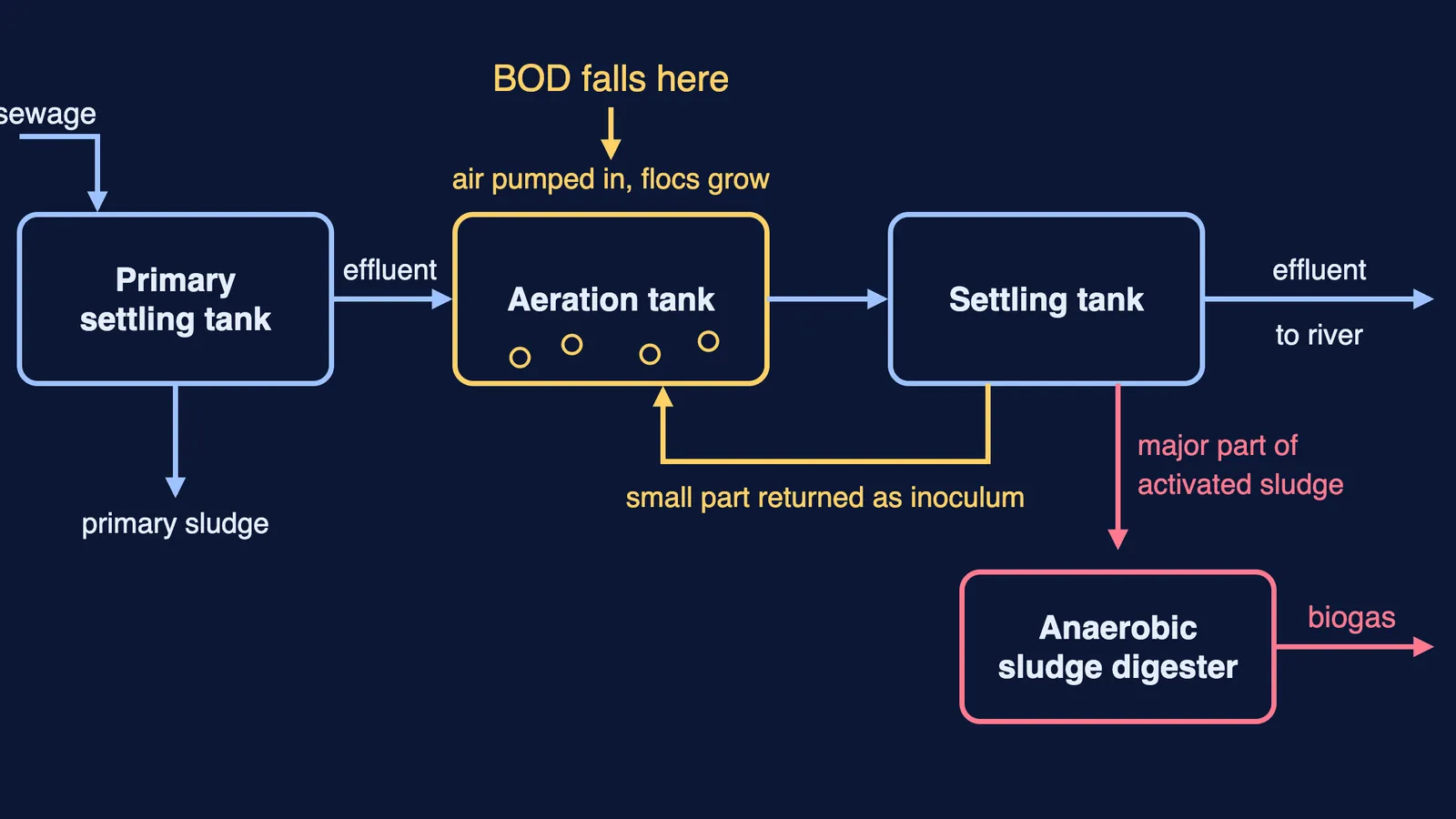
Q5 (hard). Assertion (A): The BOD of sewage effluent falls significantly in the aeration tanks during secondary treatment. Reason (R): Aerobic microbes growing there as flocs consume the major part of the organic matter in the effluent.
Answer: (A). Both are true, and R is the direct cause: BOD indirectly measures organic matter, so it drops as flocs consume it. Trap: thinking the pumped-in air lowers BOD by itself; the air only lets the aerobic microbes grow.
Q6 (hard). Assertion (A): Plants with mycorrhizal associations show tolerance to salinity and drought. Reason (R): The fungal partner in mycorrhiza absorbs phosphorus from the soil and passes it to the plant.
Answer: (B). Both are true, but NCERT lists salinity and drought tolerance among the "other benefits" of mycorrhiza, separate from phosphorus uptake. Trap: assuming the best-known function explains every benefit.
Statement I and Statement II questions on microbes in human welfare
Q7 (easy). Statement I: The puffed-up appearance of dough for idli and dosa is due to oxygen gas released by fermenting microbes. Statement II: Dough for bread is fermented using baker's yeast, *Saccharomyces cerevisiae*.
Answer: (D). Statement I is incorrect: NCERT says the dough is fermented by bacteria and puffs up because of CO2. Statement II is correct. Trap: accepting it because gas does make dough rise, without checking which gas.
Q8 (medium). Statement I: Streptokinase, produced by *Streptococcus* and modified by genetic engineering, is used as a clot buster for patients who have had a myocardial infarction. Statement II: Cyclosporin A, produced by *Trichoderma polysporum*, is given to organ-transplant patients to boost their immune response.
Answer: (C). Statement I is correct. Statement II has the right fungus but the wrong action: cyclosporin A is an immunosuppressive agent, used so the body does not reject the new organ. Trap: checking only the organism-product pair, which is right.
Q9 (medium). Statement I: Biogas is a mixture of gases containing predominantly methane, and the spent slurry from a biogas plant may be used as fertiliser. Statement II: Biogas technology was developed in India mainly through the efforts of IARI and KVIC.
Answer: (A). Both match NCERT section 8.4. Trap: marking Statement I false because "spent" slurry sounds like waste.
Q10 (hard). Statement I: In primary sewage treatment, floating debris is removed by sedimentation and grit is removed by sequential filtration. Statement II: The effluent from secondary treatment is pumped into anaerobic sludge digesters to make biogas.
Answer: (B). Both are incorrect. Statement I swaps the methods: debris goes by sequential filtration, grit by sedimentation. Statement II confuses effluent with sludge: the activated sludge goes to the digesters, while the effluent is generally released into rivers and streams. Trap: right words, wrong places.
How should you use this set?
Do all ten in 12 minutes without notes, writing T or F above each line before choosing a key.
Score yourself, then sort every miss: a wrong fact (fix it in NCERT) or a wrong link (ask again whether NCERT gives R as the reason).
Two days later, redo the misses and write a false version of each true statement.
If a miss comes from a concept gap, such as what BOD actually measures, the Fermi Concept Library has every concept in biology with its own lesson. For four-option practice on the same chapter, try our Microbes in Human Welfare NEET practice questions, and for more on the format, our assertion-reason strategy.