On this page
Microbes in Human Welfare is Chapter 8 of the NCERT Class 12 Biology textbook (reprint 2026-27). The CBSE Biology syllabus for 2026-27 covers microbes in food processing, industry, sewage treatment and energy, as biocontrol agents and biofertilisers, and antibiotics. Below, the terms follow that order. For answer-writing and a revision plan, see our Microbes in Human Welfare Class 12 board guide.
Which microbes make curd, bread and cheese?
Microbes: organisms and agents too small to see unaided: protozoa, bacteria, fungi, viruses, viroids and prions (infectious proteins).
Lactic acid bacteria (LAB): bacteria such as *Lactobacillus* that turn milk into curd. Their acids coagulate and partly digest milk proteins, and the curd gains vitamin B12.
Inoculum (starter): a little existing culture added to start a new batch. Example: curd, carrying millions of LAB, added to fresh milk.
Baker's yeast: *Saccharomyces cerevisiae*, which ferments bread dough; the CO2 it releases puffs the dough up. Don't confuse with: the dough for idli and dosa, which is fermented by bacteria.
Brewer's yeast: the same species, *S. cerevisiae*, used to ferment malted cereals and fruit juices into ethanol.
Propionibacterium sharmanii: the bacterium whose CO2 makes the big holes in Swiss cheese. Don't confuse with: Roquefort cheese, which is ripened by a fungus that gives it its flavour.
What do microbes make in industry?
Fermentor: a large vessel for growing microbes on an industrial scale.
Distilled vs undistilled drinks: wine and beer are made without distilling the fermented broth; whisky, brandy and rum are distilled.
Antibiotic: a substance produced by one microbe that kills disease-causing microbes or stops them multiplying.
Penicillin: the first antibiotic, found by chance by Alexander Fleming when a mould stopped *Staphylococci* growing; he named it after *Penicillium notatum*. Ernest Chain and Howard Florey proved its full potential; the three shared the Nobel Prize in 1945, as the NCERT chapter records.
Organic acid producers: *Aspergillus niger* (fungus) makes citric acid, *Acetobacter aceti* acetic acid, *Clostridium butylicum* butyric acid, and *Lactobacillus* lactic acid (all three bacteria).
Lipases: enzymes added to detergents to lift oily stains. Don't confuse with: pectinases and proteases, which clarify bottled fruit juices.
Streptokinase: an enzyme from the bacterium *Streptococcus*, modified by genetic engineering, used as a "clot buster" after a myocardial infarction.
Cyclosporin A: an immunosuppressive agent for organ-transplant patients, made by the fungus *Trichoderma polysporum*.
Statins: blood-cholesterol-lowering agents from the yeast *Monascus purpureus*; they competitively inhibit the enzyme that makes cholesterol. Don't confuse with: cyclosporin A, which suppresses the immune system rather than lowering cholesterol.
How do microbes treat sewage?
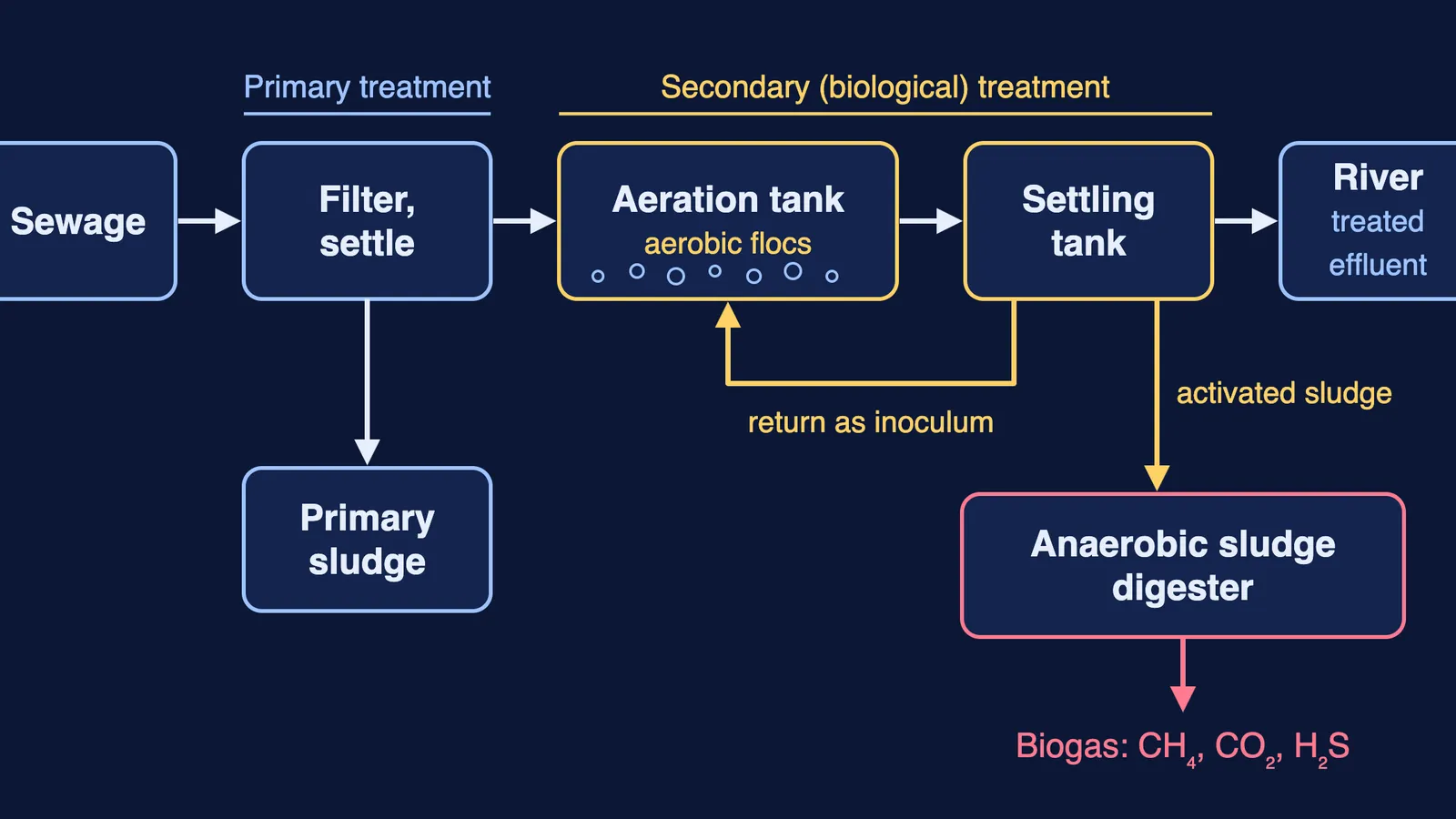
The NCERT chapter splits treatment into a physical and a biological stage, as the diagram above shows.
Sewage: municipal waste water, mostly human excreta, full of organic matter and microbes, many of them pathogenic.
Sewage treatment plant (STP): where sewage is cleaned by the heterotrophic microbes already in it.
Primary treatment: physical removal of floating debris by filtration, then grit (soil, small pebbles) by sedimentation.
Primary sludge: the solids that settle during primary treatment. Don't confuse with: the effluent, the liquid above it (supernatant) that goes on to secondary treatment.
Secondary (biological) treatment: primary effluent is stirred and aerated so aerobic microbes grow and eat most of its organic matter.
Flocs: clumps of bacteria tangled in fungal threads into a mesh.
BOD (biochemical oxygen demand): the oxygen bacteria would consume oxidising all the organic matter in a litre of water. It indirectly measures organic matter, so a higher BOD means more polluting water.
Activated sludge: the flocs that settle in the settling tank once BOD has dropped. A small part goes back to the aeration tank as inoculum.
Anaerobic sludge digester: a tank where anaerobic bacteria digest the rest of the activated sludge, giving off methane, hydrogen sulphide and CO2.
What are biogas and methanogens?
Biogas: a burnable mix of gases, mainly methane, given off as microbes break down organic waste.
Methanogens: bacteria that grow anaerobically on cellulose-rich material and release much methane plus CO2 and H2. Example: *Methanobacterium*, found in anaerobic sludge and in the cattle rumen, so cattle dung (gobar) is rich in them.
Biogas (gobar gas) plant: per the NCERT chapter, a concrete tank 10-15 feet deep fed with dung slurry; a floating cover rises as gas collects, and the spent slurry can be used as fertiliser. India's technology came mainly from IARI and KVIC.
How do microbes protect crops and feed the soil?
Biocontrol: checking crop pests and plant diseases with living organisms instead of toxic chemicals.
Bacillus thuringiensis (Bt): a bacterium sprayed on plants as dried spores; caterpillars eat it and its toxin, released in their gut, kills them while sparing other insects. Don't confuse with: Bt cotton, a plant carrying Bt toxin genes (Chapter 10).
Trichoderma: free-living soil fungi around plant roots that suppress several plant pathogens.
Baculoviruses: viruses that attack insects and other arthropods, mostly from the genus *Nucleopolyhedrovirus*; narrow-spectrum, so they suit integrated pest management.
Biofertilisers: living organisms that raise the nutrient content of soil, mainly bacteria, fungi and cyanobacteria. Don't confuse with: biocontrol agents, which protect crops rather than feed them.
Rhizobium: bacteria living symbiotically in legume root nodules, fixing atmospheric nitrogen. Don't confuse with: *Azospirillum* and *Azotobacter*, which fix nitrogen while free-living in soil.
Mycorrhiza: a fungus-root partnership, for example with *Glomus*, where the fungus absorbs phosphorus for the plant; the plant also tolerates salinity and drought better.
Cyanobacteria (blue-green algae): autotrophic microbes, many nitrogen-fixing (*Anabaena*, *Nostoc*, *Oscillatoria*), important biofertilisers in paddy fields.
Our post on biocontrol agents and biofertilisers goes deeper.
How to learn these terms
Make organism-product cards and quiz both directions: *Aspergillus niger* to citric acid and back.
Draw the sewage path from memory and mark where each sludge forms and where BOD falls.
Learn the mix-ups as pairs: primary vs activated sludge, *Rhizobium* vs *Azotobacter*, *Trichoderma polysporum* vs biocontrol *Trichoderma*, Bt spray vs Bt cotton.
Sort the gases: CO2 from dough, Swiss cheese and beverages; methane from methanogens.
Test yourself with our Microbes in Human Welfare practice questions.
If a term feels abstract, the Fermi Concept Library covers every concept in biology, each with its own lesson and its place in the map.