On this page
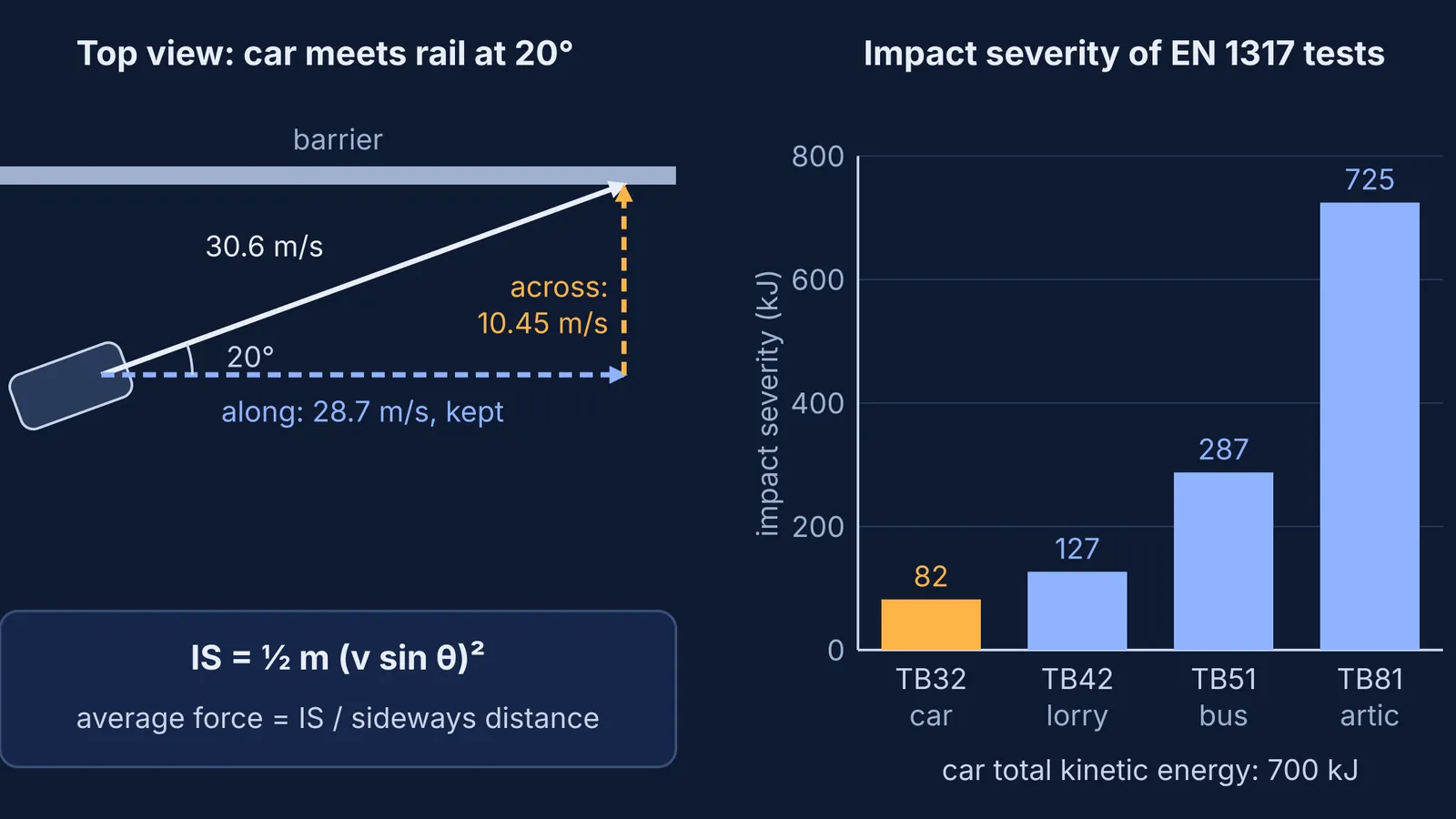
A car at 110 km/h carries about 700 kJ of kinetic energy. Yet the steel or concrete barrier along an expressway is crash-tested with a car at that speed bringing only about 82 kJ to the rail. The barrier's job is not to stop the car but to turn it, and that only means removing the small part of its velocity that points into the barrier. This is vector resolution and the work–energy theorem, applied to road safety.
Before going further: a barrier is there to protect you when something has already gone wrong, such as a burst tyre, a skid on a wet road or a moment of sleep. It is not a reason to drive faster. As the worked example shows, the energy a barrier must deal with rises with the square of speed, and a barrier is only tested up to fixed conditions.
What does a crash barrier actually have to do?
A barrier must catch a car that drifts off course and send it back along the road without letting it break through, vault over or bounce back into traffic. A car that hits at 20° keeps most of its motion along the rail. Only the sideways part has to be brought to zero.
A head-on crash, where all the kinetic energy must go somewhere, is different; see how sand-filled crash barrels stop a car, the cushions placed in front of a fixed object.
How do you split the car's velocity?
Take the barrier as the x-axis. A car moving at speed v at an angle θ to the barrier has two components:
Along the barrier: v cos θ.
Across the barrier, into it: v sin θ.
If you need a refresher on finding components, see how to find the component of a vector along another vector.
Kinetic energy is ½ m v², and since v² = (v cos θ)² + (v sin θ)², it splits into two parts. The part linked to the sideways motion is ½ m (v sin θ)². Road-safety engineers call this the impact severity, IS. The US crash-test guidance NCHRP Report 350 uses exactly this definition, IS = ½ m (v sin θ)², to set its test levels, as explained in a Colorado State University report for the US Department of Transportation.
Because the sideways energy goes as sin² θ, the angle matters enormously. sin 20° = 0.342 and sin² 20° = 0.117, so only 11.7% of the energy is sideways at 20°.
What are the standard crash tests?
In Europe, barriers are tested to EN 1317-2. A peer-reviewed paper on a high-containment bridge rail built for Istanbul lists the full test matrix (Atahan, Latin American Journal of Solids and Structures, 2018). Some of the tests are:
TB11: 900 kg car, 100 km/h, 20°.
TB32: 1,500 kg car, 110 km/h, 20°.
TB42: 10,000 kg rigid lorry, 70 km/h, 15°.
TB51: 13,000 kg bus, 70 km/h, 20°.
TB81: 38,000 kg articulated lorry, 65 km/h, 20°.
A barrier earns a containment level by passing a pair of tests. N2 needs TB32 and TB11, H1 needs TB42 and TB11, H2 needs TB51 and TB11, and H4b needs TB81 and TB11. The small-car test TB11 is in every pair: the barrier must hold the heavy vehicle and still be gentle on a light car.
India's road safety barrier guidelines, IRC:119-2015 from the Indian Roads Congress, ask for steel beam barriers to meet EN 1317-2 for containment levels N2, H1 and H2, or the US NCHRP 350 levels TL-3 and TL-4.
Worked example: how much energy does the TB32 test bring to the rail?
A 1,500 kg car strikes a barrier at 110 km/h and 20°.
Speed in m/s. 110 / 3.6 = 30.56 m/s.
Along the rail. 30.56 × cos 20° = 30.56 × 0.940 = 28.71 m/s.
Into the rail. 30.56 × sin 20° = 30.56 × 0.342 = 10.45 m/s, which is 37.6 km/h.
Total kinetic energy. ½ × 1,500 × 30.56² = 700 kJ.
Impact severity. ½ × 1,500 × 10.45² = 81.9 kJ.
Fraction. 81.9 / 700 = 0.117, or 11.7%, which is sin² 20°.
Units: kg × (m/s)² = J. Vary only the angle: at 5°, IS = 5.3 kJ; at 30°, 175 kJ; head-on at 90°, all 700 kJ.
The same formula gives the heavy tests. TB42 gives ½ × 10,000 × (19.44 × sin 15°)² = 127 kJ. The TB51 bus gives 288 kJ. The TB81 articulated lorry gives 725 kJ, more than the whole kinetic energy of the TB32 car, even at 65 km/h. That is why the higher containment levels need much taller, stronger barriers.
Why does a barrier that gives a little treat you more gently?
Suppose the barrier takes all the sideways motion out of the TB32 car while the car moves 1.0 m sideways, as the rail bends and the car's side crumples. By the work–energy theorem the average sideways force is F = IS / distance = 81.9 kJ / 1.0 m = 82 kN. Dividing by the mass, the average sideways acceleration is 54.6 m/s², about 5.6 g.
Halve the distance to 0.5 m and both double, to about 11 g. These are illustrative averages, not test results, but they show the trend. The Indian guidelines say the same in words: flexible wire rope barriers deflect the most and have the lowest impact severity on the occupants, while rigid concrete barriers deflect least and cause the highest. Rigid barriers are therefore preferred where only small angles of impact are expected, such as narrow medians.
Two cautions. IS is a test-design number, not the energy a barrier actually absorbs: the car leaves at a small angle, and friction along the rail also slows it. And EN 1317 uses the words "impact severity" for something else, how hard the test car's occupants are shaken, measured with accelerometers using indices such as the Acceleration Severity Index (ASI). So check which meaning a source uses.
What does this say about speed?
At 20°, IS grows as v². The same 1,500 kg car at 100 km/h brings 67.7 kJ to the rail; at 130 km/h it brings 114 kJ, 40% more than the TB32 test the barrier was built for. A barrier certified for N2 has been shown to work for the test conditions, not for every speed or angle. Keep to the speed limit; the barrier is a last line of defence, not a reason to drive fast.
Components and the work–energy theorem in a two-step problem like this one are common JEE ground. If you are preparing for JEE Main and Advanced, Fermi Test Prep offers personalised preparation with an AI tutor, live classes, adaptive mocks, mentorship and a study plan that updates based on mastery.
Quick checklist
A barrier redirects a car; only the velocity component into it, v sin θ, has to be removed.
Impact severity: IS = ½ m (v sin θ)², which is sin² θ of the total kinetic energy.
TB32 (1,500 kg, 110 km/h, 20°): 81.9 kJ of 700 kJ, 11.7%.
Average sideways force = IS / sideways distance; a barrier that gives is gentler.
EN 1317 containment levels pair a heavy test with the small-car TB11 test.
IS grows with v²: a barrier is tested for fixed conditions and is no reason to speed.