On this page
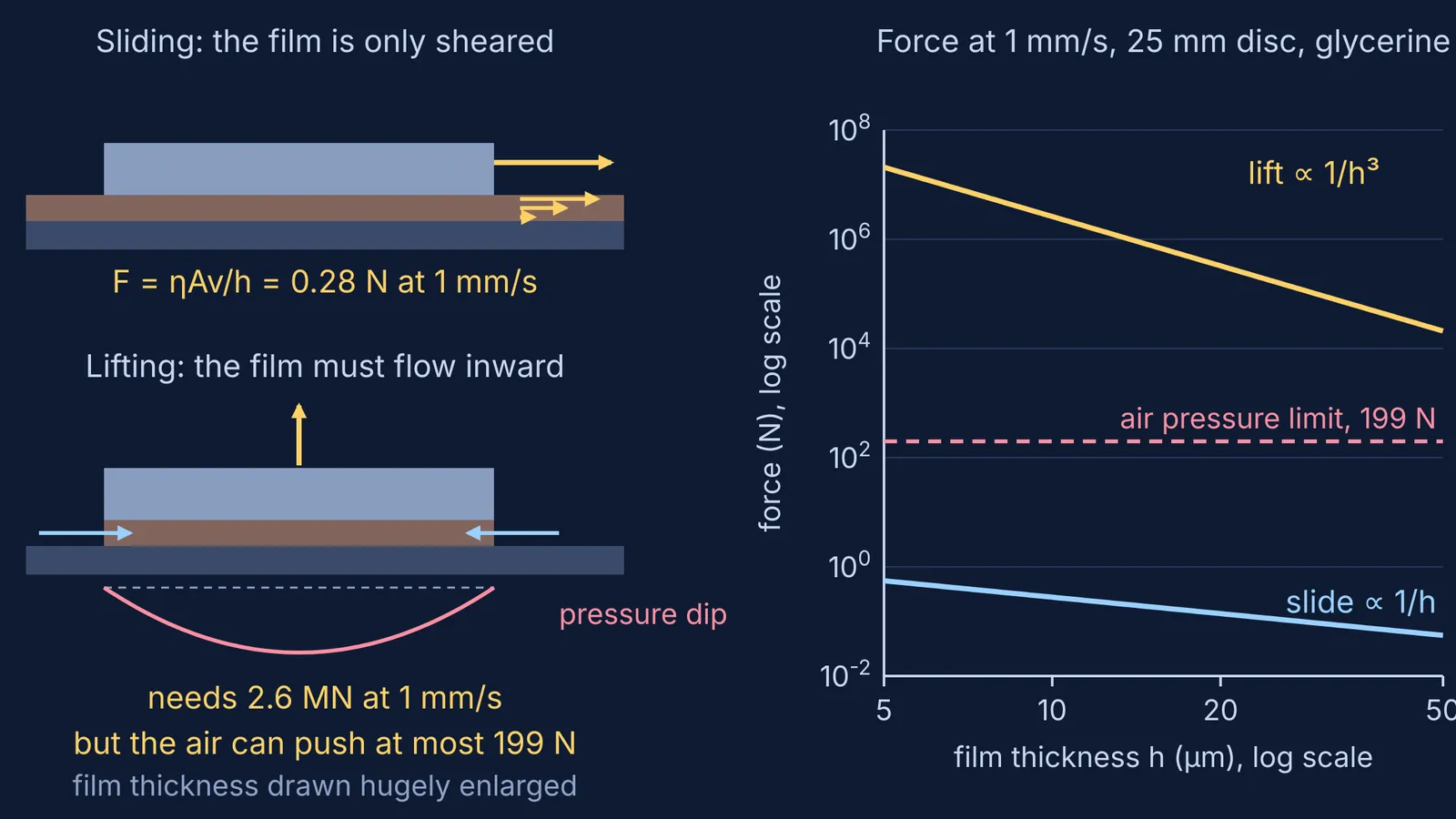
Put a drop of oil between two flat glass plates and press them together. You can slide the top plate off with a fingertip, but lift it straight up and it hangs on as if glued. Only the direction of pull has changed. Sliding just shears the thin film. Lifting forces the liquid to flow inward from the rim through a gap a few micrometres thick, and that costs a very large force.
If you try this, handle the glass plates carefully. Glass can break, and broken glass and sharp edges can cut. Use plates with smoothed edges, work over a soft surface, never lever the plates apart with a blade, and slide them apart rather than prising.
What force do you need to slide a plate over an oil film?
Newton's law of viscosity says the force needed to shear a liquid layer is F = ηA(dv/dy). In a thin film the velocity changes in a straight line from zero at the bottom plate to v at the top plate, so dv/dy = v/h and
F(slide) = ηAv/h
where η is the viscosity, A the plate area and h the film thickness. Units: Pa s × m² × (m/s) ÷ m = N. If the units of η are new to you, see the SI unit of viscosity, the pascal second, and the poise.
Why is lifting a plate so much harder than sliding it?
When the top plate rises, liquid must flow in from the edge to fill the widening gap, and all of it has to squeeze through a slit only h thick. To pull it in, the pressure under the plate must fall below the outside pressure. That dip is deepest at the centre and shaped like a parabola. It is large because the volume to fill grows as R², the liquid travels a distance of order R, and the flow a slit can carry falls as h³.
Josef Stefan worked out the result in 1874 for two parallel discs of radius R:
F(lift) = 3πηR⁴v / (2h³)
Here v is the speed at which the gap opens. Poivet, Nallet, Gay and Fabre, in Europhysics Letters in 2003, pulled viscous liquids apart between parallel plates and found that this law matched their early-time force readings at low pulling speeds, with no adjustable parameters. (They write it in terms of the liquid's volume, πR²h, which gives the same formula.) The proof is beyond the syllabus; the scaling, R⁴ and 1/h³, is the point.
Divide one force by the other and most terms cancel:
F(lift) / F(slide) = 3R² / (2h²)
How big is the difference for a real plate?
Take an illustrative disc of radius 25 mm on a 10 µm film of glycerine at 20 °C. Cheng's formula for glycerol–water viscosity, in Industrial & Engineering Chemistry Research in 2008, gives about 1.41 Pa s for pure glycerol at 20 °C, a value that falls steeply with warmth or added water.
Area. A = πR² = π × (0.025)² = 1.96 × 10⁻³ m².
Slide at 1 mm/s. F = 1.41 × 1.96 × 10⁻³ × 10⁻³ ÷ 10⁻⁵ = 0.28 N.
Lift at 1 mm/s. R⁴ = 3.91 × 10⁻⁷ m⁴ and h³ = 10⁻¹⁵ m³. F = 3π × 1.41 × 3.91 × 10⁻⁷ × 10⁻³ ÷ (2 × 10⁻¹⁵) = 2.6 × 10⁶ N, or 2.6 MN.
Ratio. 3R²/(2h²) = 3 × (0.025)² ÷ (2 × 10⁻¹⁰) = 9.4 × 10⁶.
Units check. Pa s × m⁴ × (m/s) ÷ m³ = Pa × m² = N.
So lifting at the same speed would need about 9.4 million times the sliding force. On a 5 µm film it would be eight times more again, 21 MN.
Can you actually pull with 2.6 MN?
No, and the reason is the air. The viscous force comes from low pressure under the plate. The pressure in the film cannot usefully fall below zero, so the most the outside air can press the plate down with is atmospheric pressure times the area:
101 kPa × 1.96 × 10⁻³ m² ≈ 199 N
Pull harder than that and the film gives way. Poivet and co-workers saw exactly this at high pulling speeds: bubbles opened inside the liquid, the force levelled off, and when outside air broke in it dropped suddenly, by an amount matching about 1 atmosphere over the sample area.
With a modest pull the plate does rise, but very slowly. Even at the 199 N limit, the gap can open at only about 0.08 µm per second while the film is 10 µm thick.
How long does a steady pull take to separate the plates?
With a constant force F, Stefan's law can be integrated. The time to open the gap from h₀ to h₁ is
t = (3πηR⁴ / 4F) × (1/h₀² − 1/h₁²)
For our disc pulled with a steady 10 N, from 10 µm to 1 mm:
3πηR⁴/(4F) = 3π × 1.41 × 3.91 × 10⁻⁷ ÷ 40 = 1.30 × 10⁻⁷ s m².
1/h₀² − 1/h₁² = 10¹⁰ − 10⁶ ≈ 1.0 × 10¹⁰ m⁻².
t ≈ 1,300 s, about 22 minutes.
Three quarters of that time goes in getting from 10 µm to 20 µm.
With water (η about 1.0 mPa s at 20 °C, from the same 2008 formula) the time drops to about 0.9 s, which is why the viscous effect is easy to miss with wet plates. Water holds plates by a different mechanism, the curved surface at the rim, giving F = 2TA/d, explained in the force needed to separate two glass plates with water between them. For our disc on 10 µm of water, with T = 0.073 N/m, that is about 29 N. Surface tension, the viscous squeeze and suction can all act together, so do not confuse them.
Where does a squeeze film matter outside the lab?
Sticky liquids and adhesives. Adhesives are tested by pulling a flat probe straight off a thin film. Poivet and co-workers showed that even a plain viscous liquid, pulled this way, gives a force curve that looks like an adhesive's, with a peak, a plateau and a sudden drop.
Air films. The same thin-gap physics, with air fed in instead of drawn in, lets a balloon and CD hovercraft glide.
Stefan's formula assumes flat parallel plates, a full film and slow, steady flow. Real plates must be extremely flat for a 10 µm film to exist, so treat the numbers as an idealised model.
If you want to practise viscosity questions that mix A/h and R⁴/h³ scaling, the Fermi Problem Library has a step-by-step solver that explains the reasoning, and the Concept Library covers Newton's law of viscosity.
Quick checklist
Sliding shears the film: F = ηAv/h.
Lifting draws liquid inward through the gap: F = 3πηR⁴v/(2h³).
Ratio of lift to slide: 3R²/(2h²), about 9.4 million for a 25 mm disc on 10 µm.
The air caps the pull at about p(atm) × area, 199 N here.
A 10 N pull takes about 22 minutes on glycerine and under a second on water.
Handle glass plates carefully: they can break and cut.