On this page
Ask a piano tuner to tune an octave and they will make it slightly wide: the upper note ends up a little sharp of exactly double the frequency, a little in the middle of the keyboard and more towards the ends. This is not taste. It follows from one assumption in the Class 11 formula for a vibrating string that a real steel piano wire does not quite meet.
The ideal series is covered in which harmonics go missing when you pluck a string at L/3, and the naming in the difference between overtones and harmonics. Here the question is why a real string departs from it.
What does the string formula assume?
For a string of length L, tension T and mass per unit length μ, the wave speed is v = √(T/μ) and the allowed frequencies are f_n = n v / 2L. Every mode is an exact whole-number multiple of the fundamental. In this post, the nth partial means mode n, so the 4th partial is the 4th harmonic (the 3rd overtone).
The only restoring force in that formula is the tension; the string is treated as perfectly flexible, like a thread. A piano wire is hard steel about a millimetre thick. Bend it and it springs back by itself, like a ruler. That bending stiffness adds a second restoring force.
Why do high partials run sharp?
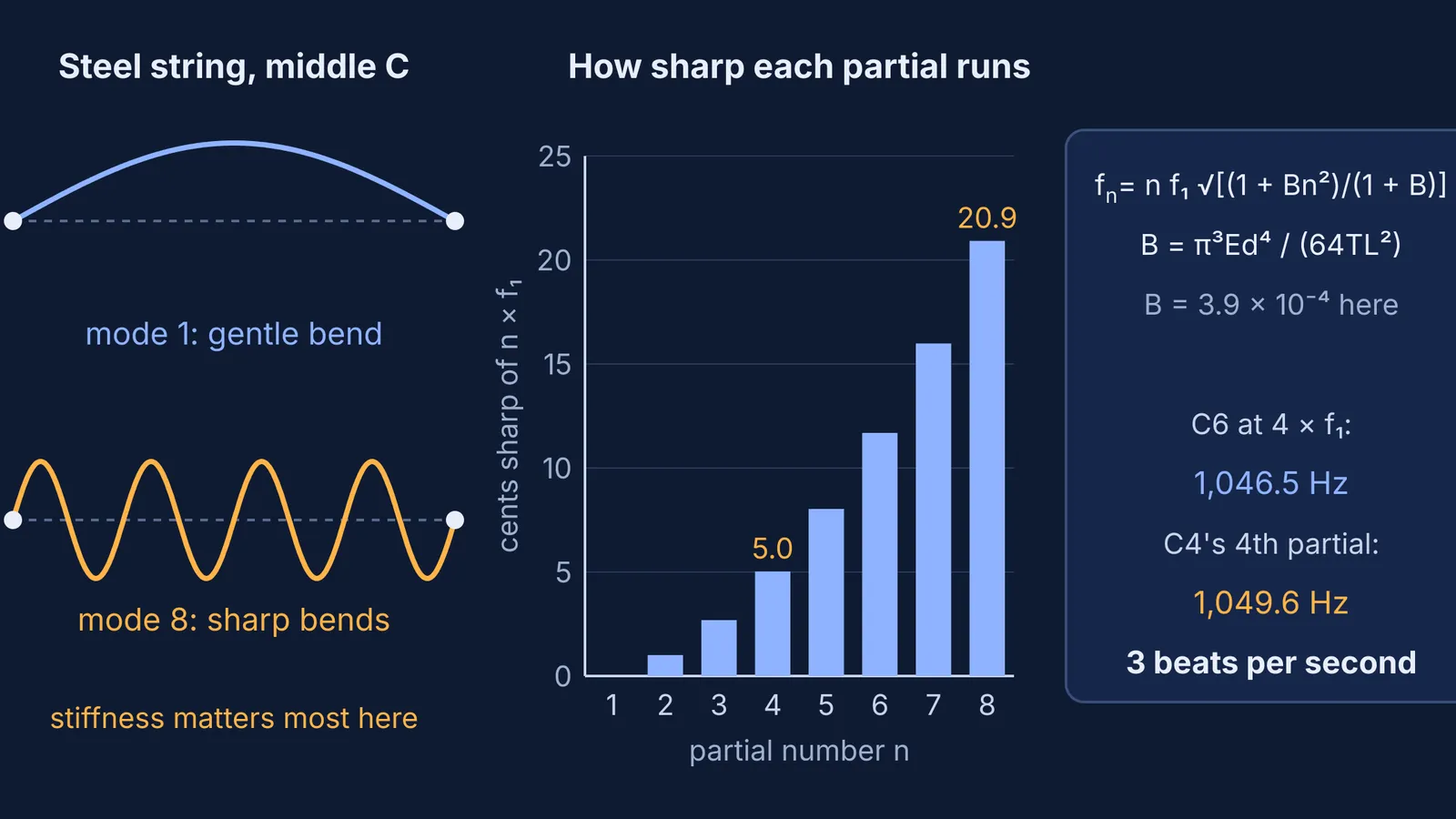
Bending stiffness matters most where the string is most sharply curved. In mode 1 the string makes one gentle arch. In mode 8 it makes eight short arches, far more sharply bent, so the high modes get a much bigger share of the extra restoring force.
More restoring force for the same mass means a higher frequency. So every partial comes out a little sharp of n times the fundamental, and the higher the partial, the sharper it runs.
Harvey Fletcher worked this out for piano strings in the Journal of the Acoustical Society of America in 1964 and checked it against an upright piano. His result is:
f_n = n f₁ √[(1 + B n²) / (1 + B)]
Here B, the inharmonicity coefficient, is set by the wire: B = π³ E d⁴ / (64 T L²), where E is Young's modulus and d the wire diameter. You will not be asked to derive B, but its shape tells you the trend. A thicker wire (d⁴ on top) makes it much larger; more tension or a longer string makes it smaller.
How sharp are the partials of middle C?
Take an illustrative middle C string, close to the sizes used in real pianos but not any one piano: L = 0.62 m, steel wire d = 1.0 mm, E = 200 GPa, density 7,850 kg/m³, tuned to f₁ = 261.63 Hz.
Mass per length. μ = 7,850 × π × (1.0 × 10⁻³)² / 4 = 6.17 × 10⁻³ kg/m.
Tension. From f₁ = (1/2L)√(T/μ), T = (2 L f₁)² μ = (2 × 0.62 × 261.63)² × 6.17 × 10⁻³ = 649 N.
Wave speed. v = √(649 / 6.17 × 10⁻³) = 324 m/s.
Inharmonicity coefficient. B = π³ × (2.0 × 10¹¹) × (1.0 × 10⁻³)⁴ / (64 × 649 × 0.62²) = 3.9 × 10⁻⁴.
Partials, in cents. A cent is one hundredth of an equal-tempered semitone, 1200 log₂ of a frequency ratio. Compared with exactly n f₁, partial 2 is 1.0 cent sharp, partial 3 is 2.7, partial 4 is 5.0 and partial 8 is 20.9 cents sharp, a fifth of a semitone.
These numbers match measurement. Robert Young measured plain steel strings in six pianos and found the 2nd partial of the middle C string sharp by about 1.2 cents in all of them (JASA, 1952). Our string gives 1.3 cents measured from Young's reference, the frequency an ideal flexible string would have.
Why does a perfect octave beat?
A tuner does not measure frequencies. They listen for beats, the slow throb you hear when two tones a few hertz apart sound together, at a rate equal to the difference in frequency. How beats differ from steady interference is explained in beats vs interference of sound.
Play middle C and the C two octaves up (C6) together. If C6 is tuned to exactly 4 × 261.63 = 1,046.52 Hz, it sounds against middle C's 4th partial, which is at:
4 × 261.63 × √[(1 + 16B) / (1 + B)] = 1,049.56 Hz
The difference is 3.0 Hz, so you hear three beats every second. To a tuner that "exact" double octave sounds out of tune. They raise C6 until the beats stop, about 5 cents wide. For the single octave C4 to C5 the mismatch is only 0.3 Hz (1 cent), one slow beat every three seconds, so the stretch is small there.
Why is the stretch bigger at the top of the keyboard?
Young found that above middle C the inharmonicity roughly doubles every eight semitones. Treble strings are short, and for a fixed wire material and note, B depends on length as 1/L⁴. Halve the length and B goes up 16 times. Each note is tuned to the sharp partials of the one below, so the small stretches add up octave after octave. The top notes of a piano end up audibly sharp of the equal-tempered values.
In the 1930s O. L. Railsback used a stroboscope to measure pianos right after tuners finished. The octaves were consistently stretched, more towards both ends of the keyboard (JASA, 1938). The curve of this stretch is now called the Railsback curve.
There is no single correct stretch. It depends on the piano and on which partials the tuner chooses to match.
Why do small pianos need more stretch?
Size matters through that L⁴. Shrink a middle C string from 0.62 m to 0.50 m, keep the wire and the note, and B rises by (0.62/0.50)⁴ = 2.4 times. A compact upright has shorter strings than a concert grand, so its partials run sharper and its octaves need more stretch. Young saw this below middle C, where small pianos had more inharmonicity than large ones.
Bass strings need a lot of mass per metre to give a low note on a limited length. A thick solid steel rod would add mass but also huge stiffness, so bass strings are a steel core wound with copper. The winding adds mass without much bending stiffness, keeping B down. Fletcher's 1964 paper also covers these wound strings.
If you want to see standing waves on a string and how mode shapes change with n, the Simulation Lab has interactive simulations for ideas that are easier to see than read. For the theory of strings, beats and resonance, the Concept Library covers every concept in physics.
Quick checklist
f_n = n v / 2L assumes a perfectly flexible string; real wire also resists bending.
Bending stiffness raises high partials most, because they bend the string most sharply.
Fletcher: f_n = n f₁ √[(1 + Bn²)/(1 + B)], with B larger for thick, short strings.
Illustrative middle C: B = 3.9 × 10⁻⁴, 4th partial 5.0 cents sharp, 8th about 21 cents.
An exact double octave beats 3 times a second, so tuners stretch it.
Stretch grows towards the top, and small pianos need more of it.