On this page
The Class 12 mechanism for adding HCN to a carbonyl group has two steps: cyanide ion attacks the carbon, then the oxygen picks up a proton. In 1903 Arthur Lapworth argued for that order using only a yellow solution and a clock. The paper, "Reactions involving the Addition of Hydrogen Cyanide to Carbon Compounds", is in the Journal of the Chemical Society, Transactions, volume 83, pages 995–1005 (DOI 10.1039/CT9038300995). A scan of the volume is free on the Internet Archive, and every quote below comes from it. Hydrogen cyanide and cyanide salts are extremely toxic, so this post covers only the history and the mechanism.
What problem was Arthur Lapworth trying to solve?
Lapworth, writing from the Goldsmiths' Institute in New Cross, London, opens with a complaint chemists still recognise. When making cyanohydrins, "the speed of the reaction and the yield of cyanohydrin obtained may vary in an extraordinary manner, even when the experimental conditions are apparently constant."
There were clues. Kiliani had found that "a drop of ammonia" helped with sugars. Others said HCN worked better when "nascent", generated in the flask from a cyanide salt and acid. From the ionic standpoint, Lapworth wrote, that word "is meaningless": dissolved HCN is continuously regenerated from its ions anyway.
How did a yellow compound work as a reaction clock?
Lapworth could not simply weigh the product, because cyanohydrins partly fall apart in solution.
His way round it was colour. Camphorquinone "has a bright yellow colour, which is perceptible even in very dilute solutions, whilst its cyanohydrin is almost, if not quite, colourless." As the cyanohydrin forms, the yellow fades, and the time it takes is a rough measure of the rate. With nothing added, the colour disappeared "in about 8—10 hours". Then he added small amounts of other substances:
A drop of hydrochloric acid: no noticeable fading after 14 days. Weak acids such as acetic acid slowed it less.
A drop of potassium hydroxide solution: the colour went "within the space of a few seconds". Ammonia and amines brought the time down to minutes.
Salts of weak acids such as borax "behaved in much the same way as alkalis".
Potassium cyanide: "a great acceleration".
One more test separated cyanide from plain alkalinity. Cyanohydrin solution made alkaline with KOH turned faintly yellow as some broke back down; adding potassium cyanide made it colourless again. In his words, "whilst a large concentration of alkali causes the reversal of the reaction, with potassium cyanide this is not the case."
His conclusion: "the reaction velocity depended mainly on the concentration of the cyanogen ions". Cyanogen ion is the old name for CN⁻.
The paper is qualitative: he timed a colour change and reported no rate constants.
Why could the HCN molecule not be the attacker?
Lapworth tested each possible picture against the colour clock.
(A) HCN adds as a whole molecule. HCN is a weak electrolyte, "present almost entirely in the undissociated form". A drop of acid or cyanide hardly changes how much HCN there is, so this picture cannot explain 14 days against a few seconds.
(B) H⁺ and CN⁻ add together. The rate would follow the product [H⁺][CN⁻], which he said is "unaltered by the addition of small quantities of acids, bases, or cyanides". In modern terms, [H⁺][CN⁻] = Ka[HCN], and [HCN] barely moves.
(C) H⁺ joins the carbonyl first, then CN⁻. Mass action "would predict no acceleration by the addition of a base".
(D) CN⁻ joins first, then H⁺. This predicts faster reaction with bases and cyanides and slower reaction with acids, which is what he saw. If the second step is much faster, "the velocity will be proportional to the concentration of the cyanogen ions".
He settled on (D): "a comparatively slow union of the negative cyanide ions with the carbonyl compound, followed by the almost instantaneous combination of the complexes with hydrogen ions."
In textbook form:
R₂C=O + CN⁻ → R₂C(O⁻)CN (slow, rate-determining)
R₂C(O⁻)CN + HCN → R₂C(OH)CN + CN⁻ (fast)
So the rate law is rate = k[R₂C=O][CN⁻]. Our guide to how HCN adds to aldehydes and ketones covers the curved arrows, the racemic product and hydrolysis to α-hydroxy acids, so they are not repeated here.
How much cyanide is present as CN⁻ at a given pH?
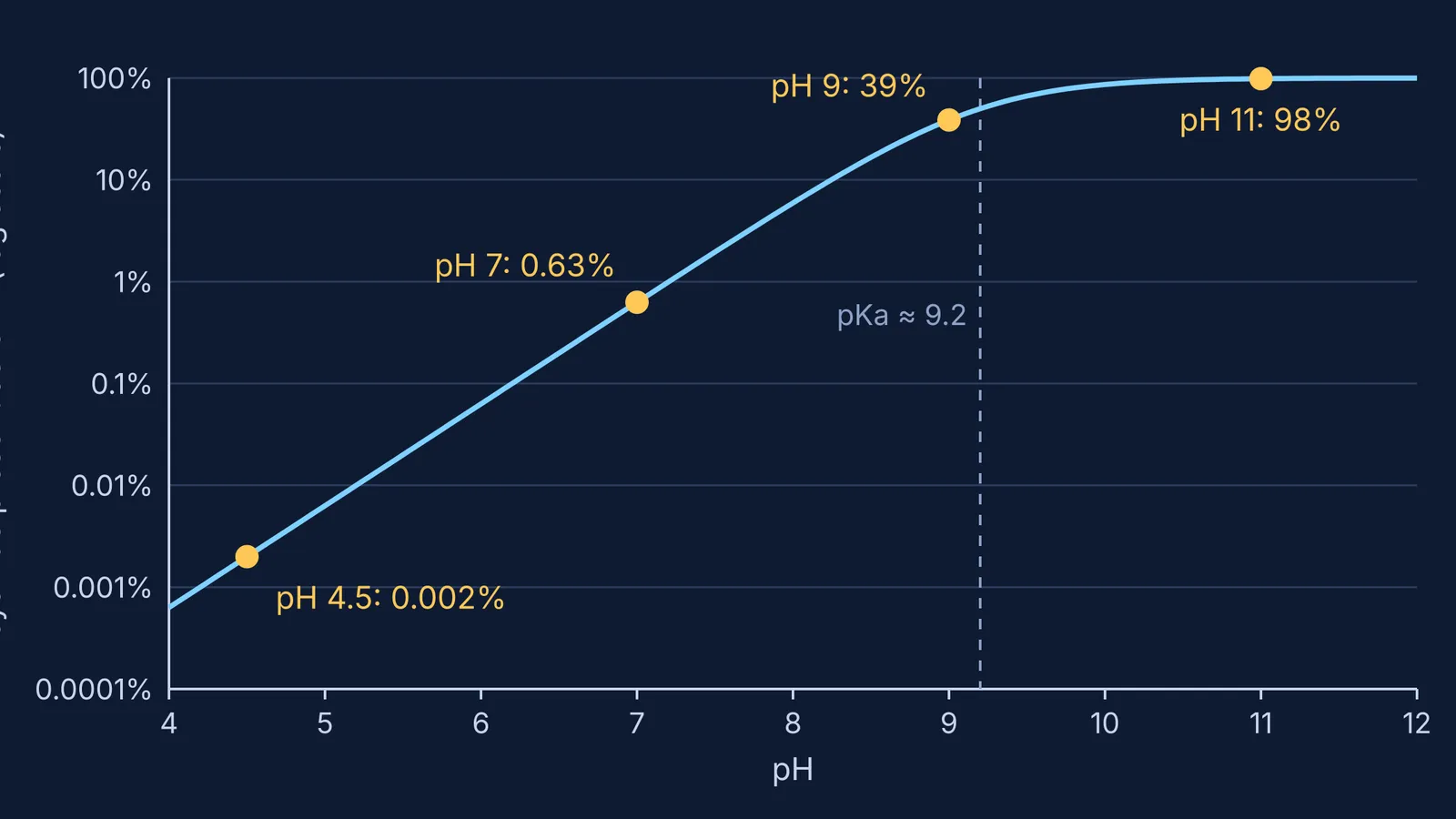
This worked example turns Lapworth's observations into numbers. HCN is a weak acid with a pKa of about 9.2 (PubChem). For HCN ⇌ H⁺ + CN⁻, the Henderson–Hasselbalch relation gives [CN⁻]/[HCN] = 10^(pH − pKa). The fraction of cyanide present as CN⁻ is that ratio divided by (1 + ratio). Lapworth never measured pH, so the pH values below are illustrative.
pH 7: ratio = 10^(7 − 9.2) = 10^(−2.2) = 6.3 × 10⁻³. Fraction = 0.0063, or 0.63%.
pH 4.5 (a little strong acid added): ratio = 10^(−4.7) = 2.0 × 10⁻⁵, so 0.002%. That is about 310 times less CN⁻ than at pH 7.
pH 9: ratio = 10^(−0.2) = 0.63. Fraction = 0.63 ÷ 1.63 = 0.39, or 39%. That is about 62 times more CN⁻ than at pH 7.
pH 11: ratio = 10^(1.8) = 63. Fraction = 63 ÷ 64 = 0.98, or 98%.
With the same total cyanide and the same carbonyl compound, rate ∝ [CN⁻], so the rate scales with these fractions. A trace of acid starves the reaction of its nucleophile, which is why Lapworth's acidified flask stayed yellow for two weeks. A trace of base multiplies [CN⁻] many times over. Base is a catalyst, not a reagent, because step 2 hands the CN⁻ back.
Why not use lots of alkali? Above about pH 11 nearly all the cyanide is already CN⁻, so extra base adds little nucleophile, while strong alkali reverses the reaction, as Lapworth saw. Step 2 also needs a proton donor such as HCN or water.
This also solves the "nascent" puzzle. Generating HCN from a cyanide salt with slightly too little acid leaves free cyanide behind, so the reaction runs fast; with excess acid, Lapworth noted, "the velocity will be greatly diminished."
For revising the ionisation side, see how to find Ka from the pH of a weak acid. To link nucleophilic addition and weak-acid equilibria as ideas, the Fermi Concept Library covers every concept in physics, chemistry, biology, mathematics and computing.
What do JEE and NEET ask about this mechanism?
Expect assertion–reason or "explain why" items:
Addition of HCN to carbonyl compounds is catalysed by base. True: base raises [CN⁻], the actual nucleophile.
The rate-determining step is attack by CN⁻ on the carbonyl carbon, not protonation.
Bulky ketones react poorly. That is a steric effect on the same first step, explained in why 2,2,6-trimethylcyclohexanone resists cyanohydrin formation.
For timed practice on mechanism questions like these, Fermi Test Prep is built for JEE Main and Advanced preparation, with an AI tutor.
Quick checklist
Lapworth (1903) timed the fading yellow of camphorquinone: acid stalled it, a trace of base or KCN made it fast.
He rejected HCN adding whole and H⁺ adding first, and chose CN⁻ attack followed by fast protonation.
Rate ∝ [CN⁻]. Fraction as CN⁻ = 1 ÷ (1 + 10^(pKa − pH)).
At pH 7 only about 0.6% of the cyanide is CN⁻; at pH 9 about 39%.
Base is a catalyst; strong alkali reverses the reaction.