

On this page
Addition of HCN to a carbonyl group is one of the first carbon–carbon bond-forming reactions you meet in Class 12 organic chemistry, and it turns up in JEE conversion questions again and again. The mechanism is short, but examiners like to test three details: why a base is needed, which carbon the cyanide attacks, and what the product becomes after hydrolysis. This post walks through all three, then works one full conversion so you can see the carbon count change.
Why does HCN need a base to add to a carbonyl?
Hydrogen cyanide is a weak acid, with a pKa of 9.25 (LibreTexts, Smith College organic chemistry/19%3A_Aldehydes_and_Ketones-_Nucleophilic_Addition_Reactions/19.07%3A_Nucleophilic_Addition_of_HCN-_Cyanohydrin_Formation)). That means very little of it exists as cyanide ion on its own, and the neutral HCN molecule is a poor nucleophile.
The OpenStax textbook puts it plainly: the reaction "occurs slowly when pure HCN is used but rapidly when a small amount of base is added to generate the nucleophilic cyanide ion" (LibreTexts, OpenStax Organic Chemistry 19.6/19%3A_Aldehydes_and_Ketones-_Nucleophilic_Addition_Reactions/19.06%3A_Nucleophilic_Addition_of_HCN-_Cyanohydrin_Formation)). The base is a catalyst, not a reagent, because the cyanide ion is given back at the end.
The same OpenStax text credits studies by Arthur Lapworth in the early 1900s with showing that cyanohydrin formation is reversible and base-catalysed. One of his papers, "Reactions involving the addition of hydrogen cyanide to carbon compounds", appeared in the Journal of the Chemical Society in 1903 (Crossref record).
In practice, Chemguide's page on HCN addition describes mixing the carbonyl compound with aqueous sodium or potassium cyanide plus a little sulphuric acid, with the pH adjusted to about 4 to 5 because that gives the fastest reaction; the rate falls if the pH is any higher. The solution then contains hydrogen cyanide but still some free cyanide ions, which Chemguide notes is important for the mechanism.
What is the mechanism of cyanohydrin formation?
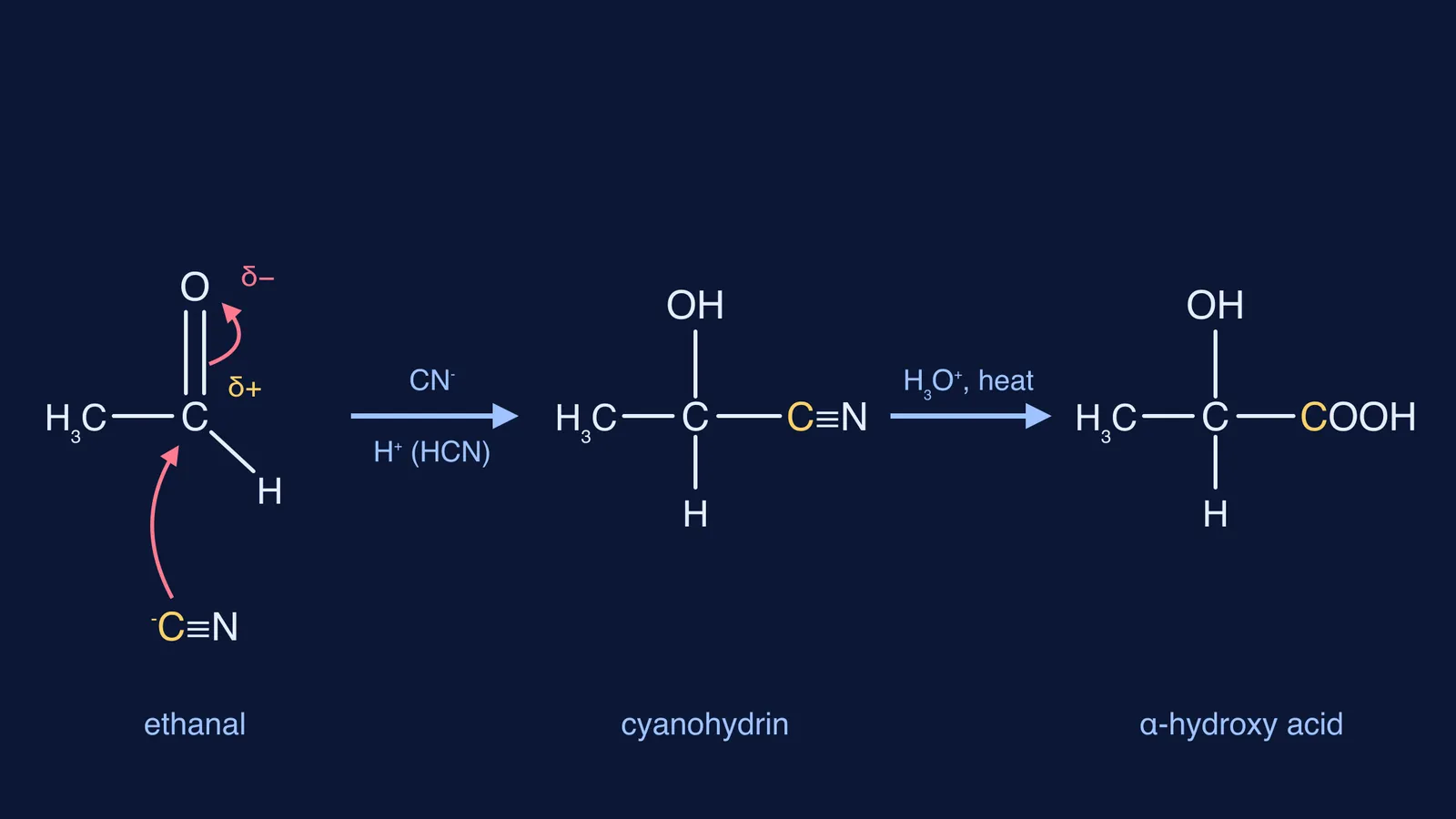
The mechanism has two steps (OpenStax via LibreTexts/19%3A_Aldehydes_and_Ketones-_Nucleophilic_Addition_Reactions/19.06%3A_Nucleophilic_Addition_of_HCN-_Cyanohydrin_Formation)):
Nucleophilic attack: the carbon of CN⁻ attacks the slightly positive carbonyl carbon. The C=O π electrons move onto oxygen, giving a tetrahedral alkoxide ion.
Protonation: the alkoxide takes H⁺ from an HCN molecule. You get the cyanohydrin and a fresh CN⁻, which goes on to attack the next carbonyl.
Two points that cost marks:
The new bond is C–C. Cyanide attacks through its carbon, which is why the product is a nitrile (–C≡N), not an isonitrile.
Attack can happen from either face of the flat carbonyl group, with an equal chance of each. Chemguide explains that this is why 2-hydroxypropanenitrile from ethanal is a 50/50 mixture of two optical isomers, a racemic mixture. Methanal is the exception: its product, HOCH₂CN, has no chiral carbon.
Not every carbonyl cooperates. Aldehydes and unhindered ketones give cyanohydrins, while the equilibrium becomes unfavourable for sterically hindered ketones (OpenStax via LibreTexts/19%3A_Aldehydes_and_Ketones-_Nucleophilic_Addition_Reactions/19.06%3A_Nucleophilic_Addition_of_HCN-_Cyanohydrin_Formation)). We cover the reasons in why aldehydes are more reactive than ketones to nucleophiles and in why 2,2,6-trimethylcyclohexanone resists cyanohydrin formation.
How do cyanohydrins become α-hydroxy acids?
The –CN group of a cyanohydrin can be converted into a carboxylic acid by heating with hot aqueous acid; the Vollhardt and Schore text shows 2-hydroxy-2-methylpropanenitrile becoming 2-hydroxy-2-methylpropanoic acid this way (LibreTexts, Vollhardt and Schore 17.11/17%3A_Aldehydes_and_Ketones_-_The_Carbonyl_Group/17.11%3A_Addition__of_Hydrogen_Cyanide_to_Give__Cyanohydrins)). The –OH stays on the carbon next to the new –COOH, so the product is an α-hydroxy acid.
This is why examiners love the reaction: the cyanide carbon becomes the carboxyl carbon, so the chain grows by exactly one carbon. The same nitrile can instead be reduced with LiAlH₄ to a primary amine (OpenStax via LibreTexts/19%3A_Aldehydes_and_Ketones-_Nucleophilic_Addition_Reactions/19.06%3A_Nucleophilic_Addition_of_HCN-_Cyanohydrin_Formation)), which gives you a second branch to remember.
Worked example: ethanal to lactic acid
Here is a conversion question solved the way you would write it in an exam.
Question: Convert ethanal (2 carbons) into 2-hydroxypropanoic acid (3 carbons).
Count carbons. The target has one more carbon than the start, and an –OH next to –COOH. That pattern points to a cyanohydrin.
Step 1: CH₃CHO + HCN (NaCN with a little acid) gives CH₃CH(OH)CN, 2-hydroxypropanenitrile.
Step 2: heat with aqueous acid. –CN becomes –COOH, giving CH₃CH(OH)COOH, 2-hydroxypropanoic acid (lactic acid).
Check: the product is racemic, because the cyanide attacked the flat aldehyde from both faces.
Use the same three checks on any conversion: one extra carbon, –OH on the α carbon, an aldehyde or unhindered ketone at the start. Benzaldehyde runs the same route; see benzaldehyde to mandelic acid by the cyanohydrin route.
How should you practise this for JEE?
Draw the mechanism from memory with both curved arrows, then label which species is the catalyst.
Write the cyanohydrin and the hydroxy acid for methanal, ethanal, propanone and benzaldehyde, name each one, and mark which products are chiral.
Mix in one hindered ketone so you practise saying "no useful reaction" and why.
If you get the right product by the wrong route, the Fermi Problem Library has worked problems with a step-by-step solver that explains the reasoning rather than printing an answer. If nucleophilic addition itself feels shaky, the Fermi Concept Library gives each chemistry concept its own lesson and shows its place in the map.


