On this page
The reaction you titrate in the Class 12 lab, potassium permanganate with oxalic acid, was also one of the first reactions whose course chemists followed minute by minute. In 1865 A. Vernon Harcourt and William Esson of Oxford stopped it at chosen moments, measured what was left, and found two of the integrated rate laws you now learn: one where the residue times the time stays constant, and one where the residue falls by the same fraction each minute. Their paper, "On the Laws of Connexion between the Conditions of a Chemical Change and its Amount", is in Philosophical Transactions, volume 156 (1866), pages 193–221 (DOI 10.1098/rstl.1866.0010). A scan is free on the Internet Archive. Every quote and number below comes from that scan.
Who were Harcourt and Esson?
The paper's title line describes Harcourt as a Student of Christ Church and Demonstrator of Chemistry in the University of Oxford, and Esson as a Fellow of Merton College. A footnote splits the work: "The experimental inquiries recorded in this paper were chiefly Mr. Harcourt's, the mathematical discussion is Mr. Esson's." It was received on 5 September 1865 and read to the Royal Society on 16 November 1865.
They complained that chemists had studied "the result, and not upon the course of these changes". Their aim was to measure that course.
How did they stop a reaction at a chosen moment?
A rate study needs a reaction you can start and stop "abruptly at a given moment". Their overall equation, in the old double formula for permanganate, was:
K₂Mn₂O₈ + 3H₂SO₄ + 5H₂C₂O₄ → K₂SO₄ + 2MnSO₄ + 10CO₂ + 8H₂O
It balances: 2 K, 2 Mn, 3 S, 10 C, 16 H and 40 O on each side. In ionic form it is 2MnO₄⁻ + 5H₂C₂O₄ + 6H⁺ → 2Mn²⁺ + 10CO₂ + 8H₂O, with a charge of +4 on both sides.
To stop a run, they threw in excess potassium iodide, which reduces the remaining permanganate "instantaneously". The iodine set free was then titrated with sodium thiosulphate ("hyposulphite" in their day). The result was the "percentage of oxidizing residue", y, at time x. In later runs a clock beating seconds timed each experiment, and the flask sat in a water-filled casing held at 16 °C.
They also met the problem you see at the burette. Manganous sulphate sped the reaction up, and they traced the path through manganese dioxide:
K₂Mn₂O₈ + 3MnSO₄ + 2H₂O → K₂SO₄ + 2H₂SO₄ + 5MnO₂
MnO₂ + H₂SO₄ + H₂C₂O₄ → MnSO₄ + 2H₂O + 2CO₂
Both balance. Because a product speeds the reaction, they added extra MnSO₄ at the start of most runs. Our post on why KMnO₄ fades slowly at first in the oxalic acid titration explains this autocatalysis in modern terms. A footnote adds: "Direct sunlight produces a great acceleration."
What law did they find when both reagents ran down together?
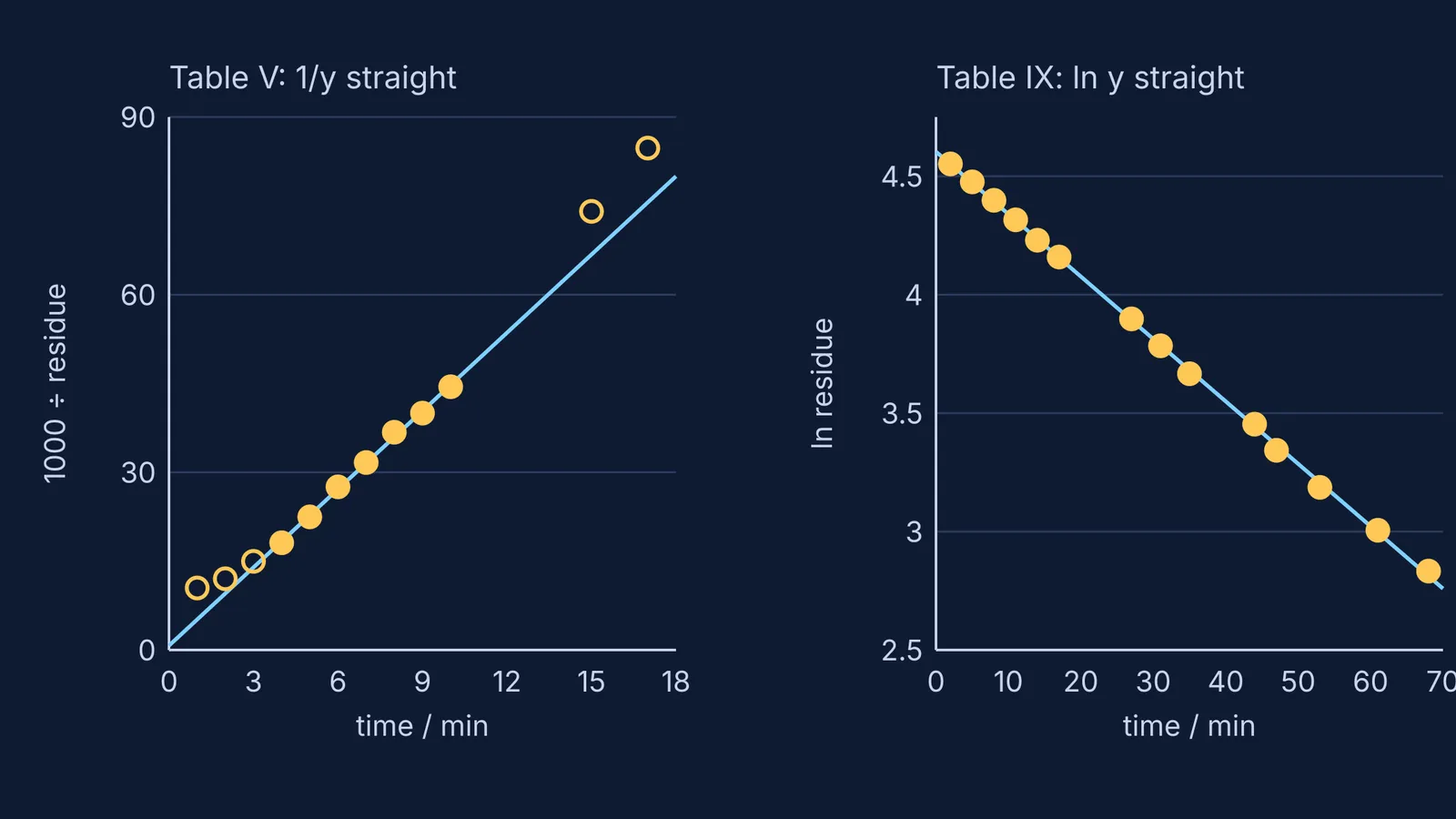
In Table V, permanganate and oxalic acid were taken "in the proportions in which they react", so both fell together. The residue y at each minute x was 95.6, 83.2, 66.8, 55.2, 44.5, 36.3, 31.6, 27.2, 25.0 and 22.5.
From the fourth to the tenth minute, they noticed "a relation exists between the corresponding numbers in the first and second columns which strikes the eye at once. Their product is a constant quantity." Esson derived it: if the rate is proportional to the amount of each of the two substances, it varies as y², and integrating gives xy = k. In today's notation, rate = k[A][B] with [A] = [B], so 1/[A] rises in a straight line with time. That is the test in [how to recognise a second-order reaction from a 1/[A] plot](https://news.fermi.ai/academic-success/second-order-kinetics-1-over-a-plot).
The first three minutes did not fit. They blamed the two-step manganese route: until the MnO₂ step had nearly finished, after about four minutes, the simple law could not hold. The 15- and 17-minute readings also drift, which they put down as "probably due to an experimental error".
What happened when oxalic acid was in large excess?
In Table IX, they used 108 molecules of oxalic acid and 14 of MnSO₄ for each K₂Mn₂O₈, and no sulphuric acid. Only the permanganate's residue changed appreciably. They predicted that "the total amount of change occurring at any moment will be proportional to the quantity of substance then remaining", which integrates to y = ae^(−kx). In their words, the quantities remaining "after a series of intervals of time increasing in arithmetical progression, form a series in geometrical progression".
They fitted y = 94.8(0.974)^x. Their calculated column starts at 94.8 for the 2-minute reading, so x is in effect counted from 2 minutes. This is the idea behind pseudo-first-order reactions: flood every reagent but one, and the order you see is the order in that one.
Worked example: test both orders on their own data
Table V, product test. x × y for 4 to 10 minutes gives 220.8, 222.5, 217.8, 221.2, 217.6, 225.0 and 225.0. The mean is 221.4, and every value is within 2% of it. So y = 221.4 ÷ x.
Straight-line check. Fitting 1/y against x for those minutes gives R² = 0.998. Fitting ln y against x gives only 0.975. The data favour second order.
Second-order half-life. From y = 221.4 ÷ x, the residue is 44.3 at 5 minutes and 22.1 at 10 minutes, so the first halving takes 5 minutes. The next, down to 11.1, ends at 20 minutes and takes 10 minutes. The half-life doubles each time.
Table IX, first-order constant. k = −ln 0.974 = 0.0263 per minute. Then t½ = 0.693 ÷ 0.0263 = 26.3 minutes. A least-squares fit of ln y on all 14 readings gives the same k, with R² = 0.9995.
Prediction check. At 31 minutes, 94.8 × 0.974^29 = 44.2, against 44.0 found. Residue 94.8 at 2 minutes should halve by about 28.3 minutes; the reading at 27 minutes was 49.3.
If the fitting steps feel slow, the Fermi Problem Library has worked problems with a step-by-step solver that explains the reasoning. To watch a first-order decay keep a constant half-life, try the Fermi Simulation Lab.
Was this the first rate law?
No. Ludwig Wilhelmy had already published a first-order law for the acid inversion of cane sugar in 1850; see how Ludwig Wilhelmy measured the first reaction rate. What Harcourt and Esson added was a systematic study of how the amount of change depends on time and on each reagent, with both the first-order and the second-order forms fitted to data.
They were also honest about the limits. With sulphuric acid present, the first-order law fitted poorly, and they concluded that "the reaction here examined is of a complex character, and thus unsuited to the purpose with which we entered upon this investigation". They turned to the simpler reaction of hydrogen peroxide with hydriodic acid. The mathematical section states the general law as: "The velocity of chemical change is directly proportional to the quantity of substance undergoing change."
Quick checklist
Harcourt and Esson (Phil. Trans. 1866) quenched KMnO₄ + oxalic acid with KI and titrated the iodine with thiosulphate.
Equal proportional amounts: residue × time constant, so second order.
Large excess of oxalic acid: residue in geometric progression, so first order.
Table IX: k = 0.0263 min⁻¹, t½ = 26.3 min.
Wilhelmy (1850) came first; they called their own reaction too complex.