

On this page
Class 12 kinetics is built on rate laws, but somebody had to measure one first. That person was Ludwig Wilhelmy, and his tools were a sugar solution, some acid and a beam of polarised light.
Who measured the first rate of a chemical reaction?
Ludwig Ferdinand Wilhelmy (1812–1864) is usually credited with publishing the first quantitative study in chemical kinetics, according to his Wikipedia biography. He trained in pharmacy, then studied chemistry and physics at Berlin, Giessen and Heidelberg, and took his doctorate at Heidelberg in 1846, as the Complete Dictionary of Scientific Biography entry on Encyclopedia.com records.
His 1850 paper, "Ueber das Gesetz, nach welchem die Einwirkung der Säuren auf den Rohrzucker stattfindet" (on the law by which acids act on cane sugar), appeared in Annalen der Physik und Chemie, volume 81. The same entry says it went virtually unnoticed until Wilhelm Ostwald drew attention to it thirty-four years later, in 1884.
How did a polarimeter let Wilhelmy watch sugar react?
In acid, sucrose (cane sugar) reacts with water to give a 1:1 mixture of glucose and fructose. All three sugars rotate plane-polarised light, but by different amounts and in different directions.
Sucrose has a specific rotation of about +66.6°, glucose about +52.2° and fructose about −92.4°, so the finished mixture rotates light the other way, at roughly −19.7°, according to Wikipedia's article on inverted sugar syrup. That flip from right-handed to left-handed rotation is why the reaction is called inversion. We explain the chemistry itself in our post on why sucrose hydrolysis gives invert sugar.
The clever part was the measurement. A polarimeter reading does not disturb the reacting solution, so Wilhelmy could take reading after reading on the same sample while the reaction ran, as the Encyclopedia.com entry notes.
What did Wilhelmy's rate law say?
With water in large excess and the acid unchanged, Wilhelmy found that the amount of sugar converted at any instant was proportional to the amount still present. He wrote it as −dZ/dt = MZS, where Z is the sugar concentration, S is the acid concentration and M is a constant, according to the Encyclopedia.com entry.
He then integrated it to get log Z = −MSt + C, as described in a history of chemical kinetics by Ptáček, Opravil and Šoukal. In today's language, MS is a single constant k, and the reaction is pseudo-first-order: the rate depends only on the sugar because water and acid barely change. He also studied how temperature affects the reaction, decades before the Arrhenius equation gave chemists a formula for it.
How do you use Wilhelmy's method on a sucrose inversion problem?
Board and JEE Main questions on sucrose inversion often give polarimeter readings, not concentrations. Rotation changes in step with how much sucrose is left, so one formula turns readings into concentrations.
Here is a worked example with illustrative readings (not Wilhelmy's own data):
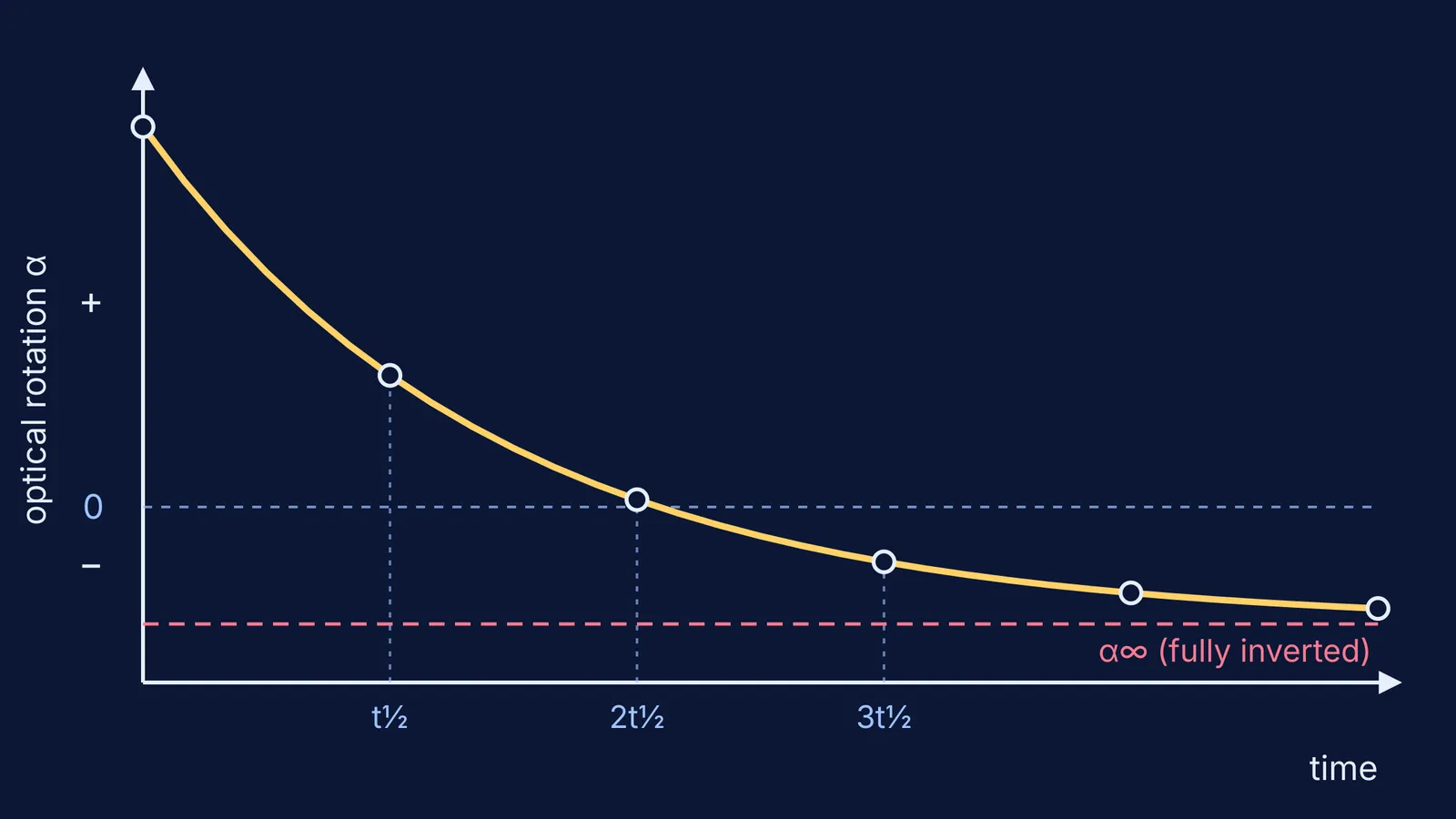
At the start, α₀ = +13.0°
After 30 minutes, α = +4.5°
After the reaction is complete, α∞ = −4.0°
Find the fraction of sucrose left: (α − α∞) / (α₀ − α∞) = (4.5 + 4.0) / (13.0 + 4.0) = 8.5 / 17.0 = 0.50.
Half the sucrose is gone in 30 minutes, so the half-life is 30 minutes.
Rate constant: k = ln 2 / t½ = 0.693 / 30 ≈ 0.023 per minute.
Predict the reading at 60 minutes: two half-lives leave 0.25, so α = −4.0 + 17.0 × 0.25 = +0.25°.
When does the rotation pass zero? Set the fraction to 4.0 / 17.0 and solve t = ln(17.0 / 4.0) / k ≈ 63 minutes.
The common mistake is to put α₀ and α straight into ln(α₀ / α). That ignores the fact that the products also rotate light, so it gives the wrong k. Always subtract α∞ first. For the full derivation of the integrated law, read our walk-through of the first-order rate equation.
What can you take from Wilhelmy today?
His method still works as a study plan for any kinetics question:
Find a quantity you can measure that changes in step with concentration (rotation, absorbance, volume of gas, titre).
Convert each reading into the fraction of reactant left, using the start and end values.
Check whether ln(fraction) falls in a straight line with time. If it does, the reaction is first order and the slope is −k.
If you get the right formula but the wrong number, the Fermi Problem Library has worked problems with a step-by-step solver that explains the reasoning rather than printing an answer. If the curve itself feels abstract, the Fermi Simulation Lab has interactive simulations for ideas that are easier to see than to read.
Next time a question hands you three polarimeter readings, remember that you are repeating an experiment from 1850.


