On this page
You close the door of your study room and still hear the TV next door. The wall is solid brick, the door is solid wood, yet the room leaks sound through a strip of air under the door barely a centimetre high. The physics is the decibel and intensity arithmetic from your sound chapter, applied to the energy passing through each part of a wall.
What does a wall's sound reduction in decibels actually mean?
When sound strikes a wall, most of its energy is reflected or absorbed. A small fraction gets through. Call that fraction the transmission coefficient τ (tau): transmitted power ÷ incident power.
Engineers quote the wall's sound reduction R (or transmission loss) in decibels:
R = 10 log(1/τ), so τ = 10^(−R/10)
This is the same 10 log rule as for sound intensity level, which is covered in how to calculate sound intensity level in decibels. The US Unified Facilities Criteria for noise control, UFC 3-450-01 (section C-5.3), uses exactly this definition.
So a wall rated 45 dB lets through τ = 10^(−4.5) = 3.2 × 10⁻⁵ of the sound energy falling on it. A door rated 30 dB lets through 10⁻³. An open gap lets everything through: τ = 1, which is R = 0 dB.
Why a solid wall's R rises with mass and frequency is in why you hear only the bass from your neighbour's music.
How do you find the sound insulation of a wall with a door or a gap?
Each part passes sound power in proportion to its area and its τ. Add the powers and divide by the total area:
τ_total = (τ₁S₁ + τ₂S₂ + τ₃S₃ + ...) / (S₁ + S₂ + S₃ + ...)
R_total = −10 log τ_total
This is equation C-9 of UFC 3-450-01, which also notes that the sum must be repeated for each frequency band, because every R depends on frequency.
Average the energy fractions, never the decibels. The 30 dB door's τ is 32 times the 45 dB wall's, so the door dominates even though it is smaller.
Why does a 1% gap ruin a 45 dB wall?
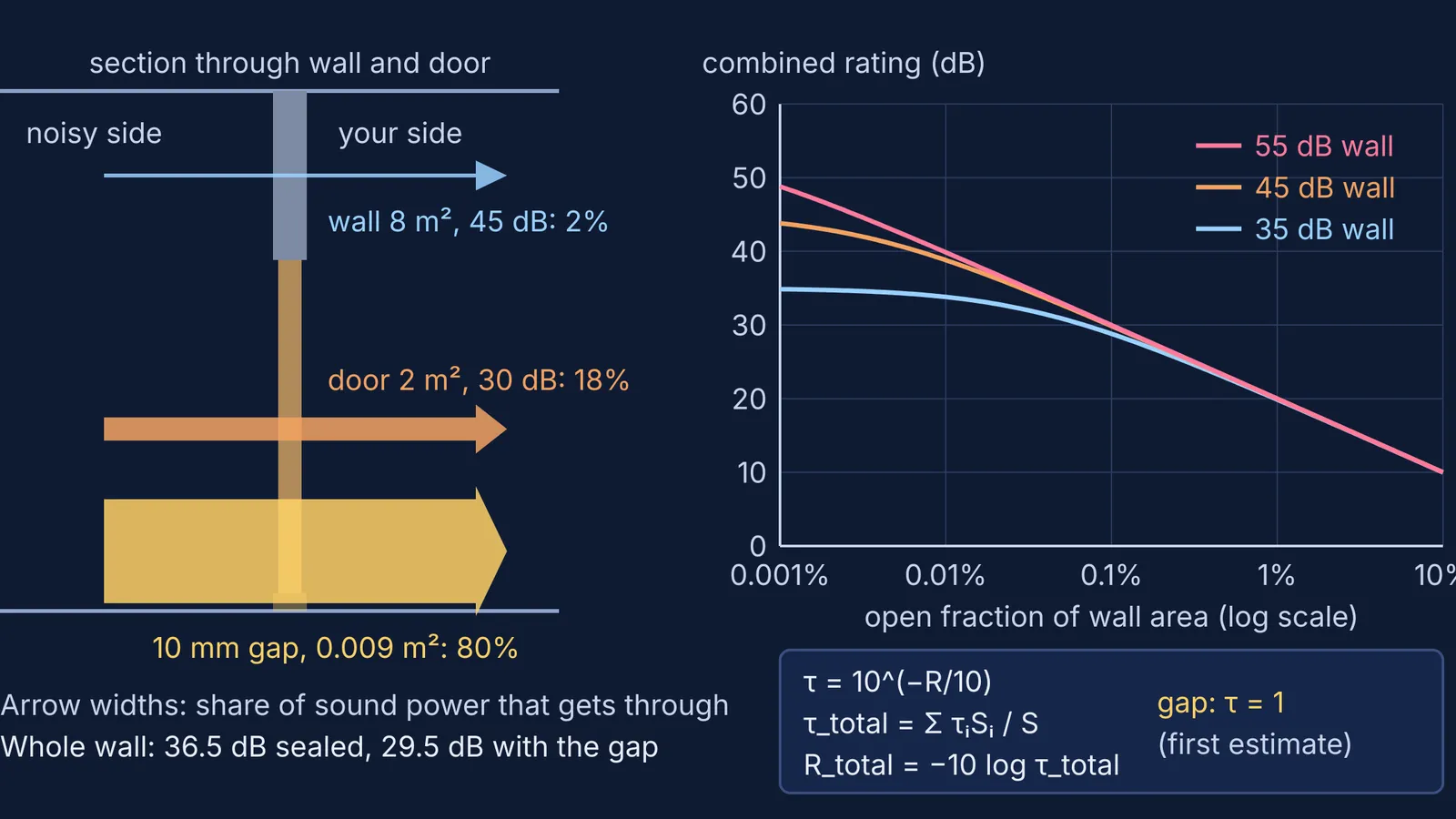
Take a 45 dB wall and open up a fraction f of its area. Then τ_total = (1 − f) × 3.2 × 10⁻⁵ + f × 1.
0.01% open (f = 10⁻⁴): τ_total = 3.2 × 10⁻⁵ + 1.0 × 10⁻⁴ = 1.3 × 10⁻⁴, so R = 38.8 dB.
0.1% open (f = 10⁻³): τ_total = 1.03 × 10⁻³, so R = 29.9 dB.
1% open (f = 10⁻²): τ_total = 1.0 × 10⁻², so R = 20.0 dB.
A hole one ten-thousandth of the wall's area already costs 6 dB. At 1% open, the wall is no better than the hole.
Now repeat the 1% case for a heavier 55 dB wall. τ_wall = 3.2 × 10⁻⁶, and τ_total = 0.99 × 3.2 × 10⁻⁶ + 0.01 = 0.0100. R = 20.0 dB again. A 35 dB wall with the same 1% gap gives 19.9 dB. Once the gap carries most of the energy, the wall's quality hardly matters.
How much does a gap under a door cost? A worked example
A room wall has a total area of 10 m². It contains a door 0.9 m wide and about 2.2 m high, so treat it as 8 m² of wall and 2 m² of door. For the ratings, use values from the transmission-loss tables in UFC 3-450-01: at 1,000 Hz, Table C-8 gives 45 dB for 4-inch (about 10 cm) dense masonry, and Table C-13 gives 30 dB for a well-gasketed solid-core wood door. Real ratings vary with frequency and construction, so treat these as one-band example values.
Wall: τ₁S₁ = 3.16 × 10⁻⁵ × 8 = 2.53 × 10⁻⁴ m².
Door, sealed all round: τ₂S₂ = 1.0 × 10⁻³ × 2 = 2.0 × 10⁻³ m².
Without a gap: τ_total = (2.53 × 10⁻⁴ + 2.0 × 10⁻³) / 10 = 2.25 × 10⁻⁴. R = −10 log(2.25 × 10⁻⁴) = 36.5 dB. The door already costs 8.5 dB compared with the bare wall.
Add a 10 mm undercut: the gap is 0.9 m × 0.010 m = 0.009 m², only 0.09% of the wall. Take τ = 1 for it, and reduce the door's area by the same 0.009 m² (this changes nothing to three figures).
With the gap: τ_total = (2.53 × 10⁻⁴ + 1.98 × 10⁻³ + 0.009) / 10 = 1.12 × 10⁻³. R = 29.5 dB.
So a 1 cm gap under the door costs the room 7 dB. Of all the sound power that now gets through, the gap carries 80%, the door 18% and the brick wall only 2%.
The same sum for other undercuts:
3 mm gap (0.0027 m²): 33.1 dB, a loss of 3.4 dB.
10 mm gap (0.009 m²): 29.5 dB, a loss of 7.0 dB.
20 mm gap (0.018 m²): 26.9 dB, a loss of 9.5 dB.
A 7 dB drop means five times as much sound energy reaches you.
Is a real gap exactly as leaky as its area suggests?
Not exactly. A narrow slit through a thick door frame behaves like a short pipe. At some frequencies it resonates and lets through more than its area suggests; at others it lets through less. Asakura and colleagues, studying slits about 100 mm deep, found sharp dips in sound insulation near the pipe resonances in their slit (Acoustical Science and Technology, 2009). They also showed that lining a slit with porous absorbent changes and reduces this leak.
Taking τ = 1 for the open area is the standard first estimate. It gets the size of the effect right.
This is why the practical advice in noise vs music: the physics difference and how to cut noise starts with sealing gaps. UFC 3-450-01 recommends gaskets around doors and a seal at the bottom, and the numbers above show why: closing the gap matters more than a heavier door.
How do JEE questions use this idea?
JEE tests the same skills: converting between intensity ratios and decibels and adding intensities, never decibels. Two 60 dB sources together give 63 dB, not 120 dB; the gap problem is the same rule applied to parts of a wall.
If you are working through sound and decibel numericals for JEE, Fermi Test Prep offers personalised preparation for JEE Main & Advanced with an AI tutor, live classes, adaptive mocks, mentorship and a study plan that updates based on mastery. For a single problem you are stuck on, the Fermi Problem Library has a step-by-step solver that explains the reasoning.
Quick checklist
τ = 10^(−R/10): 45 dB is 3.2 × 10⁻⁵, 30 dB is 10⁻³, an open gap is 1.
Combine parts with τ_total = Σ τᵢSᵢ / ΣSᵢ, then R_total = −10 log τ_total.
1% open area limits any wall to about 20 dB, whether it is rated 35, 45 or 55 dB.
A 10 mm gap under a 0.9 m door takes a 10 m² wall from 36.5 dB to 29.5 dB.
Treat τ = 1 for a gap as a first estimate, since slits can resonate.