

On this page
Have you ever washed two glass plates, stacked them together while wet, and found them impossible to pull apart? It feels as if they have been superglued. But there is no adhesive at work—only water, surface tension, and the invisible weight of the atmosphere.
The force holding them together can easily reach tens of kilograms, even for small glass slides. Here is the physics behind why wet glass plates stick and how you can separate them without shattering them.
What causes the force between wet glass plates?
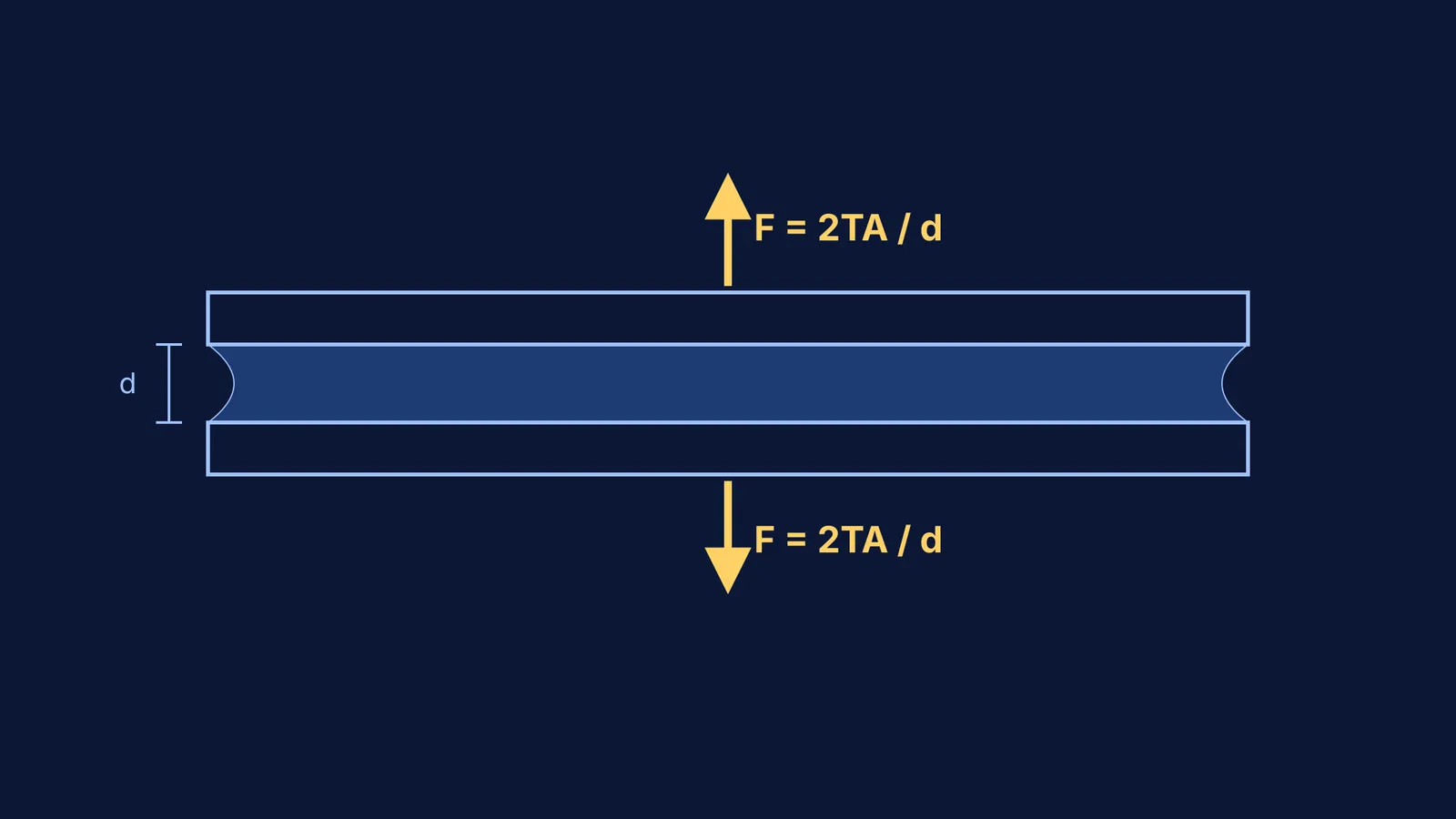
When a drop of water is squeezed between two flat glass plates, it spreads out into a thin film. Because water "wets" glass (meaning it has a contact angle close to zero), it forms a highly curved, concave edge around the perimeter of the plates 1.
This curved boundary is called a meniscus. According to the Young-Laplace equation, any curved liquid surface creates a pressure difference between its inside and outside 1. Because the meniscus curves inward, the pressure inside the water film drops below the atmospheric pressure outside. (This boundary effect is distinct from the bulk fluid forces covered in our guide to hydrostatics and pressure at depth).
As a result, the outside air pushes the two plates together. You are not just fighting the water when you try to separate them; you are fighting the Earth's atmosphere.
The formula: F = 2TA / d
To pull the plates straight apart, you must overcome the force created by this pressure difference. The force (F) is calculated using this standard formula 2:
F = 2TA / d
Here is what each term means:
T: The surface tension of the liquid (for water, it is about 0.072 N/m) 2.
A: The contact area of the glass plates.
d: The distance between the plates, or the thickness of the water film.
The key to the massive force is the distance (d) in the denominator. As the film gets thinner, the force required to separate the plates skyrockets.
Calculating the force: a worked example
Let's put some numbers to the formula. Suppose you have two small glass slides, each with an area of 10⁻² m² (about 10 cm × 10 cm), and the water film between them is just 0.05 mm thick 2.
Using the surface tension of water as 72 × 10⁻³ N/m, the calculation looks like this:
Convert thickness to metres: d = 0.05 × 10⁻³ m.
Plug the values into the formula: F = (2 × 72 × 10⁻³ × 10⁻²) / (0.05 × 10⁻³)
Simplify the numerator: 2 × 72 × 10⁻⁵ = 144 × 10⁻⁵.
Divide by the denominator: (144 × 10⁻⁵) / (5 × 10⁻⁵) = 28.8 N.
You would need 28.8 Newtons of force—equivalent to lifting nearly 3 kg—just to pull apart two small, wet slides. If the plates were larger or the film was thinner, the force would be much higher.
How do you safely separate stuck glass plates?
If you find yourself dealing with stuck glassware, never try to pry them apart with a knife or pull them straight up. The glass will likely shatter before the water seal breaks. Instead, use physics to your advantage:
Slide them horizontally: As mentioned above, shear forces only have to overcome the water's low viscosity, which is much easier than fighting atmospheric pressure. (You can explore more about shear forces in our overview of surface tension and viscosity).
Submerge them in water: If you place the stuck plates completely underwater, you eliminate the air-water interface at the edges. Without the meniscus, the Laplace pressure difference vanishes, and the plates will drift apart easily.
Add a drop of soap: Detergent lowers the surface tension (T) of the water, which proportionally reduces the force holding the plates together.
When you're trying to picture how a tiny concave meniscus translates into a massive force, reading a textbook isn't always enough. Whether you are balancing fluid forces or calculating electrostatic pressure on a soap bubble, the Fermi Concept Library maps out ideas like surface tension and Laplace pressure step by step. If you get stuck on a homework problem involving F = 2TA/d, Fermi's AI tutor can draw the free-body diagram on a board and help you find the missing variable. By linking the math to the physical geometry, the result stops being a memorised trick and starts making perfect sense.


