

On this page
What makes a balloon and CD hovercraft float?
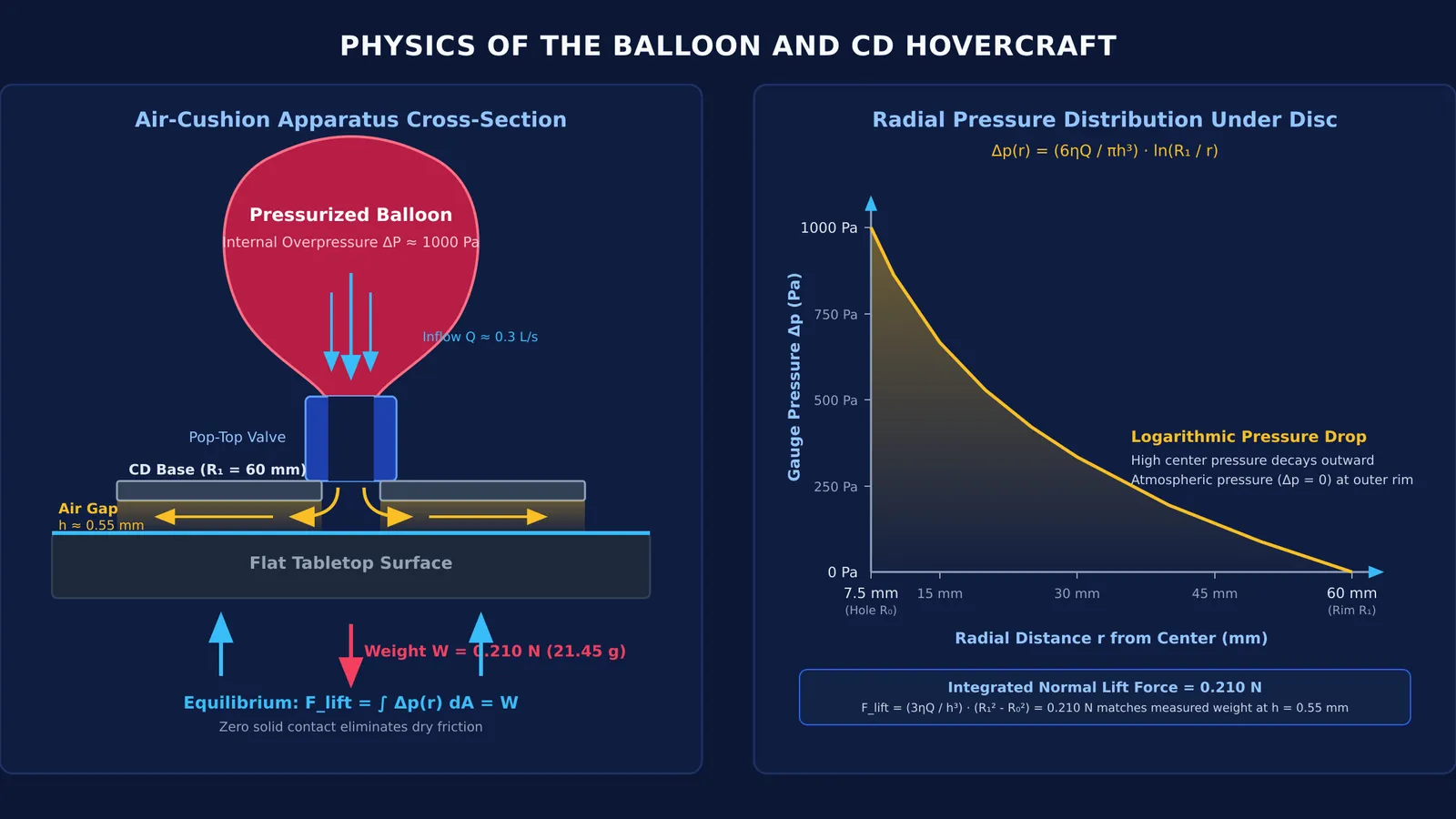
When you inflate a balloon and stretch its neck over a bottle cap glued to a compact disc, the elastic latex acts as a pressure vessel. The contracting rubber squeezes the enclosed air, generating an internal overpressure of approximately 1000 Pa (about 10 hPa above room atmospheric pressure), according to an experimental fluid dynamics study by Charles de Izarra and Grégoire de Izarra in the *European Journal of Physics*. When you open the valve, this pressure gradient forces air through the disc's central hole at roughly 0.3 × 10⁻³ m³/s.
Rather than jetting straight out, the escaping air meets the tabletop and turns 90 degrees outward, spreading radially toward the disc's 60 mm outer rim. Because the air flows through an extremely narrow clearance, classical lubrication theory governs the radial gauge pressure distribution:
Δp(r) = (6ηQ / πh³) × ln(R₁ / r)
Here, η is the dynamic viscosity of air (1.8 × 10⁻⁵ Pa·s), Q is the volumetric flow rate, h is film thickness, R₁ is outer radius (60 mm), and r is distance from the center. Integrating this pressure profile over the disc base yields the upward lift force. De Izarra's measurements showed that for a 21.45 g hovercraft (a gravitational weight of 0.210 N), this lift balances gravity at an equilibrium air gap of h ≈ 0.55 mm. The CD floats without touching the surface. For physical concepts that are easier to see than to read, students can explore fluid pressure and balancing forces in the Fermi Simulation Lab.
Why does the hovercraft glide instead of stopping?
When an unpowered CD rests on a table, microscopic surface irregularities called asperities interlock. For polycarbonate on laminate or wood, the coefficient of kinetic friction is typically μ_k ≈ 0.3. For the 21.45 g craft measured by de Izarra and de Izarra, the downward weight of 0.210 N produces a sliding friction force of:
f_k = μ_k × N = 0.3 × 0.210 N ≈ 0.063 N
Separating the two solid surfaces with an air cushion replaces dry contact with fluid friction, as discussed in our guide on methods to reduce friction. The disc lifts off the table, preventing asperities from touching.
As explored in Ludwig Prandtl's boundary layer theory, shearing a thin gas layer requires minimal force. For a disc moving at 0.2 m/s over an air gap of 0.55 mm, the viscous drag force is:
F_viscous ≈ η × (v / h) × A ≈ (1.8 × 10⁻⁵) × (0.2 / 0.00055) × 0.011 ≈ 7 × 10⁻⁵ N
This viscous drag is roughly 900 times smaller than the dry sliding friction of the disc. With resistive forces reduced by two orders of magnitude, a gentle tap sends the craft gliding across the table.
How do you build a working hovercraft at home?
Building a balloon hovercraft takes ten minutes using common household items, as outlined in the NASA JPL hovercraft activity guide:
One discarded CD or DVD with a clean, flat plastic base.
One push-pull bottle cap from a sports drink bottle.
One standard 9-inch or 12-inch party balloon.
Hot glue or craft adhesive.
A smooth, non-porous test surface, such as polished granite or glass.
Follow these steps to assemble and launch the craft:
Attach the valve: Glue the base of the bottle cap over the central spindle hole on the printed side of the CD, creating an airtight seal.
Seal and inflate: Push the valve closed, inflate the balloon to about 70 percent capacity, and pinch the neck without tying a knot.
Mount and launch: Stretch the balloon neck over the closed nozzle. Place the CD on a smooth table, pull the nozzle open, and give the disc a gentle horizontal tap.
On smooth surfaces like polished granite or glass, the craft glides freely. On rough or porous surfaces like tablecloths, air escapes before a cushion forms, causing rapid deceleration.
What classroom physics does this simple toy prove?
The balloon hovercraft provides an experimental demonstration of the laws of motion in Class 9 physics, supported by the data in the de Izarra hovercraft study:
Newton's first law (inertia): Without solid friction, the craft demonstrates Galilean inertia: once pushed, it coasts in a straight line at near-constant speed until it reaches the edge of the table.
Newton's second law (F = ma): Because drag is negligible, even a small horizontal force produces immediate acceleration.
Newton's third law (action and reaction): Pressurized air pushed downward against the table generates an equal and opposite normal force that supports the craft.
Aerospace engineers use this exact air-cushion principle in testing facilities. NASA's Jet Propulsion Laboratory uses planar air bearings to float robotic simulators across flat floors, creating a frictionless two-dimensional testbed that mimics orbital weightlessness.
To explore every concept in mechanics and build intuition for contact forces, students can study interactive lessons in the Fermi Concept Library.


