On this page
The Indian Standard for monosodium glutamate (MSG, sold as ajinomoto), IS 9505:2007, checks its purity with a titration that looks odd at first. The sample is dissolved in formic and glacial acetic acid, not water, and titrated with perchloric acid. The standard then says each mL of 0.1 N perchloric acid is equivalent to 9.356 mg of MSG. That is half of what a one-to-one reaction would give, so each MSG takes up two protons. Here is why, with the purity sum and the standard's other chemistry. For taste and the safety debate, see the chemistry of ajinomoto and umami; this post stays with the analysis.
What does IS 9505 say MSG is?
The foreword names it monosodium L-glutamate monohydrate, C₅H₈NO₄Na·H₂O, M = 187.13, and writes it as HOOC–CH(NH₂)–CH₂–CH₂–COONa·H₂O. The standard first appeared in 1980, based on FAO/WHO specifications, and the 2007 revision follows JECFA.
Its identity tests include:
Ninhydrin gives an intense violet-blue colour (the free α-amino group).
Uranyl zinc acetate gives a yellow crystalline precipitate (the test for Na⁺).
pH of a 1 in 50 solution: 6.7 to 7.2.
Table 1 sets purity at 99% minimum, loss on drying (98 °C, 5 h) at 0.5% maximum, chloride at 0.2%, arsenic 2 mg/kg, heavy metals 10 mg/kg, and lead 5 mg/kg, which Amendment No. 1 (August 2017) cut to 1 mg/kg. Note that the crystal water is 18.02/187.13 = 9.6% of the mass, far above the 0.5% drying limit. So the drying step removes surface moisture and leaves the monohydrate intact, which is why purity is reported as the monohydrate.
How does BIS titrate MSG?
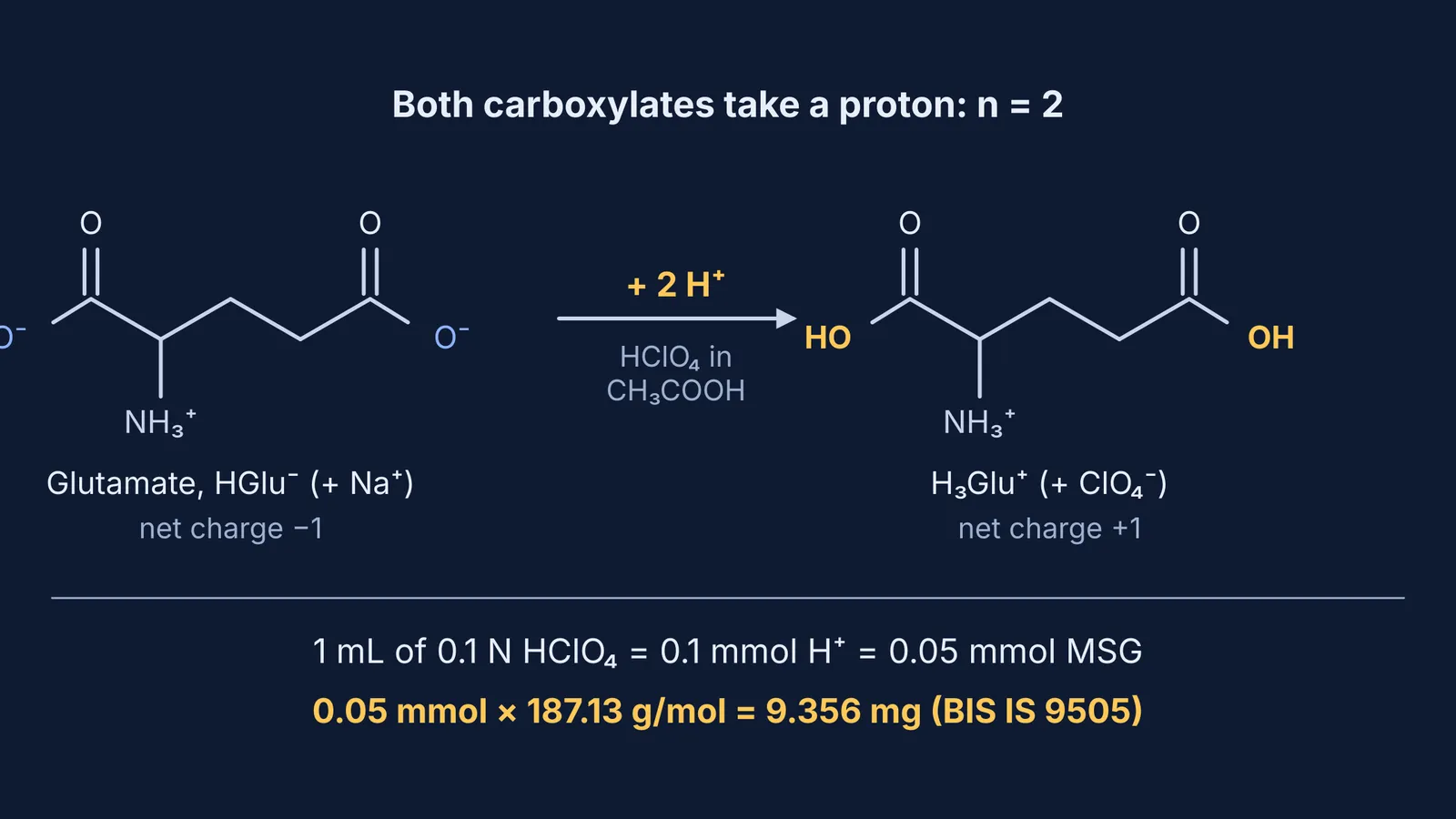
Annex A dissolves about 200 mg of the dried sample in 6 mL of formic acid, adds 100 mL of glacial acetic acid, and titrates with 0.1 N perchloric acid to a potentiometric end point, correcting for a blank. Each mL of 0.1 N HClO₄ = 9.356 mg of C₅H₈NO₄Na·H₂O.
Now test the number. One mL of 0.1 N acid supplies 0.1 mmol of H⁺. If one MSG took one H⁺, that would be 0.1 mmol × 187.13 = 18.71 mg. BIS says 9.356 mg, which is 0.05 mmol. So:
n = M / (10 × mg per mL) = 187.13 / 93.56 = 2
Why does each MSG take two protons?
Count charges instead of drawing arrows. Glutamic acid has three groups that can carry a proton. OpenStax Organic Chemistry lists pKa values of 2.19 (α-COOH), 4.25 (side-chain COOH) and 9.67 (–NH₃⁺).
Fully protonated cation, H₃Glu⁺: HOOC–CH(NH₃⁺)–CH₂CH₂–COOH, charge +1.
Glutamic acid, H₂Glu: one carboxyl has passed its proton to the amino group, so it is a zwitterion with net charge 0. See amino acids as zwitterions.
Glutamate, HGlu⁻: charge −1. MSG is Na⁺HGlu⁻.
Going from HGlu⁻ to H₃Glu⁺ adds two protons, whichever way you draw the molecule. In the zwitterion picture, ⁻OOC–CH(NH₃⁺)–CH₂CH₂–COO⁻ Na⁺, both carboxylates pick up a proton. In BIS's neutral way of writing it, the –COONa and the –NH₂ take one each. You end at the same cation either way. With perchlorate as the counter-ion:
C₅H₈NO₄Na + 2HClO₄ → [C₅H₁₀NO₄]⁺ClO₄⁻ + NaClO₄
Atoms balance (C 5, H 10, N 1, O 12, Cl 2, Na 1 on each side) and charge is zero on both sides.
Why not titrate it in water?
Both proton-taking groups are very weak bases. The carboxylate whose acid has pKa 4.25 has pKb = 14 − 4.25 = 9.75; the one at 2.19 has pKb = 11.81. In water, the strongest acid you can have is H₃O⁺, and water competes with such weak bases for the proton. The titration curve has no sharp jump to find.
Glacial acetic acid is a much weaker base than water. Perchloric acid protonates it, HClO₄ + CH₃COOH → CH₃COOH₂⁺ + ClO₄⁻, and the CH₃COOH₂⁺ ion is a far stronger proton donor than H₃O⁺. Now even the weak carboxylate bases are protonated completely, and the electrode shows a clear end point. Perchloric acid is used because it stays the strongest common acid in this solvent; see the levelling effect of water on strong acids. BIS does not say why it adds formic acid; presumably it helps dissolve the salt.
Worked example: purity and the chloride limit
You titrate 200.0 mg of dried MSG with exactly 0.1000 N HClO₄ and need 21.20 mL after the blank.
Mass of MSG found = 21.20 × 9.356 = 198.3 mg.
Purity = 198.3 / 200.0 × 100 = 99.2%. The minimum is 99%, so it passes.
Sanity check: with n = 1 you would use 18.71 mg per mL and get 198.3%. A purity near 200% is the sign you used the wrong n-factor.
The chloride test (Annex B) compares 0.07 g of sample with 0.4 mL of 0.01 N HCl in a Nessler tube, both with dilute nitric acid and silver nitrate. That standard holds 0.4 × 0.01 = 0.004 mmol of Cl⁻, or 0.004 × 35.45 = 0.142 mg. And 0.142/70 × 100 = 0.20%, which is the Table 1 limit. If the sample's turbidity is no stronger, it passes.
Why is rotation measured in 2 N HCl?
Clause 3.2.4 sets [α]²⁰D between +24.8° and +25.3° for a 10% (w/v) solution in 2 N hydrochloric acid. The standard gives the condition but not the reason. The likely reason is that rotation changes with the ionic form, and the form in water depends on pH. In 2 N HCl the pH is about zero or below, so the fraction present as H₃Glu⁺ is at least 1/(1 + 10^(0 − 2.19)) = 0.994. Every sample is then measured as the same species.
In a polarimeter, α = [α] × l × c. A 10% w/v solution is 0.100 g/mL. In a 2 dm tube, [α] = +25.0° gives α = 25.0 × 2 × 0.100 = +5.0°, and the allowed range reads +4.96° to +5.06°.
Why is L-glutamate (S)?
At C-2 the Cahn–Ingold–Prelog priorities are NH₂ (N) > COOH (O, O, O) > CH₂CH₂COOH (C, H, H) > H. With H pointing away, the order runs anticlockwise for the natural L form, so it is (S). PubChem names L-glutamic acid (2S)-2-aminopentanedioic acid. L does not always mean S (L-cysteine is R), and neither label predicts the + sign of rotation, which has to be measured.
What is the pyroglutamic acid test?
The 2017 amendment added clause 3.2.6: a thin-layer chromatography test for pyrrolidone carboxylic acid (pyroglutamic acid). The sample is run beside a reference on silica gel with n-butanol, acetic acid and water (2:1:1). No spot may appear at the reference position.
Pyroglutamic acid forms when the α-NH₂ attacks the side-chain COOH and water is lost, closing a five-membered lactam (four carbons and one nitrogen):
C₅H₉NO₄ → C₅H₇NO₃ + H₂O
The nitrogen is now an amide nitrogen, so the free amino group that ninhydrin and the titration rely on is gone.
Where does this sit in the syllabus?
Class 12, Biomolecules: amino acids, zwitterions, L-configuration.
Class 11, Some Basic Concepts and Equilibrium: n-factor, equivalents, Brønsted bases, levelling.
Class 11 and 12 stereochemistry: R/S assignment and specific rotation.
For n-factor and titration traps like this in JEE Main and Advanced, Fermi Test Prep has an AI tutor for practice. For the reasoning behind each step of a sum, try the Fermi Problem Library.
Quick checklist
9.356 mg per mL of 0.1 N = 187.13/20, so n = 2.
HGlu⁻ → H₃Glu⁺ is two protons in any drawing.
Water is too basic a solvent; glacial acetic acid lets HClO₄ protonate weak bases fully.
Rotation: +24.8° to +25.3° in 2 N HCl, not water.
L-glutamic acid is (S): N > COOH > CH₂ chain > H.
Pyroglutamic acid = glutamic acid − H₂O, a lactam.