

On this page
Ask a Class 11 student which is stronger, HCl or HClO4, and you may hear "both are strong". In water that is correct, and that is the problem: water hides the difference. Here is why, how chemists rank strong acids anyway, and a short method for exam questions.
What is the levelling effect of water on strong acids?
The levelling effect is the way a solvent makes every acid stronger than the solvent's own protonated form look equally strong. David Harvey's open textbook Analytical Chemistry 2.1/09:_Titrimetric_Methods/9.02:_AcidBase_Titrations) puts it in one line: the strongest acid that can exist in water is the hydronium ion, H3O+.
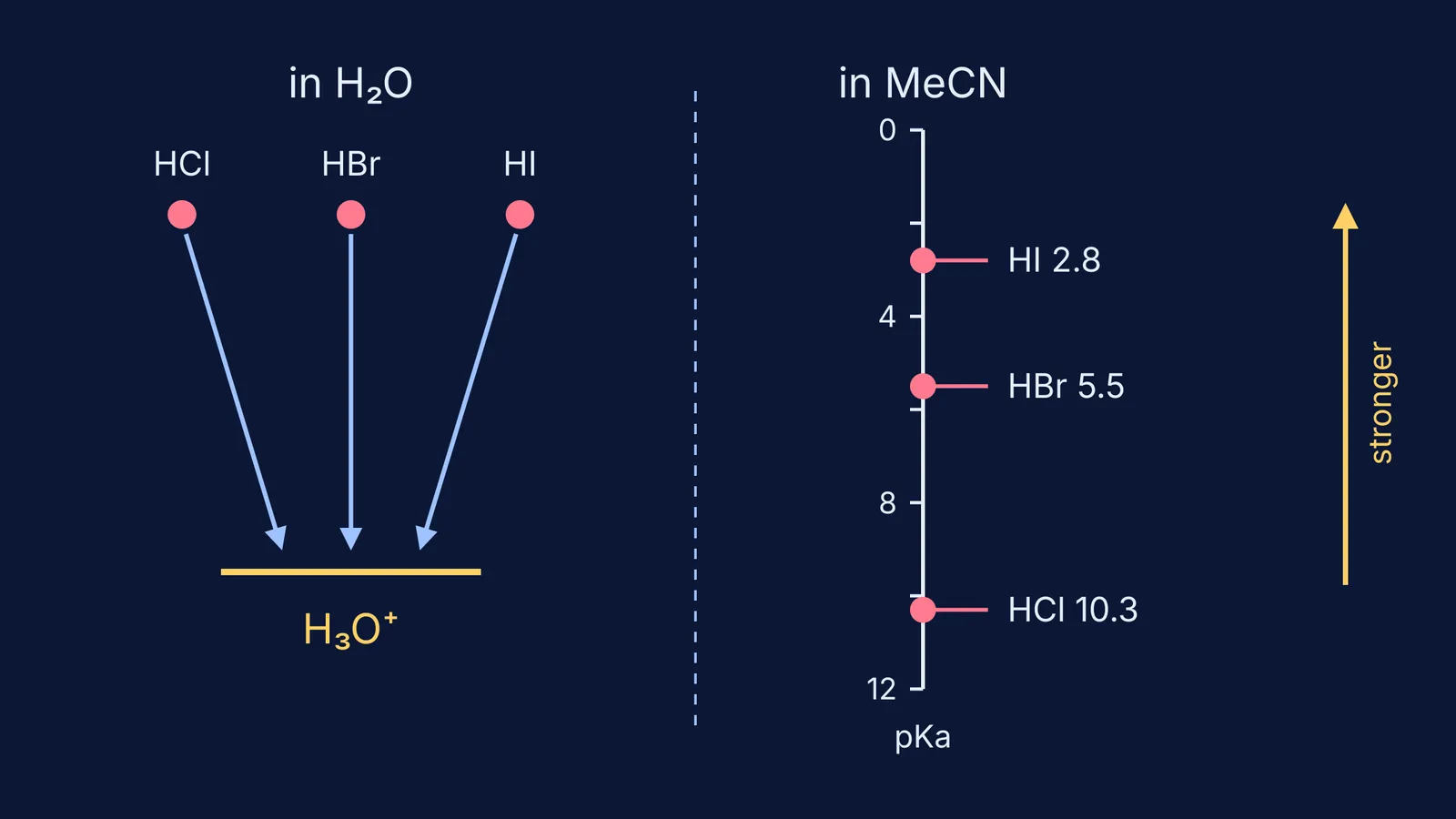
HCl, HBr, HI and HClO4 are all better proton donors than H3O+. So each one reacts with water almost completely:
HCl + H2O → H3O+ + Cl−
HBr + H2O → H3O+ + Br−
HClO4 + H2O → H3O+ + ClO4−
Afterwards the acid in every beaker is the same particle, H3O+. Harvey notes that HCl and HNO3 are levelled to the strength of H3O+ this way, and may not behave as strong acids in a different solvent.
A quick check: in 0.1 M HCl, HBr or HClO4, complete ionisation gives [H3O+] = 0.1 M, so pH = −log(0.1) = 1 for all three. A pH meter cannot tell them apart. To see what happens when you add water, read how the pH of a strong acid changes on dilution.
Why can't water rank HCl, HBr and HClO4?
Think of water as a scale that tops out at a fixed load. Water is basic enough to pull the proton off every one of these acids, so all of them read "maximum".
This is also why the pKa values of strong acids in water are hard to pin down: almost no un-ionised acid is left to measure. A 2016 analysis of HCl, HBr, HI, HClO4 and triflic acid by Trummal and colleagues in The Journal of Physical Chemistry A found that, in some cases, the accepted pKa values had to be revised by more than 10 orders of magnitude. So treat any negative pKa quoted for HClO4 in water as an estimate.
Which solvent shows the real order of strong acids?
To rank them, you need a solvent that is a weaker base than water, so the acids ionise only partly. Acetonitrile (CH3CN, or MeCN) and anhydrous acetic acid are common choices.
In acetonitrile, measured pKa values are 10.30 for HCl, 5.5 for HBr and 2.8 for HI, from Raamat and colleagues in the Journal of Physical Organic Chemistry, as listed in the University of Tartu pKa table. The group's acetonitrile scale of 231 acids runs from hydrogen iodide at pKa 2.8 to indole at 32.57, reported by Kütt and colleagues in the European Journal of Organic Chemistry.
A classic comparison for perchloric acid uses anhydrous acetic acid, where HCl and HClO4 are only partly dissociated and perchloric acid is about 5000 times stronger than hydrochloric acid (Skoog and colleagues' Fundamentals of Analytical Chemistry, as cited in the Wikipedia article on the levelling effect).
The reasons behind the order are covered in why HF is weak but HI is strong and why HClO4 is the strongest chlorine oxoacid.
How do you turn pKa values into "times stronger"?
A difference of 1 pKa unit means a factor of 10 in Ka. So the ratio of two acids' Ka values is 10 raised to their pKa difference. Here is a worked example with the acetonitrile values from the Tartu pKa table.
HBr vs HCl: 10.3 − 5.5 = 4.8, and 10^4.8 ≈ 63,000. HBr is about 63,000 times stronger than HCl in acetonitrile.
HI vs HBr: 5.5 − 2.8 = 2.7, and 10^2.7 ≈ 500. HI is about 500 times stronger than HBr.
HI vs HCl: 10.3 − 2.8 = 7.5, and 10^7.5 ≈ 3 × 10^7.
In water, the same three acids give the same pH at equal concentration. A factor of tens of millions shrinking to one is the levelling effect in a line.
One caution: compare pKa values only within one solvent. Values in acetonitrile and in water sit on different scales.
How to answer levelling-effect questions in exams
Use this four-step check for JEE and board questions:
Name the solvent and its protonated form: H3O+ in water, CH3COOH2+ in acetic acid.
Is each acid a better proton donor than that form? If yes, it is levelled.
If all are levelled (HCl, HBr, HClO4 in water), answer "equal strength in this solvent".
In a less basic solvent, rank by pKa if given, or by the reasons above.
Bases work the same way: in water, any base stronger than OH− is levelled to OH−.
If "conjugate acid" still feels shaky, the Fermi Concept Library gives each chemistry concept its own lesson. For practice, the Fermi Problem Library has a step-by-step solver that explains the reasoning rather than printing an answer.


