

On this page
Fluorine is the most electronegative element, at 3.98 on the Pauling scale against 2.66 for iodine, according to the Pauling values listed on Wikipedia. So most students expect HF to be the strongest acid of the four hydrogen halides. In water it is the weakest. Here is why, with numbers for a board or JEE answer, plus a twist: the weakest acid boils highest.
Why is HF a weak acid but HI a strong acid?
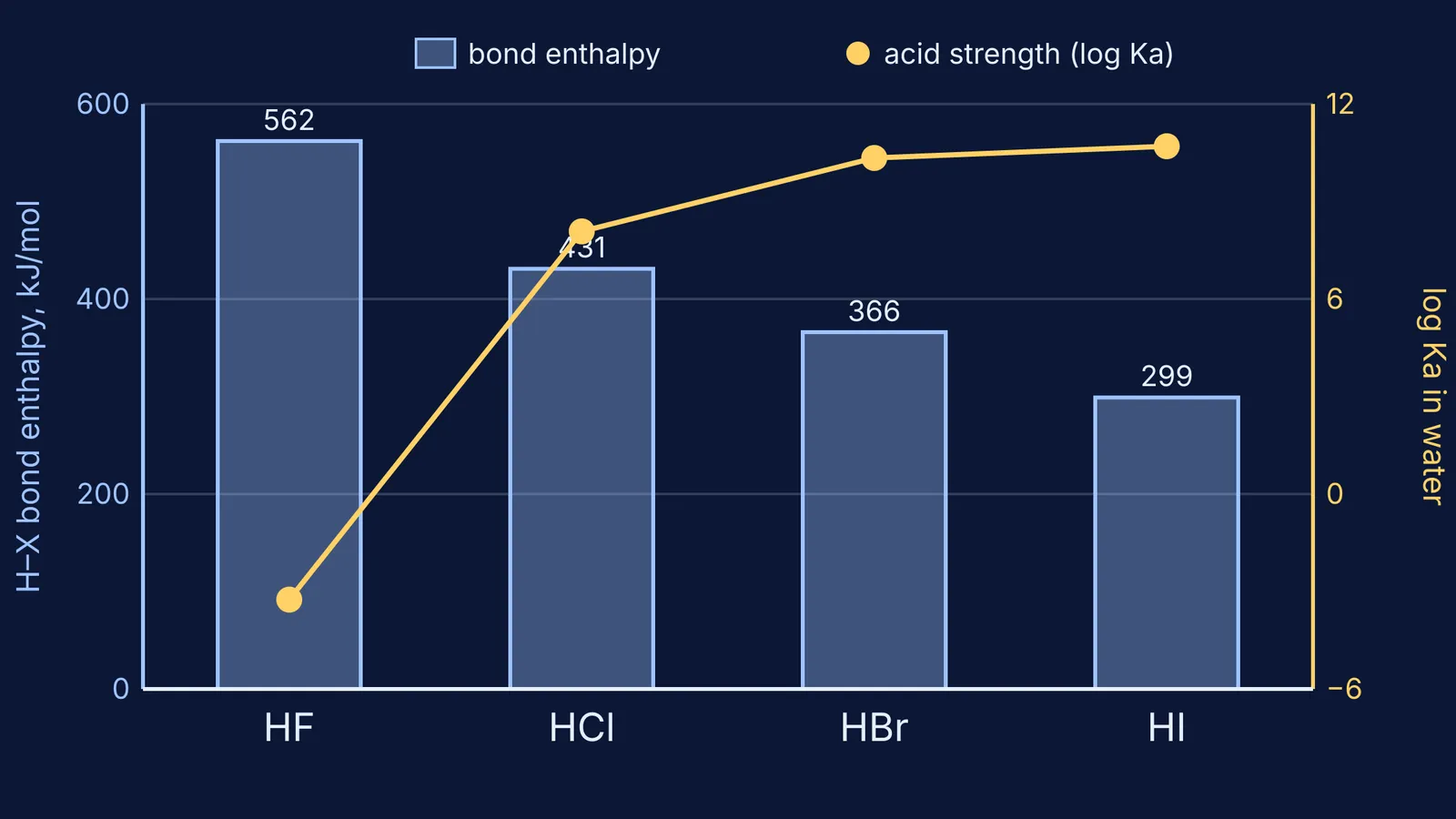
An acid is strong in water when almost every HX molecule hands its proton to water. LibreTexts' page on the acidity of the hydrogen halides gives an experimental Ka of 5.6 × 10⁻⁴ for HF, and estimated values of 1.2 × 10⁸ for HCl, 2.2 × 10¹⁰ for HBr and 5.0 × 10¹⁰ for HI. On those numbers, HI's Ka is roughly 10¹⁴ times larger than HF's.
The usual first explanation is bond strength. The same LibreTexts page lists bond enthalpies of 562 kJ/mol for H–F, 431 for H–Cl, 366 for H–Br and 299 for H–I. As the halogen atom gets bigger, the bond gets longer and weaker, and acid strength rises in the same order: HF < HCl < HBr < HI.
But for HF, LibreTexts says the strong-bond explanation "does not hold". Its energy cycle, below, shows the bond cost is mostly paid back; entropy and hydrogen bonding with water keep HF weak.
Why doesn't electronegativity decide acid strength here?
Electronegativity tells you how polar the H–F bond is, not how much energy it takes to break it. Across a period (CH₄ to HF) electronegativity is the useful guide; down a group, size and bond strength take over. You will see the same pattern in acidic strength of H2O, H2S, H2Se and H2Te.
What does the energy cycle for HF and HCl actually show?
Here is a worked comparison using the numbers from the LibreTexts energy cycle, all in kJ/mol at 298 K.
Breaking the bond: +562 for HF, +431 for HCl. HF starts 131 kJ/mol behind.
Hydrating the halide ion: −506 for F⁻, −364 for Cl⁻. The tiny fluoride ion wins back 142 kJ/mol.
Electron affinity: −328 for F, −349 for Cl. So those three steps sum to −272 for HF and −282 for HCl, almost a tie.
The full cycle, which also includes pulling dissolved HF out of its strong hydrogen bonds with water, gives ΔH = −13 for HF and −59 for HCl.
Entropy: TΔS = −29 for HF and −13 for HCl, because small F⁻ ions order the water around them.
ΔG = ΔH − TΔS gives +16 for HF and −46 for HCl.
A positive ΔG means K is less than 1. Check it yourself: K = e^(−ΔG/RT) = e^(−16000 / (8.314 × 298)) ≈ 1.6 × 10⁻³, which is the estimated Ka LibreTexts gives for HF, about three times the measured 5.6 × 10⁻⁴. So the strong H–F bond is real, but fluoride's hydration pays most of it back. Hydrogen bonding to water and the entropy cost tip HF into weak-acid territory.
If bond enthalpy, hydration or Gibbs energy is shaky, the Fermi Concept Library gives each concept its own lesson and its place in the map.
Why does HF boil at a higher temperature than HCl, HBr and HI?
Boiling point depends on forces between molecules, not on the H–X bond inside each one. Wikipedia's hydrogen fluoride article says HF does not boil until about 20 °C, and its infobox data for the others are −85.05 °C for HCl, −66.8 °C for HBr and −35.36 °C for HI.
From HCl to HI the boiling point rises because bigger, more polarisable electron clouds give stronger dispersion forces. HF breaks the trend because it alone forms hydrogen bonds: the hydrogen halide overview notes that HF is the only one of the series with hydrogen bonding between molecules. For the full picture, read why HF is a liquid but HCl is a gas at room temperature and the hydride boiling point graph where H2O, NH3 and HF break the trend.
How should you write this in an exam?
Use this five-line checklist for any hydrogen halide question:
Acid strength in water: HF < HCl < HBr < HI.
Trend down the group: H–X bond enthalpy falls from 562 to 299 kJ/mol, so the proton is released more easily.
Name the trap: electronegativity predicts the reverse order, and it is wrong down a group.
For a longer answer on HF: fluoride's hydration repays most of the bond cost, so add the entropy cost of ordering water around small F⁻ and HF's hydrogen bonding with water.
Boiling point: HCl < HBr < HI < HF, with HF high because of intermolecular hydrogen bonding.
Then test yourself. The Fermi Problem Library has worked problems with a step-by-step solver that explains the reasoning rather than printing an answer, which helps when you got the order right but the reason wrong.


