

On this page
Ajinomoto, the white crystals in many Indo-Chinese kitchens, is monosodium glutamate (MSG). Whether it is harmful often comes up when noodles or manchurian are on the table.
What is MSG, chemically?
The US Food and Drug Administration defines MSG as "the sodium salt of the common amino acid glutamic acid" (FDA). In water it splits into a sodium ion and a glutamate ion, and the glutamate is what you taste.
In 1908 the chemist Kikunae Ikeda traced the savoury taste of kombu (kelp) broth to glutamic acid, and in 1909 the seasoning went on sale as AJI-NO-MOTO (Ajinomoto Group history). He wrote: "I propose to call this taste 'UMAMI' for convenience" (Ikeda, translated in Chemical Senses).
A 2002 study in Nature identified an amino-acid taste receptor, T1R1+3, "a heteromer of the taste-specific T1R1 and T1R3 G-protein-coupled receptors" that responds to most standard L-amino acids but not their D-enantiomers (Nelson et al., Nature).
If enantiomers or amino acids feel hazy, the Fermi Concept Library has a lesson for every concept in chemistry and biology.
Where does glutamate occur naturally?
FDA notes that MSG "occurs naturally in many foods, such as tomatoes and cheeses", which contain free glutamate (FDA). Tomatoes contain about 246 mg of naturally occurring glutamate per 100 g (Umami Information Center, tomato). Parmigiano-Reggiano aged 24 months contains about 1,680 mg per 100 g, because ageing breaks milk protein into free amino acids (Umami Information Center, cheese).
FDA estimates that an average adult takes in about 13 grams of glutamate a day from protein in food, against about 0.55 grams a day of added MSG (FDA).
Is MSG harmful, according to safety reviews?
FDA considers adding MSG to foods "generally recognized as safe" (FDA). A 1990s review by the scientific group FASEB, done for FDA, concluded MSG is safe, while noting "short-term, transient, and generally mild symptoms" such as headache or flushing in some sensitive people who consume 3 grams or more without food. A typical serving with added MSG contains less than 0.5 grams, FDA says.
The fear dates to a 1968 letter in the New England Journal of Medicine titled "Chinese-Restaurant Syndrome" (NEJM). In a later double-blind trial of 130 people who believed they reacted to MSG, more reacted to 5 g taken without food than to a placebo, but "neither persistent nor serious effects" were seen and responses were not consistent on retesting (Geha et al., Journal of Allergy and Clinical Immunology, 2000).
In 2017 the European Food Safety Authority set a group acceptable daily intake of 30 mg per kg of body weight per day for added glutamates, expressed as glutamic acid (EFSA Journal). EFSA also noted that for some population groups, intake exceeded this limit and even doses linked to adverse effects in people, so "safe" means safe at ordinary amounts, not by the spoonful.
How much glutamate is on your plate?
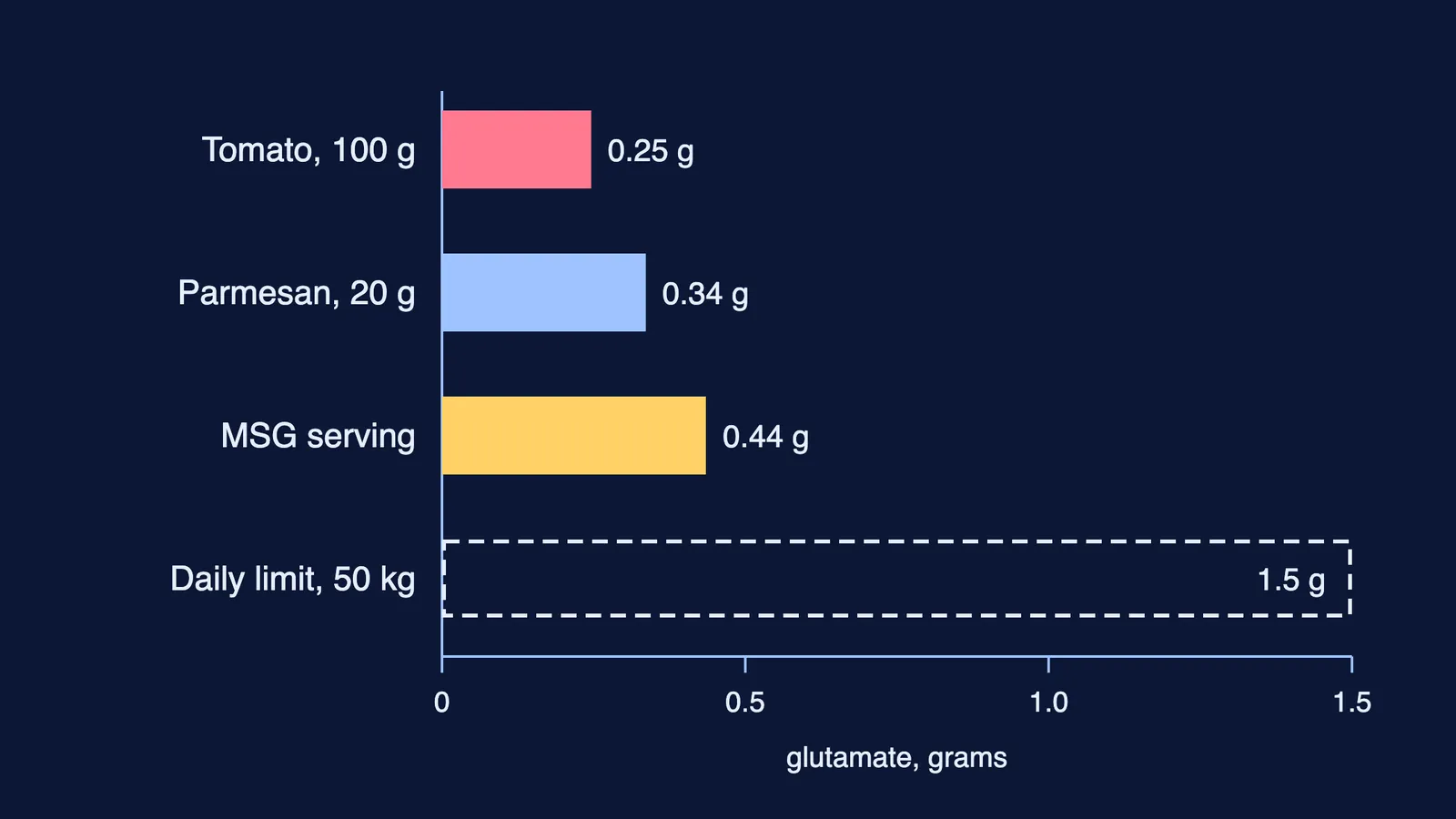
Take a 50 kg student and the figures from FDA, EFSA and the Umami Information Center.
Glutamic acid, C5H9NO4, is 147.1 g/mol; dry MSG, C5H8NO4Na, is 169.1 g/mol. So 1 g of MSG carries 147.1 ÷ 169.1 = 0.87 g of glutamic acid. Water in the crystals only lowers this.
EFSA limit: 30 mg × 50 kg = 1,500 mg, or 1.5 g a day.
One serving with added MSG: under 0.5 g × 0.87 = 0.44 g.
100 g of tomato gives 0.25 g of natural glutamate; 20 g of grated 24-month Parmesan gives 0.34 g. EFSA's limit covers added glutamates, not these.
Hitting the limit from added MSG alone takes about 1.5 ÷ 0.44 = 3.4 servings at the top of FDA's typical range, every day.
Sodium is the other number worth knowing: it is 23.0 ÷ 169.1 = 13.6% of MSG but 23.0 ÷ 58.4 = 39.3% of table salt. A pinch of MSG adds about a third of the sodium of the same pinch of salt.
To practise mass-fraction sums like these, the Fermi Problem Library has worked problems with a step-by-step solver that explains the reasoning rather than printing an answer.
What should you do about MSG at home?
Read the ingredient list for monosodium glutamate or the number 621 (EFSA lists it as E 621). Our guide to reading a nutrition label in India, line by line covers the rest of the packet.
Judge the whole dish. Instant noodles and ready gravies often bring salt, oil and heavy processing along with MSG; here is how to spot ultra-processed food on the packet.
Build savoury flavour other ways too: ripe tomatoes, a little aged cheese, and the Maillard reaction that turns roti and toast brown.
If you think you react to MSG, note what you ate and whether your stomach was empty, and talk to a doctor. For babies and anyone with a diagnosed condition, follow your doctor's advice.


