On this page
Turn over any packet of biscuits or namkeen. The front is marketing; the back panel, set in India by the Food Safety and Standards (Labelling and Display) Regulations, 2020, tells you what is inside.
What must an Indian nutrition label show?
Under regulation 5(3) of the FSSAI labelling regulations, a packaged food must give nutrition information per 100 g or 100 ml (or per single-consumption pack), plus the per-serve percentage contribution to the Recommended Dietary Allowance. The panel must list:
energy (kcal)
protein, carbohydrate, total sugars and added sugars (g)
total fat, saturated fat, trans fat (g) and cholesterol (mg)
sodium (mg)
Saturated and trans fat need only be given when total fat is above 0.5%, and cholesterol only when the food also contains fat of animal origin. The same regulation requires the serving size in grams or millilitres and the number of servings in the pack. Unprocessed single-ingredient foods, plain tea and coffee, salt, herbs and spices are among the products exempt from the panel altogether.
How do you read serving size and per 100 g?
Per 100 g is for comparing products: two brands of muesli become comparable whatever their pack size. Per serve tells you what you actually eat, but only if you eat what the maker calls a serving.
The FSSAI regulations define a serving as "an amount of food customarily consumed per eating occasion or as defined on the label", so the maker picks it. Always check the number of servings in the pack. If a 120 g pack says four servings and you finish it in one sitting, multiply everything in the per-serve column by four.
What do the % figures on the label mean?
The % column compares one serving with a daily reference for an average adult. FSSAI sets that reference at 2,000 kcal energy, 67 g total fat, 22 g saturated fat, 2 g trans fat, 50 g added sugar and 2,000 mg sodium (5 g salt) in its labelling regulations. So 12% next to added sugar means one serving gives 12% of 50 g, which is 6 g.
These are adult numbers: for children aged 2 to 15, the WHO sodium fact sheet recommends adjusting the adult limit downward based on their energy needs. At 4 kcal per gram, the 50 g sugar reference is 200 kcal, or 10% of 2,000 kcal, in line with WHO advice to keep free sugars (which include added sugars) below 10% of energy. The WHO sugars guideline adds that going below 5%, roughly 25 g or 6 teaspoons a day, would bring further benefits.
How do you spot added sugar and sodium?
Read the added sugars line, not just total sugars. In the FSSAI definitions, sugars means all monosaccharides and disaccharides, including lactose, while added sugars are the ones added to foods and beverages. If monosaccharides and disaccharides are hazy from Class 11 biology, the Fermi Concept Library has every concept in physics, chemistry, biology, mathematics and computing, each with its own lesson.
Sodium is listed in milligrams, but advice is usually given in grams of salt. According to the WHO, 1 g of salt is equivalent to 400 mg of sodium, so multiply sodium by 2.5 to get salt. WHO recommends adults have less than 2,000 mg of sodium a day, which is less than 5 g of salt, or just under a teaspoon.
Why does the ingredient order matter?
The FSSAI regulations require ingredients to be "listed in descending order of their composition by weight or volume" at the time of manufacture. The first ingredient is what the product is mostly made of. If sugar or refined wheat flour (maida) comes before oats in an oats cookie, the cookie has more sugar or maida than oats.
Sugar also hides under other names. ICMR-NIN's 2024 Dietary Guidelines for Indians warned that sugar-free foods may be loaded with fats, refined cereals and hidden sugars such as maltitol, fructose, corn syrup or molasses, Down To Earth reported.
A worked example: one pack of biscuits
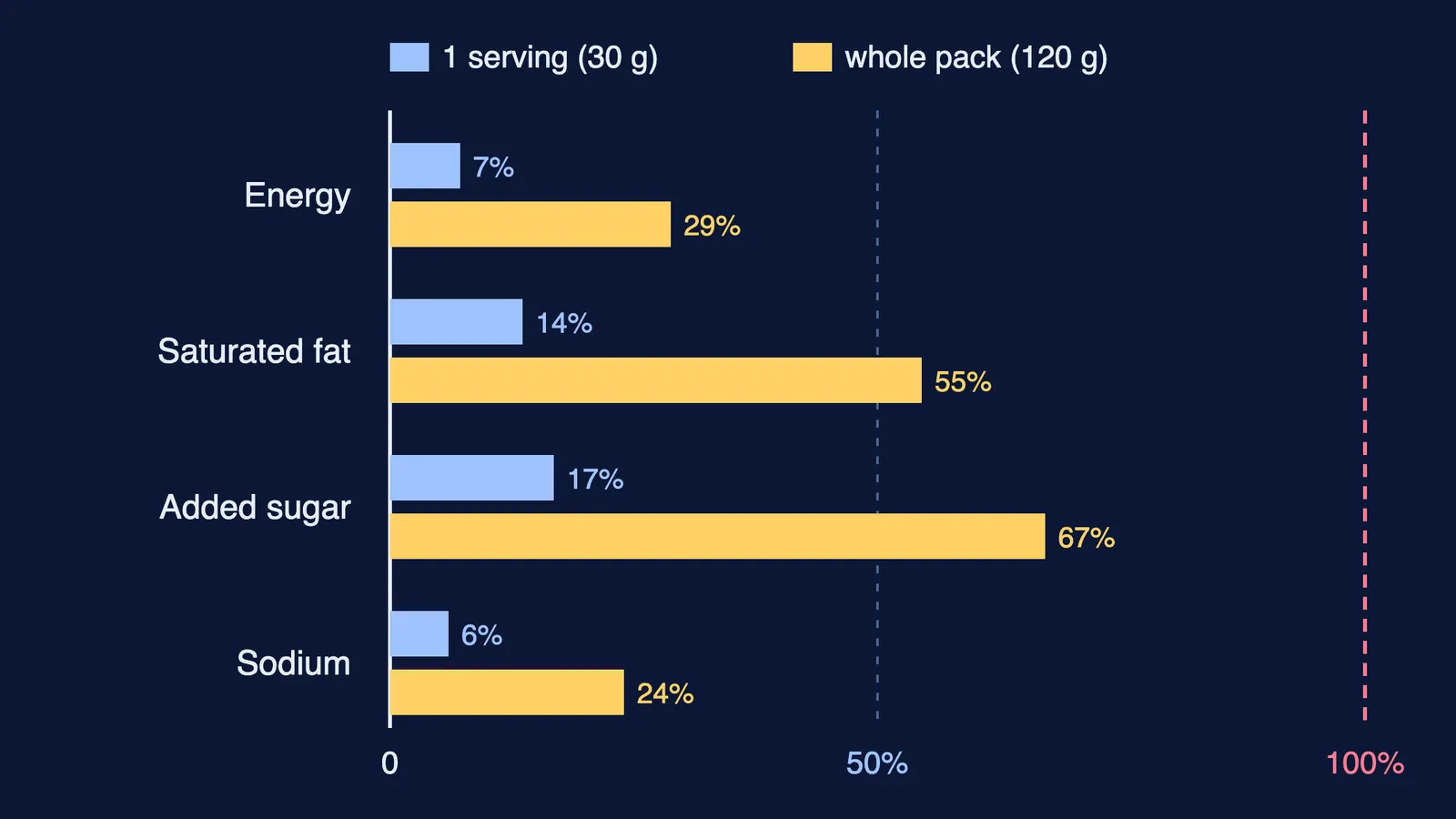
Here is an illustrative label (not a real brand) for a 120 g pack, read against the FSSAI reference values:
Per 100 g: 480 kcal, 28 g added sugar, 10 g saturated fat, 400 mg sodium
Serving size: 30 g; servings per pack: 4
For one 30 g serving, multiply each per 100 g figure by 0.3:
Energy: 144 kcal, 7% of 2,000 kcal.
Added sugar: 8.4 g, 17% of 50 g.
Saturated fat: 3 g, 14% of 22 g.
Sodium: 120 mg (about 0.3 g of salt), 6% of 2,000 mg.
Now the whole pack, easy to finish in one long study session: 576 kcal (29%), 33.6 g of added sugar (67%, and more than the 25 g the WHO sugars guideline links to extra benefit), 12 g of saturated fat (55%) and 480 mg of sodium (24%). Same label, very different picture.
If you or your child has diabetes, high blood pressure or another condition, ask a doctor or registered dietitian what your own limits should be.