

On this page
Put a slice of bread on a hot tawa and in two minutes it turns golden and smells wonderful. Drop the same slice into boiling water and it never browns. The difference is one chemical reaction, and you can see it on every tawa at home.
What is the Maillard reaction?
The Maillard reaction is a chemical reaction between amino acids and reducing sugars that produces a brown colour and new flavours (Tamanna and Mahmood, 2015). It is named after the French chemist Louis Camille Maillard, whose 1912 paper described amino acids reacting with sugars (Martins, Jongen and van Boekel, 200000022-X)). Food scientists call it non-enzymatic browning, because no enzyme is involved.
In plain terms, a sugar such as glucose meets the amino group (–NH2) of an amino acid or protein. The two join, rearrange, break apart and recombine into many small molecules, which carry the smells of toast, roasted coffee and browned onions. The last stage builds large, strongly coloured pigments called melanoidins (Tamanna and Mahmood, 2015).
Why do roti, toast and fried onions turn brown?
Three conditions decide whether food browns: heat, a dry surface and the right pH.
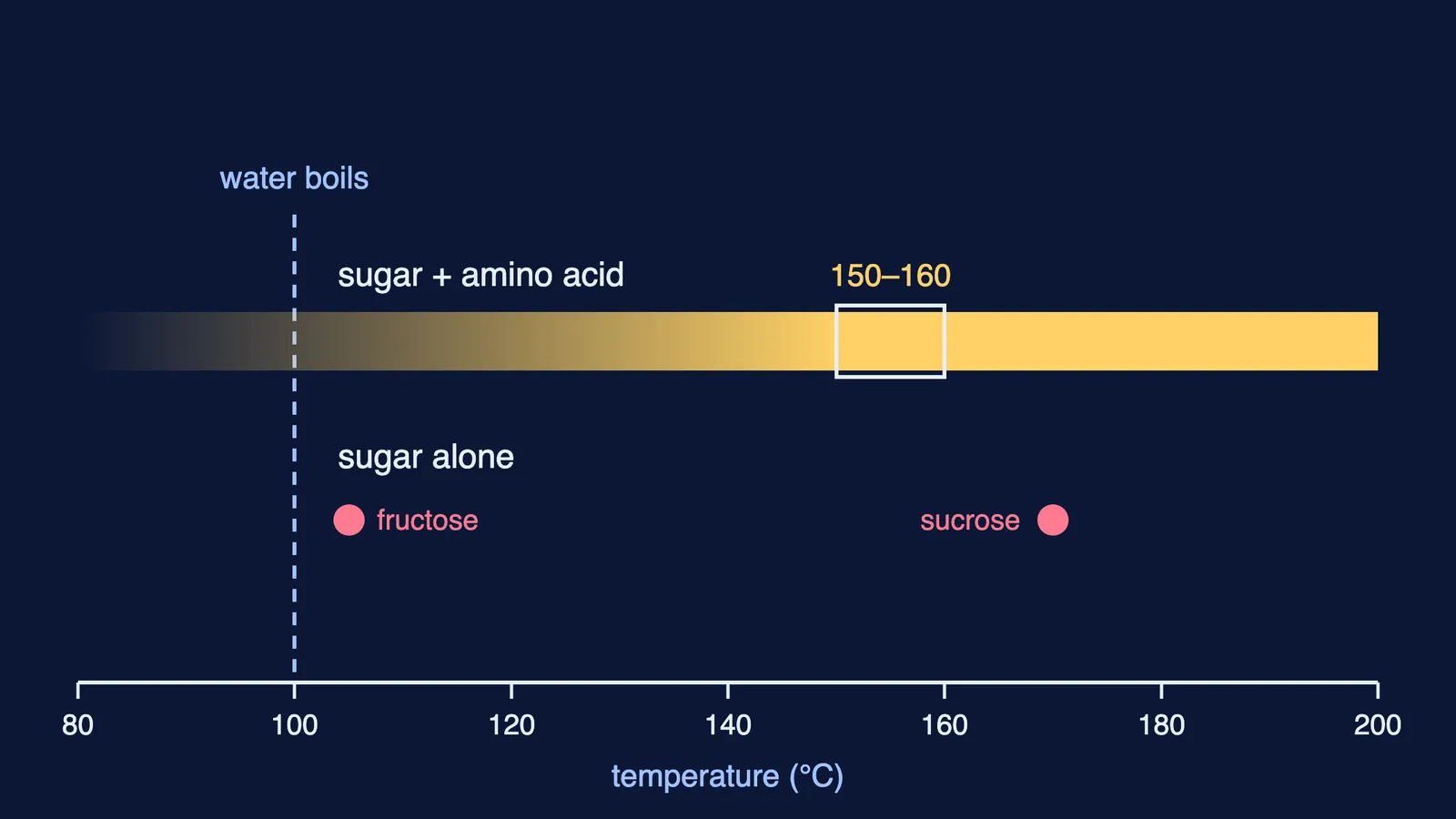
Heat. The American Society of Baking gives a typical reaction range of 150–160 °C for baked goods and notes that browning still happens at lower temperatures, only more slowly (American Society of Baking).
Dryness. The same source says the reaction is fastest at a water activity of 0.60–0.80 and slows at 0.95 or higher (American Society of Baking). A wet surface also cannot get much hotter than water's boiling point of about 100 °C, so boiled and steamed food stays pale.
pH. It puts optimal browning at pH 6–8, with alkaline conditions favouring the reaction (American Society of Baking).
Now apply that to your kitchen:
Roti on a tawa. Wheat dough has protein and a little sugar. The patches pressed against the hot tawa dry out first, get past 100 °C and brown, while the puffed parts full of steam stay pale. For why a tandoor gets there faster, read how a tandoor cooks rotis so fast.
Toast. A toaster aims dry heat at the surface, which loses its water quickly, so the outside browns while the inside stays soft.
Fried onions. Onions contain sugars and some protein. In hot oil the water hisses off first, and only as the slices dry do they turn golden, then brown.
Heat also unfolds proteins, a separate change explained in denaturation of proteins.
How is the Maillard reaction different from caramelisation?
Caramelisation is what happens when sugars are heated with no amino groups involved (Woo et al., 2015). The Maillard reaction needs both a sugar and an amino acid or protein. Caramel gets its buttery flavour from compounds such as diacetyl (Caramelization, Wikipedia), while Maillard browning gives the roasted smell of toast and coffee.
Caramelising table sugar also takes more heat than typical baking browning. A table on Wikipedia, citing Harold McGee's book On Food and Cooking, puts the start at about 170 °C for table sugar (sucrose) and about 105 °C for fructose (Caramelization, Wikipedia). For a related puzzle, see why jaggery is brown and sugar is white.
A kitchen experiment you can try tonight
Take two slices of the same bread. Toast one dry on a tawa over medium heat for two minutes. Put the other in a covered pan with two spoons of water over the same heat for the same time.
Compare colour and smell. The dry slice browns. The steamed slice stays pale, because its wet surface stays near the boiling point of water.
Heat one spoon of plain sugar in a dry steel pan on low heat. It melts, then darkens to amber with no protein in the pan: that is caramelisation. Let an adult handle this step, because molten sugar is far hotter than boiling water and sticks to skin.
Write one line for each test: what was in the pan, was it wet or dry, and did it brown?
If amino acids or reducing sugars feel shaky when you revise, the Fermi Concept Library gives every concept in chemistry and biology its own lesson and its place in the map, so you can fill the gap first.
Does browning food form acrylamide?
According to the US FDA, acrylamide forms from sugars and the amino acid asparagine during high-temperature cooking such as frying, roasting and baking, and boiling and steaming do not typically form it (US FDA). A 2002 study in Nature showed that acrylamide is formed in the Maillard reaction (Mottram, Wedzicha and Dodson, 2002). The FDA says acrylamide is more likely to build up with longer cooking or higher temperatures, and its answer to whether you should stop eating fried, roasted or baked foods is "No", followed by advice to follow an overall healthy eating plan (US FDA). Questions about your own diet are for a doctor or registered dietitian.
Next time you flip a roti, watch which spots brown first: that is chemistry you can see.


