On this page
Boil an egg and the clear white turns opaque and firm. Squeeze lemon into hot milk and it splits into paneer and whey. Both kitchen tricks are the same idea from your Class 12 biomolecules chapter: denaturation. The protein chain is still there, but the shape that made it work is gone.
What is denaturation of proteins?
Denaturation is a change in a protein's shape, caused by heat, pH or chemicals, that happens without any change in its amino acid sequence, as OpenStax Biology 2e puts it.
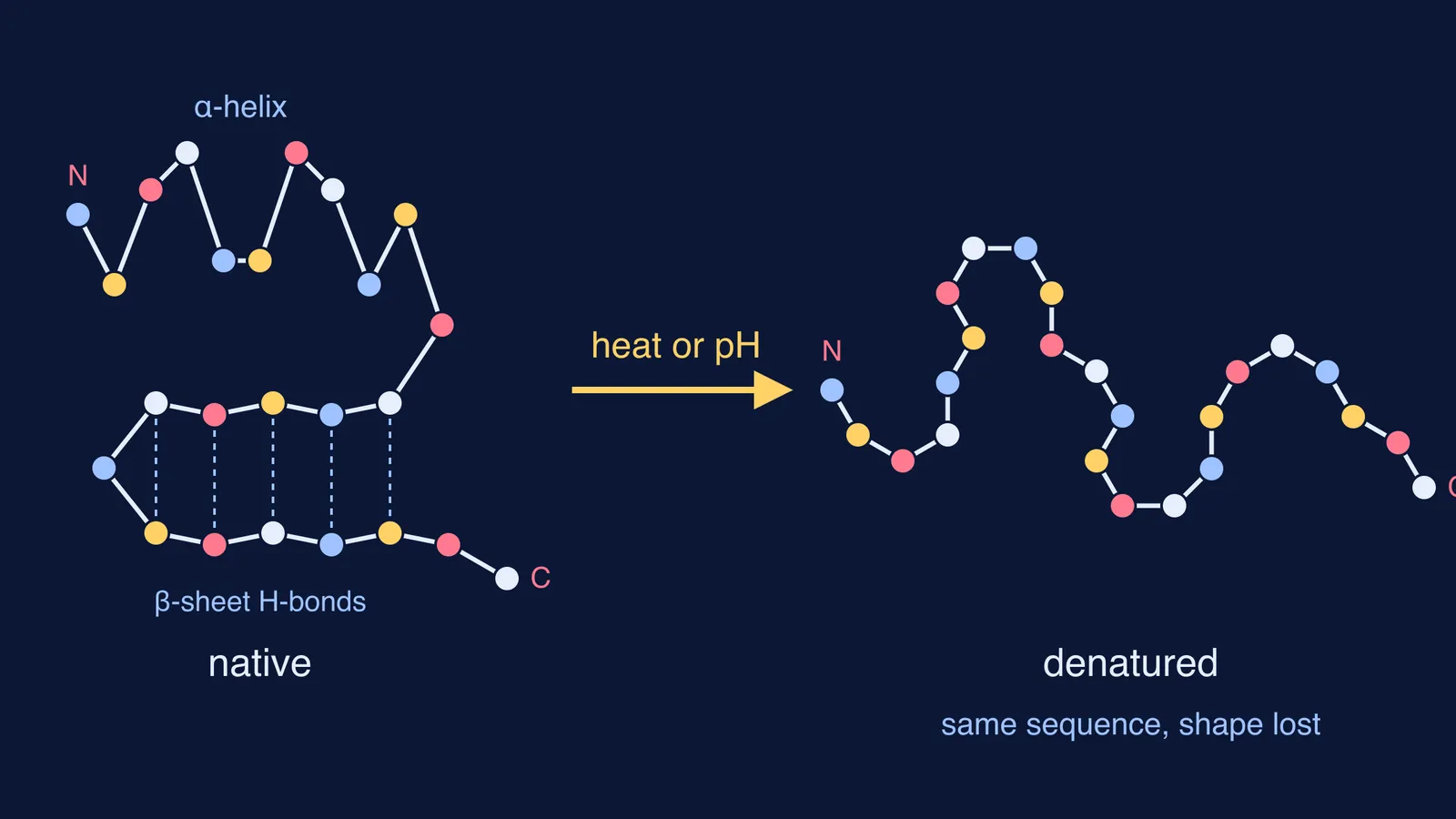
To see why the sequence survives, look at what holds each level of structure together, using the same OpenStax chapter:
Primary structure is the order of amino acids, joined by covalent peptide bonds. (Why that bond is so rigid is explained in why the peptide bond is planar.)
Secondary structure is the α-helix and β-pleated sheet, both held in shape by hydrogen bonds between backbone C=O and N–H groups.
Tertiary structure is the overall 3D fold, held by interactions between R groups: ionic bonds, hydrophobic clustering, hydrogen bonds and disulphide links. Disulphide links are the only covalent bonds formed during folding; see the role of disulphide bonds in protein structure.
Heat and pH change attack the weak, non-covalent forces. So the helices uncoil and the fold opens up, while the peptide bonds stay put.
Why does a boiled egg turn white and solid?
Egg-white proteins start out folded into compact globules, and each unfolds at its own temperature. In a 2021 study using differential scanning calorimetry on raw egg white, Koyama, Tsujii and Handa found denaturation peaks at 65.7 °C for ovotransferrin and 78.9 °C for ovalbumin, the main egg-white protein.
Once a protein unfolds, the hydrophobic parts that were tucked inside are exposed. Neighbouring chains stick to each other and form a tangled network that traps water, which is why the white sets into a gel instead of running. The longer story of colour and texture is in why egg white turns white and solid when you boil it.
This change is not reversible. OpenStax gives frying an egg as its example of irreversible denaturation, and boiling works the same way: cooling a boiled egg does not make the white runny again.
Why does milk curdle when you add lemon juice?
Here pH, not heat, does the work. Milk has a pH of about 6.6, and at that pH casein micelles carry a net negative charge and stay stable and dispersed, according to the Virtual Labs page on casein.
The isoelectric point of casein is about pH 4.6, and a protein is generally least soluble at its isoelectric point, says the same Virtual Labs page. Acid from lemon juice or vinegar protonates the phosphate groups on the micelle surface, cancels the negative charge, and the neutral protein clumps and drops out as curd. That is how paneer is made at home.
Does denaturation break the primary structure?
No, and a famous experiment shows it. In 1961 Christian Anfinsen showed that the enzyme ribonuclease, after being denatured, could fold back into its active shape, as summarised in his biography. That suggested the amino acid sequence holds all the information needed for the final shape. He later described this work in his 1973 Science paper, Principles that govern the folding of protein chains, and shared the 1972 Nobel Prize in Chemistry for work on the link between sequence and active shape.
If the sequence had been destroyed, refolding would be impossible. That is the logic behind the textbook line “primary structure remains intact”.
How to write a full-marks answer on denaturation
Use this four-step check for any “explain in terms of structure” question:
Name the agent: heat, change in pH, or a chemical.
Name the bonds it breaks: hydrogen bonds, ionic interactions, hydrophobic interactions.
Name the levels lost: secondary and tertiary (and quaternary, if the protein has several chains).
Name what survives and the result: the primary structure and its peptide bonds; the protein loses its biological activity.
Worked example. *Coagulation of egg white on boiling is an example of denaturation. Explain.*
Model answer: On heating, the hydrogen bonds and other weak interactions that hold the α-helices and the globular fold of egg-white proteins such as ovalbumin break. The chains uncoil and lose their secondary and tertiary structure, then stick together and coagulate. The peptide bonds are not broken, so the primary structure stays intact, but the protein loses its biological activity. The change is irreversible.
Swap “heating” for “adding acid” and “ovalbumin” for “casein”, and the same frame answers the milk question.
If the levels of protein structure still blur together, the Fermi Concept Library has a lesson for each concept in biology and chemistry, with its place in the map. To practise the “explain” questions, the Fermi Problem Library has worked problems with a step-by-step solver that explains the reasoning rather than printing an answer.
Next time you boil an egg, say the four steps out loud before you peel it.