On this page
Crack an egg into a hot pan and the clear, runny white turns opaque and firm. What changes is the shape of the proteins, and it is the same idea you meet in the Biomolecules unit of Class 12 chemistry.
What is egg white actually made of?
Egg white is mostly water with proteins dissolved in it. A 2006 review in Scientia Agricola reports that hen egg white has 9.7 to 12% protein and describes it as many globular proteins in an aqueous solution (Alleoni, 2006). Ovalbumin makes up about 54% of that protein, ovotransferrin about 13% and lysozyme about 3.5%, according to the same review.
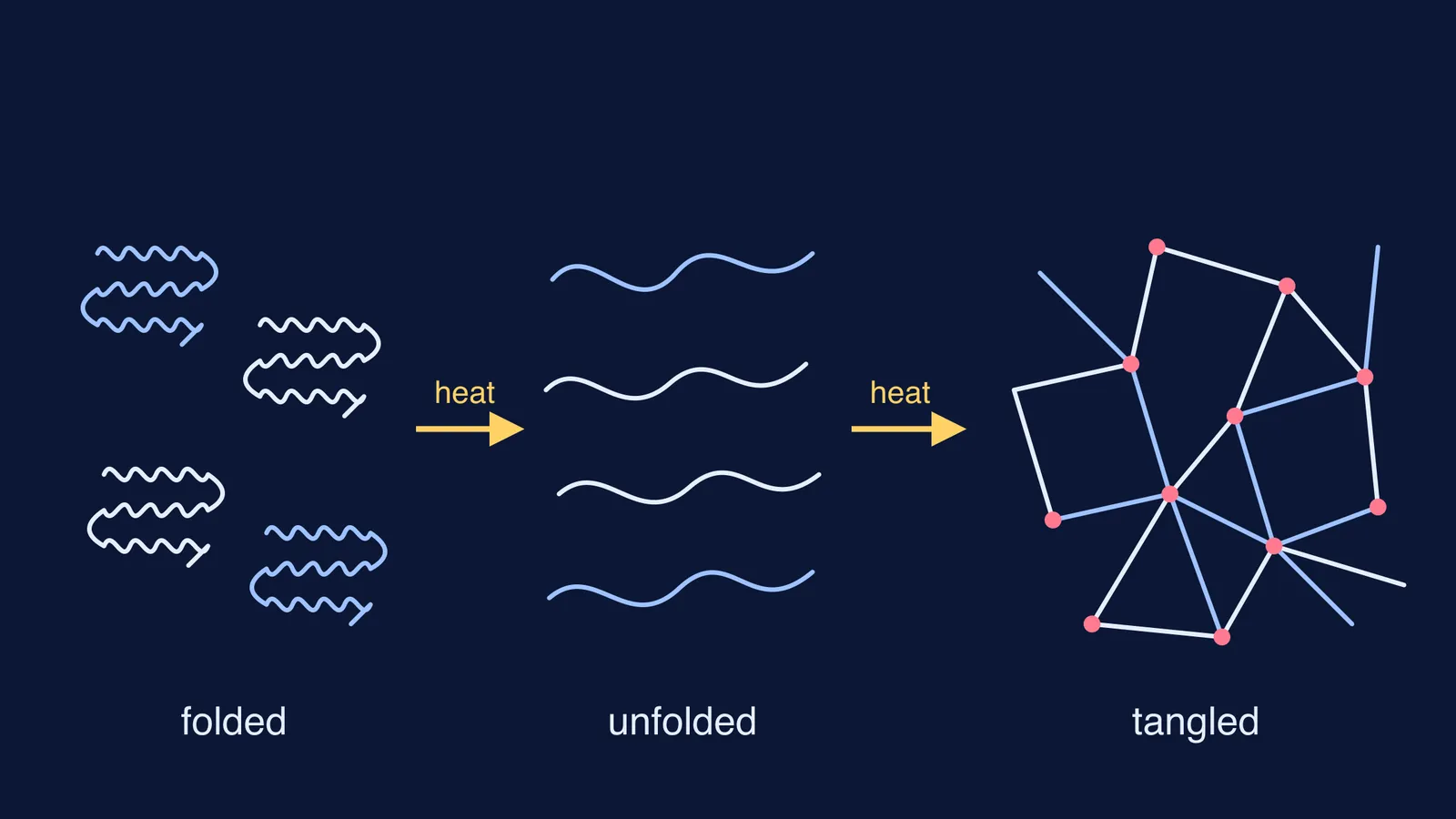
The NCERT textbook says globular proteins form when polypeptide chains "coil around to give a spherical shape", that they are usually soluble in water, and that albumins are a common example (NCERT Chemistry Part II, Unit 10: Biomolecules). Small, separate, tightly folded balls dissolved in water: that is why raw egg white is clear and runny.
What happens to albumin proteins when you boil an egg?
NCERT lists hydrogen bonds, disulphide linkages, van der Waals forces and electrostatic attraction as the main forces that stabilise secondary and tertiary structure (NCERT, Unit 10). Heat disturbs the weakest of these, the hydrogen bonds.
The same NCERT section puts it in one line: when a native protein goes through a change like a change in temperature, "the hydrogen bonds are disturbed. Due to this, globules unfold and helix get uncoiled and protein loses its biological activity." That is denaturation, and NCERT names "the coagulation of egg white on boiling" as a common example.
Unfolding is only step one. Alleoni's review describes heat-set protein gels forming in two steps: first the protein changes shape, then the denatured molecules gradually aggregate into a continuous network (Alleoni, 2006). An unfolded chain exposes parts that were buried inside the ball, including water-avoiding (hydrophobic) patches and sulphur-containing groups. A 2025 study in Gels reports that these exposed hydrophobic regions and thiol-disulphide interactions drive the unfolding and aggregation of the proteins (Wang et al., 2025). Chains from neighbouring proteins stick to each other, tangle, and set into a solid mesh.
Not every egg-white protein gives way at the same temperature. Alleoni's review quotes a denaturation temperature of 57.3 °C for conalbumin, another name for ovotransferrin, though a table in the same review gives 61 °C (Alleoni, 2006). Wang and colleagues measured ovalbumin denaturing at about 80 °C in water. The value dropped to about 77 °C in calcium chloride solution and rose slightly with faster heating (Wang et al., 2025).
Why does clear egg white turn white?
Raw egg white lets light through because the folded proteins are small, separate and evenly spread. A 2008 study in Biomacromolecules made ovalbumin variants carrying different electric charges and found that the cloudiness of their heat-induced aggregate solutions reflected the shape of the aggregates: as the aggregates became stiffer and less branched, the solutions went from turbid to transparent (Weijers et al., 2008). The random, tangled network in boiled egg white is the cloudy kind: it scatters light instead of letting it through, so the white looks white rather than clear.
This also answers NCERT intext question 10.5, "Where does the water present in the egg go after boiling the egg?" (NCERT, Unit 10). It does not boil away. It stays inside the egg, trapped in the new protein network.
Why can't you unboil an egg?
Once the unfolded chains have bonded to their neighbours, there is no easy way back to the original folds. When Wang and colleagues cooled and reheated their samples, lysozyme showed nearly 100% reversibility, but ovalbumin showed no thermal reversibility (Wang et al., 2025). Because ovalbumin is most of the protein in egg white, the set white stays set.
How do you write this answer in a Class 12 exam?
Give the chain of cause and effect, not just the word "denaturation". Use these five steps:
Egg white contains albumin, a globular protein that is soluble in water.
Heat disturbs the hydrogen bonds that hold its secondary and tertiary structure.
The globules unfold and the helices uncoil, so the protein loses its native shape.
The unfolded chains bond to each other and form an insoluble, tangled network that traps the water.
The primary structure, the amino acid sequence, remains intact.
Check that your answer contains these keywords: globular, hydrogen bonds, secondary and tertiary structure, unfold, primary structure intact. Then test yourself on NCERT's second example, the curdling of milk, which the textbook links to lactic acid made by bacteria. Ask what the trigger is there (a change in pH, not temperature) and walk through the same steps.
If the jump from a flat sequence of amino acids to a folded globule is hard to picture, the Fermi Simulation Lab has interactive simulations for ideas that are easier to see than to read. For the rest of the unit, from amino acids to enzymes, the Fermi Concept Library gives each concept its own lesson and shows where it sits in the map.
Next time you peel a boiled egg, you can explain how it set.