

On this page
Disulphide bonds get only a few lines in NCERT, but they explain a lot. The idea is simple: two sulphur atoms from two cysteines join, and a stretch of chain that could flop around is tied down.
What is a disulphide bond in a protein?
Cysteine is the amino acid whose side chain is HS–CH2–, as listed in Table 10.2 of the NCERT Class 12 Chemistry unit on Biomolecules. When the –SH groups of two cysteines are oxidised, they join as –S–S–. That link is a disulphide bond (or disulphide bridge).
The two cysteines can be far apart in the sequence, or on different chains; once bonded, the stretch between them cannot unfold freely. The same NCERT unit says the main forces stabilising the 2° and 3° structures of proteins are hydrogen bonds, disulphide linkages, van der Waals and electrostatic forces of attraction.
The difference that matters: a disulphide bond is covalent, while the others in that list are weaker attractions. LibreTexts' explanation of the permanent wave/Proteins/Case_Studies:_Proteins/Permanent_Hair_Wave) calls disulphide bonds strong covalent links that hold different chains, or loops within one chain, together. It is also a redox bond: a reducing agent breaks it into two –SH groups, and an oxidising agent makes it again.
How do disulphide bonds hold insulin together?
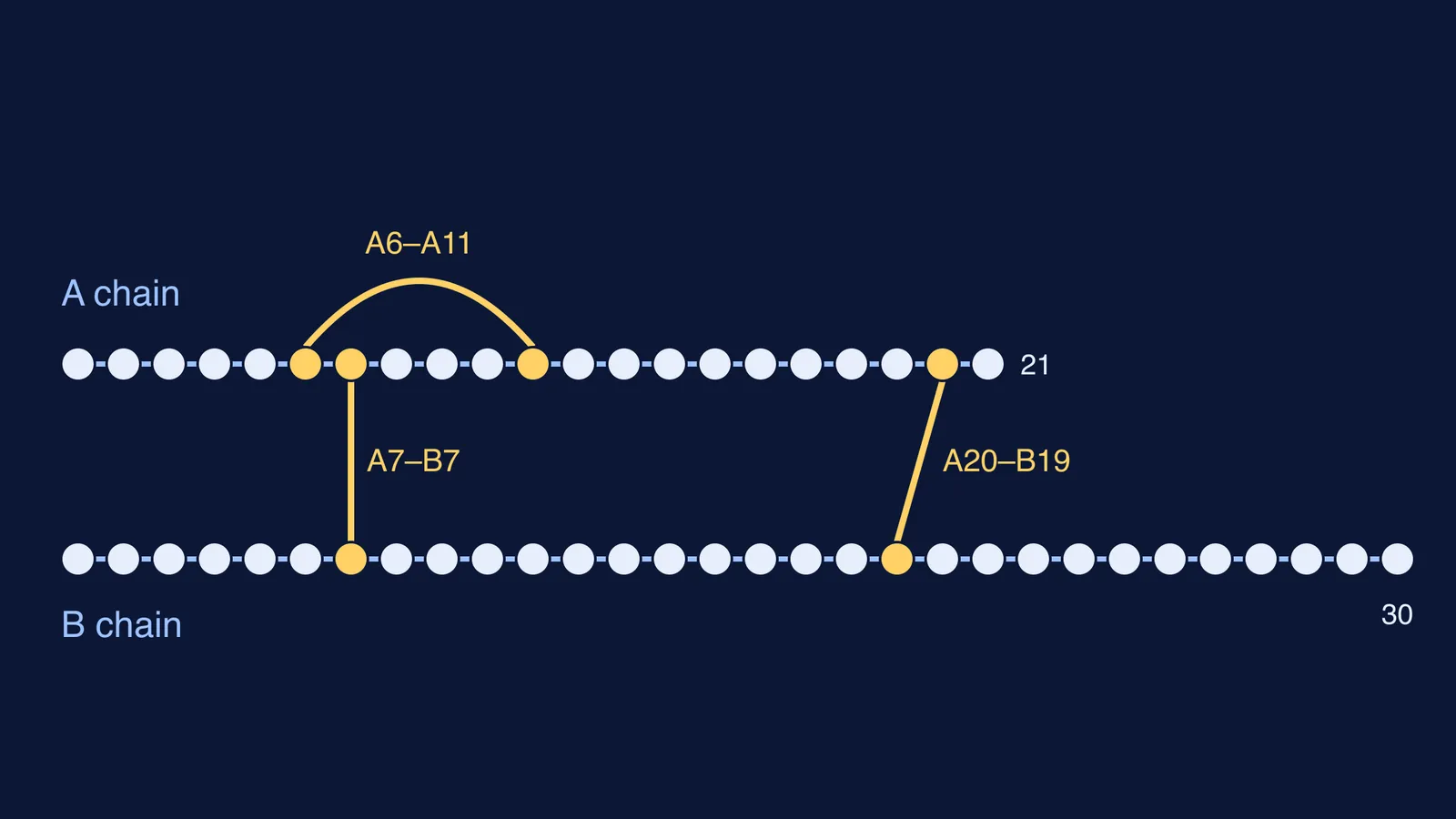
NCERT describes insulin as a protein that contains 51 amino acids (NCERT Biomolecules). Human insulin has an A chain of 21 amino acids and a B chain of 30, held together by two disulphide bonds (CysB7 to CysA7 and CysB19 to CysA20), with a third bond inside the A chain linking CysA6 to CysA11, according to Ward and Lawrence's review in Frontiers in Endocrinology.
The RCSB PDB-101 Molecule of the Month page on insulin puts it plainly: three disulphide bridges between cysteines stabilise this tiny protein.
Why does hair keep its shape, and how does a perm change it?
NCERT says that when polypeptide chains run parallel and are held together by hydrogen and disulphide bonds, a fibre-like structure forms, and names keratin in hair and wool as an example (NCERT Biomolecules).
The keratin filaments in hair are surrounded by keratin-associated proteins that cross-link with them through extensive disulphide bonding, according to Gong and colleagues in the International Journal of Biological Sciences.
In a perm, as the LibreTexts permanent wave page/Proteins/Case_Studies:_Proteins/Permanent_Hair_Wave) describes it, a basic reducing agent (usually ammonium thioglycolate) breaks some of the cross-links, the hair is set around a curler, and an oxidising agent (usually dilute hydrogen peroxide) reforms the bonds in new positions. For why hair feels none of this, see why cutting hair and nails does not hurt.
What happens to disulphide bonds when a protein is denatured?
NCERT's account of denaturation is about hydrogen bonds: heat or a pH change disturbs them, secondary and tertiary structure are lost, and the primary structure stays intact (NCERT Biomolecules). Because disulphide bonds are covalent, breaking them usually needs a chemical reducing agent as well.
That is what Christian Anfinsen did with the enzyme ribonuclease. A 2021 review by Powers and Gierasch in the Journal of Molecular Biology puts the numbers clearly: ribonuclease has eight cysteines that can form four disulphide bonds, and there are 105 possible ways to pair them, only one of which allows native folding and function. Under the right conditions, reduced and denatured ribonuclease can refold to its native state, which pointed to the sequence carrying the information for the shape. Our post on how Anfinsen showed a protein's sequence decides its shape tells that story in full.
Worked example: where does 105 come from?
Take the first cysteine. It can pair with any of the other 7.
Of the 6 left, take the next unpaired cysteine. It has 5 choices.
Then 3 choices, then 1.
Multiply: 7 × 5 × 3 × 1 = 105.
Six freely pairing cysteines would give 5 × 3 × 1 = 15 ways; insulin uses one of them.
A quick checklist before your exam
Name the amino acid: cysteine, side chain HS–CH2–.
Name the reaction: oxidation joins two –SH into –S–S–; reduction breaks it.
Name the level: NCERT lists it among the forces stabilising secondary and tertiary structure; in insulin it also links two chains.
Give two examples: insulin and hair keratin.
Separate it from the peptide bond; our explainer on peptide, glycosidic and phosphodiester bonds sets the three side by side.
If the four levels of protein structure still blur together, the Fermi Concept Library gives each concept in biology and chemistry its own lesson and shows where it sits in the map. For counting and structure questions like the one above, the Fermi Problem Library has worked problems with a step-by-step solver that explains the reasoning rather than printing an answer.


