On this page
Jaggery (gur) and the white sugar in your kitchen begin in the same place: juice pressed from sugarcane. What makes one a brown block and the other white crystals is a single choice in processing. Either you keep everything the pot contains, or you let crystals form and throw the rest away. It is also a clean school example of crystallisation as purification.
Why is jaggery brown while sugar is white?
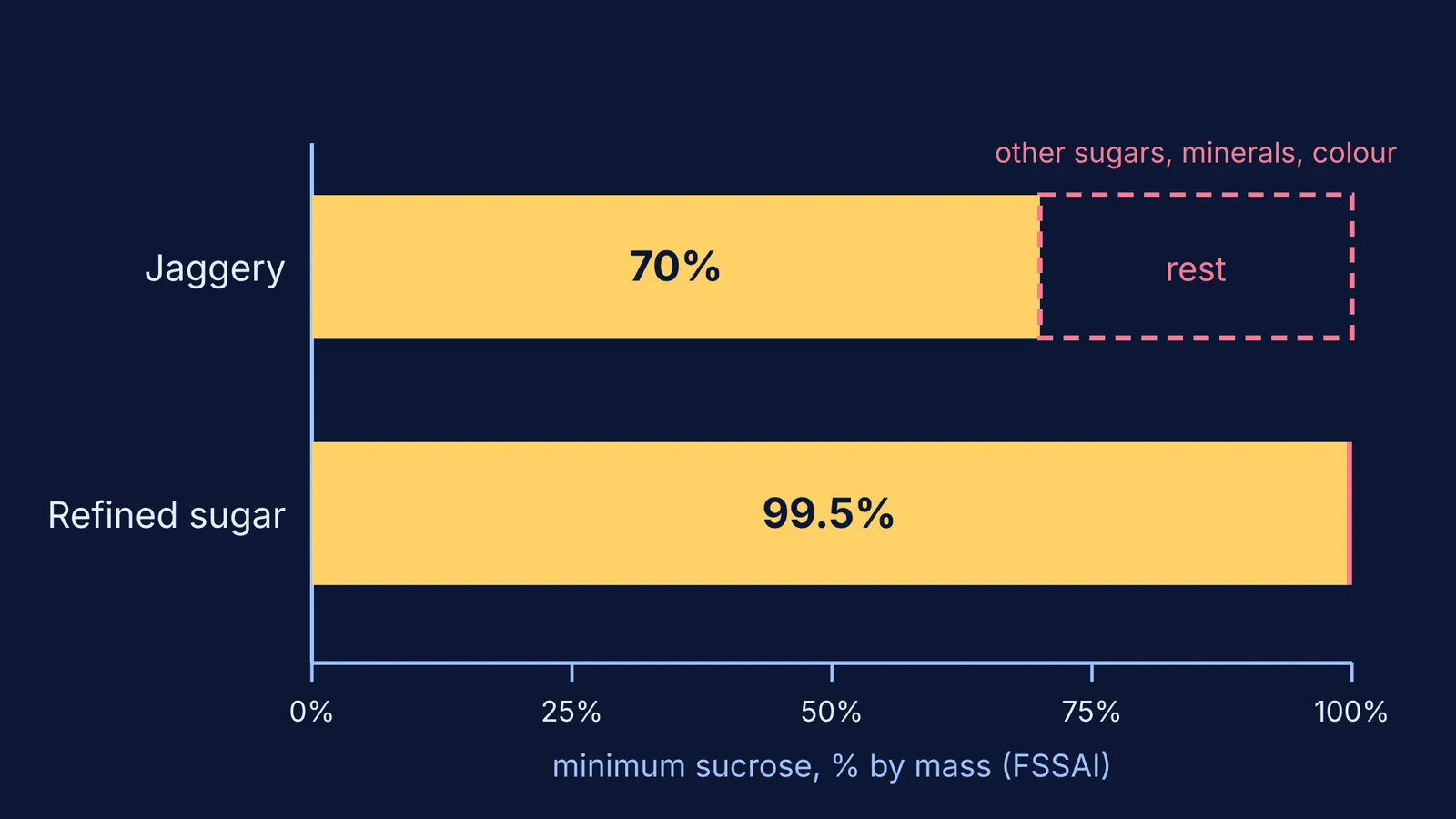
India's food standards define cane jaggery as "the product obtained by boiling or processing juice pressed out of sugarcane" (FSSAI food product standards, regulation 2.8.4.pdf)). On a dry-weight basis, the same document sets cane jaggery at a minimum of 70% sucrose, up to 20% reducing sugars and up to 4% sulphate ash (the mineral part), and it does not allow added colour.
Refined sugar, by the same FSSAI standards, must be at least 99.5% sucrose, and plantation white sugar, the ordinary crystal sugar, at least 98%.
So the difference is not that jaggery contains a brown ingredient that sugar lacks. Up to 30% of jaggery's dry weight can be something other than sucrose: other sugars, minerals and browning products. Researchers call jaggery-type products non-centrifugal sugar: a lump or powder that still contains its molasses, traditionally made by clarifying the juice with lime and skimming off foam while it boils in an open pan (Chen et al., Food Science and Technology, 2022). The word "non-centrifugal" is the clue: white sugar goes through a centrifuge, jaggery does not.
What gives jaggery its brown colour?
Three things darken the boiling juice, according to a review of jaggery making in Agricultural Reviews (Selvi, Mathialagan and Mohan):
Uncontrolled heating makes compounds already in the juice react and form dark complex compounds.
Sugars caramelise, forming dark compounds of their own.
Too much lime and iron leaching from the pans darken the colour further.
The review gives the striking temperature for solid jaggery, when the thick syrup is ready to be taken off the heat and moulded, as 116 to 120 °C.
Among the brown pigments are melanoidins: large, nitrogen-containing polymers formed in the Maillard reaction, in which reducing sugars react with amino acids (Chen et al., 2022). The reaction does not stop when the sugar cools. In that study, the colour of a membrane-clarified non-centrifugal cane sugar stored at room temperature rose by 70.13% over 10 months, while its glucose fell by 53.64% and its total amino acids by 38.71%. That helps explain why old jaggery is often darker than fresh jaggery.
How does crystallisation make sugar white?
Raw sugar still carries a film of molasses around each crystal. A refinery washes that film off, a step called affination, then dissolves the sugar and mixes the liquid with hot milk of lime. This precipitates impurities such as sulphate, phosphate, citrate and oxalate as calcium salts, along with large organic molecules such as proteins (Wikipedia: Sugar refinery). Bone char, activated carbon or ion-exchange resins then remove most of the remaining colour.
The clear liquid is boiled down under vacuum, and the syrup is made supersaturated and seeded so that sucrose crystals grow. A centrifuge spins the crystals free of the leftover syrup, and they are washed with hot water (same source).
Why does this work? A growing crystal adds molecules that fit its regular lattice. Sucrose fits; minerals, proteins and melanoidins mostly do not, so they stay in the liquid. Each round of crystallisation leaves the crystals purer and the leftover liquid darker. Molasses is the dark leftover.
Is jaggery healthier than white sugar?
Jaggery does carry minerals that refined sugar loses. The Agricultural Reviews paper lists, per 100 g of jaggery, 70 to 90 mg of magnesium and 10 to 13 mg of iron (Selvi, Mathialagan and Mohan). But FSSAI still requires at least 90% total sugars in cane jaggery (FSSAI standards.pdf)), so both are mainly sugar. If you have diabetes or a diet question, ask a doctor or a registered dietitian rather than swapping one for the other.
How do you explain it in an exam answer?
Use this four-step frame:
Same start: both come from sugarcane juice, a solution of sucrose with impurities.
Jaggery = evaporation: water is boiled off and everything else stays, including minerals and brown products of caramelisation and the Maillard reaction.
Sugar = crystallisation: sucrose crystallises from a supersaturated syrup; impurities stay in the mother liquor (molasses), which a centrifuge removes.
Result: jaggery is at least 70% sucrose by dry weight and brown; refined sugar is at least 99.5% sucrose and white.
To see it at home, with an adult handling the hot water: dissolve as much sugar as you can in a cup of hot water, add a few drops of tea and hang a clean thread in it. Over several days, crystals grow on the thread, and against white paper they look far paler than the liquid they grew from.
If supersaturation and crystal growth are hard to picture, the Fermi Simulation Lab has interactive simulations for ideas that are easier to see than to read.