On this page
NCERT gives you 2KClO₃ → 2KCl + 3O₂ with MnO₂ written over the arrow as a catalyst. It does not say what the MnO₂ actually does. In 1889 Herbert McLeod asked exactly that. He found two clues most people ignore: the oxygen always smells faintly of chlorine, and the cooled melt can turn pink. From them he proposed a three-step cycle in which MnO₂ reacts and is then remade.
The paper is H. McLeod, F.R.S., "Decomposition of Potassic Chlorate by Heat in the presence of Manganic Peroxide", J. Chem. Soc. Trans. 55 (1889) 184 (DOI 10.1039/CT8895500184; scan on the Internet Archive). "Potassic chlorate" is KClO₃ and "manganic peroxide" is MnO₂. Quotes and numbers come from the scan, checked against page images. The lab method and its gas volume sums are in preparing oxygen from potassium chlorate and manganese dioxide; this post is about the 1889 evidence.
What did McLeod find when he heated KClO₃ with MnO₂?
He used the vapour of boiling mercury as a heater that holds one fixed temperature. At that temperature pure KClO₃ barely changed: one sample lost 0.105% of its mass in an hour, another 0.167% in 10 hours, which he put down to a little water.
With MnO₂ present, the chlorate gave up almost all its oxygen. In Experiment II the mass lost was 38.682% of the chlorate. Afterwards he washed out the MnO₂ and weighed it: 99.211% came back. But it had changed. It was now "in a very fine state of division". A sample put through the reaction nine times was still active, and had turned brown instead of black. McLeod read that as a sign "that the peroxide had entered into chemical action and had been reproduced."
Worked example: how complete was Experiment II?
M(KClO₃) = 39.098 + 35.453 + 3 × 15.999 = 122.55 g/mol.
All the oxygen leaves as O₂, so the maximum loss is 3 × 15.999 ÷ 122.55 = 39.17%. McLeod's own atomic weights (K 39, Cl 35.37, O 15.96) give 39.166%, the figure he printed.
Found: 38.682%. Completeness = 38.682 ÷ 39.166 = 98.8%.
MnO₂ recovered: 99.2%. A catalyst should come back unchanged in amount, and within weighing losses it did.
Where does the chlorine come from?
In every run the gas carried a trace of chlorine. He caught it in potassium iodide solution and titrated the iodine set free with sodium thiosulphate. In Experiment II it was 0.0375% of the chlorate's mass. That is about 0.0013 mol of Cl atoms per mol of KClO₃, small but never zero. He asked whether it was "a necessary accompaniment" of the reaction.
What was the pink colour?
He watched a single grain of MnO₂ in chlorate under a microscope. The grain broke up into tiny fragments, "each of which was a nucleus from which gas bubbles rose." On cooling, "the fused mass had a distinct pink tinge as if permanganate had been formed." Chlorine plus pink pointed to KMnO₄.
Several checks supported this:
Adding a little KMnO₄ cut the chlorine; at his largest addition, none was given off.
Adding a small amount of sodium carbonate, which would take up chlorine, slowed the oxygen release sharply.
No perchlorate formed, which confirmed an earlier finding by Eccles.
Mn₃O₄ worked too. Platinum black, a "chemically inert" nucleus, released only 28.111% oxygen in 9½ hours, about 72% of the theoretical loss.
He also met the obvious objection that KMnO₄ itself breaks down at that temperature. A compound can still form where it decomposes, he argued, just as electric sparks decompose ammonia yet make small amounts of it from nitrogen and hydrogen.
What were McLeod's three steps?
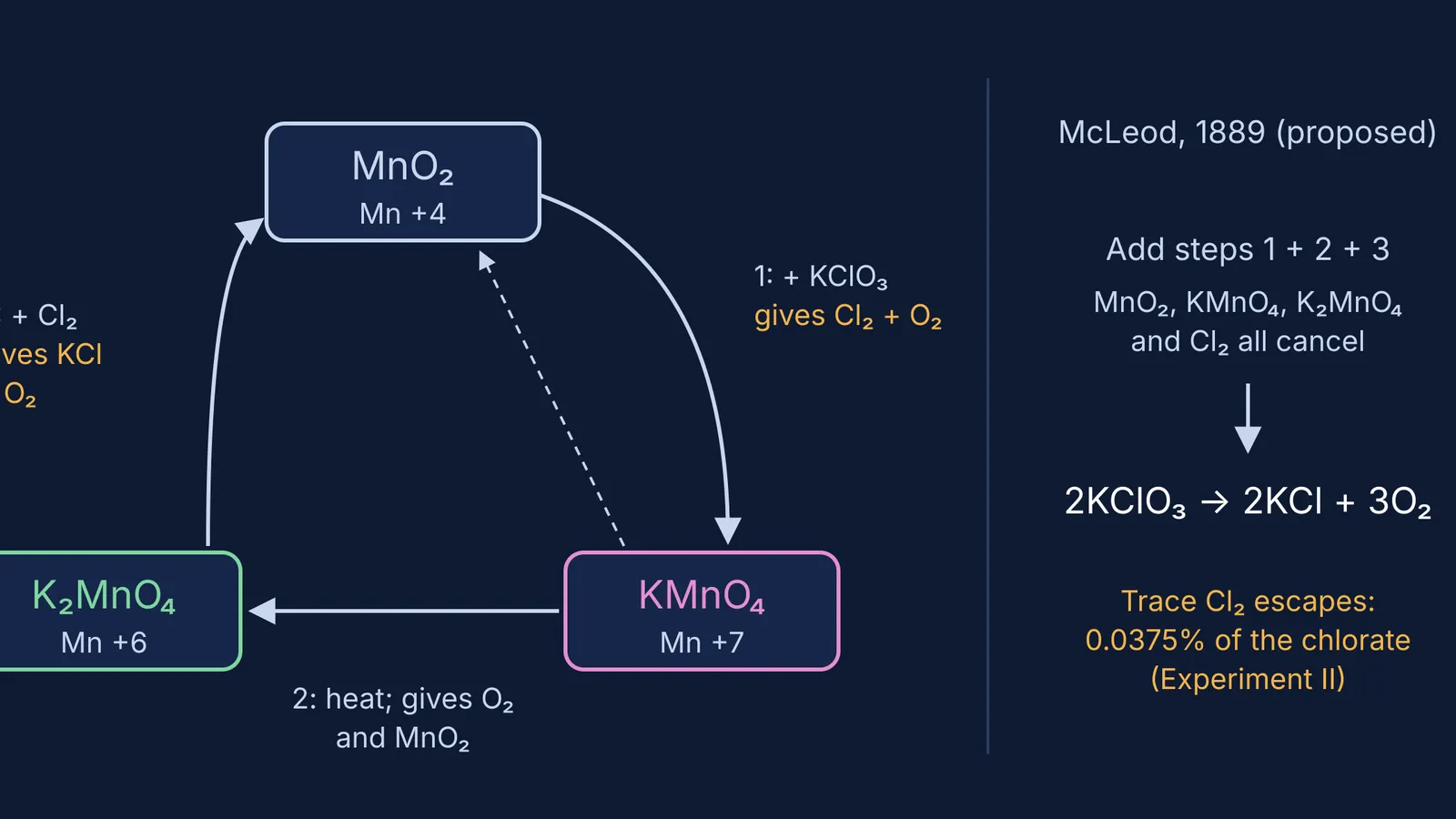
He offered them as "something of the following kind". He wrote permanganate as K₂Mn₂O₈, the doubled formula of his time; here it is KMnO₄.
2MnO₂ + 2KClO₃ → 2KMnO₄ + Cl₂ + O₂
2KMnO₄ → K₂MnO₄ + MnO₂ + O₂ ("for simplicity", he said)
K₂MnO₄ + Cl₂ → 2KCl + MnO₂ + O₂
Worked example: add the steps
Left sides together: 2MnO₂ + 2KClO₃ + 2KMnO₄ + K₂MnO₄ + Cl₂.
Right sides together: 2KMnO₄ + Cl₂ + K₂MnO₄ + 2MnO₂ + 2KCl + 3O₂.
Cancel what appears on both sides: 2KMnO₄, K₂MnO₄, Cl₂ and 2MnO₂.
What is left: 2KClO₃ → 2KCl + 3O₂. The NCERT equation.
Atom check: K 2 = 2; Cl 2 = 2; O 6 = 6. No charge on either side.
So in this scheme MnO₂ is used in step 1 and made again in steps 2 and 3. That is the intermediate-compound picture of a catalyst. The Cl₂ is also made and used, so a little that escapes before step 3 explains the smell.
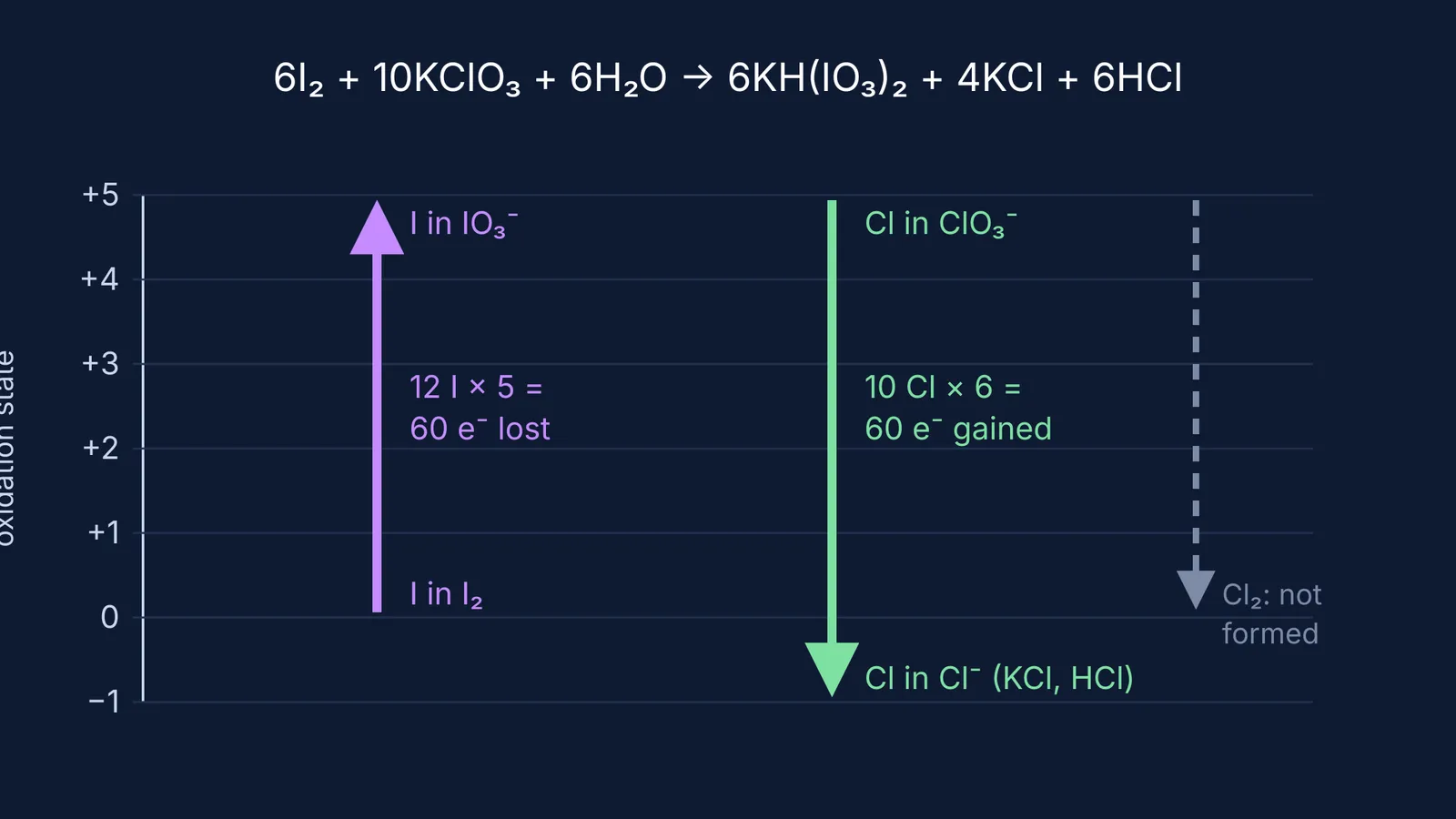
Worked example: oxidation states through step 1
Mn: +4 in MnO₂ to +7 in KMnO₄. Two Mn lose 2 × 3 = 6 electrons.
O: two O atoms go from −2 to 0 in O₂. They lose 4 electrons.
Cl: +5 in KClO₃ to 0 in Cl₂. Two Cl gain 2 × 5 = 10 electrons.
Lost 6 + 4 = 10, gained 10. Balanced.
Overall, Cl goes +5 to −1 (gain 12 for two Cl) and six O go −2 to 0 (lose 12). Mn starts and ends at +4.
Did McLeod's numbers fit the textbook KMnO₄ equation?
Not quite, and he said so. Step 2 predicts a mass loss of 32.00 ÷ (2 × 158.03) = 10.12% (he wrote 10.126). Heating commercial KMnO₄, he measured 11.176%, and 12.14% in another run. He found other equations that fit better, but warned "too much reliance must not be placed on these results" because the salt was not purified. That is why he used the simple equation only "for simplicity".
His cycle was a proposal, and this post does not settle the modern mechanism. The existing oxygen post cites a 1952 study of a surface complex on the catalyst; read both as history. For an older idea of catalysts taking part, see Elizabeth Fulhame and the first idea of how catalysts work.
Where does this fit in your syllabus?
The KClO₃ and MnO₂ preparation of oxygen is in NCERT, and the redox steps practise Class 11 oxidation numbers and balancing. Class 12 KMnO₄ chemistry covers its decomposition on heating, and the catalyst idea fits the heterogeneous examples in homogeneous vs heterogeneous catalysis.
For JEE practice, Fermi Test Prep offers JEE Main and Advanced preparation with an AI tutor. If balancing multi-step redox still trips you up, the Fermi Problem Library has a step-by-step solver that explains the reasoning.
Quick checklist
1889: McLeod found a trace of Cl₂ in every run and a pink melt he took for permanganate.
MnO₂ came back (99.2%) but finely divided, and stayed active after nine uses.
His cycle: MnO₂ → KMnO₄ → K₂MnO₄ + MnO₂ → MnO₂, with Cl₂ made and used.
The three steps add to 2KClO₃ → 2KCl + 3O₂.
Maximum mass loss is 39.17%; Experiment II reached 98.8% of it.
It was a proposal, not an established mechanism.