On this page
You mix Fehling's A (copper sulphate) with Fehling's B (alkaline Rochelle salt) and the liquid turns deep blue. Your textbook calls the blue thing a "copper(II) complex". But is the copper still a positive ion, or part of a negative one? In 1899 Orme Masson and B. D. Steele at the University of Melbourne answered that with a current: the blue colour moved towards the positive electrode. Then they measured how much alkali it takes.
The paper is O. Masson and B. D. Steele, "The Blue Salt of Fehling's Solution and other Cuprotartrates", J. Chem. Soc. Trans. 75 (1899) 725 (DOI 10.1039/CT8997500725; scan on the Internet Archive). Quotes and numbers below come from that scan, checked against the page images. For Fehling himself and the sugar test, see who invented Fehling's solution.
How did Masson and Steele show the blue copper is in an anion?
First they made a blue solution with no spare alkali. They washed cupric tartrate (the blue crystals CuC₄H₄O₆·3H₂O that form when copper sulphate meets Rochelle salt) and added caustic potash until almost all of it dissolved. The liquid looked like Fehling's solution but was "perfectly neutral to litmus".
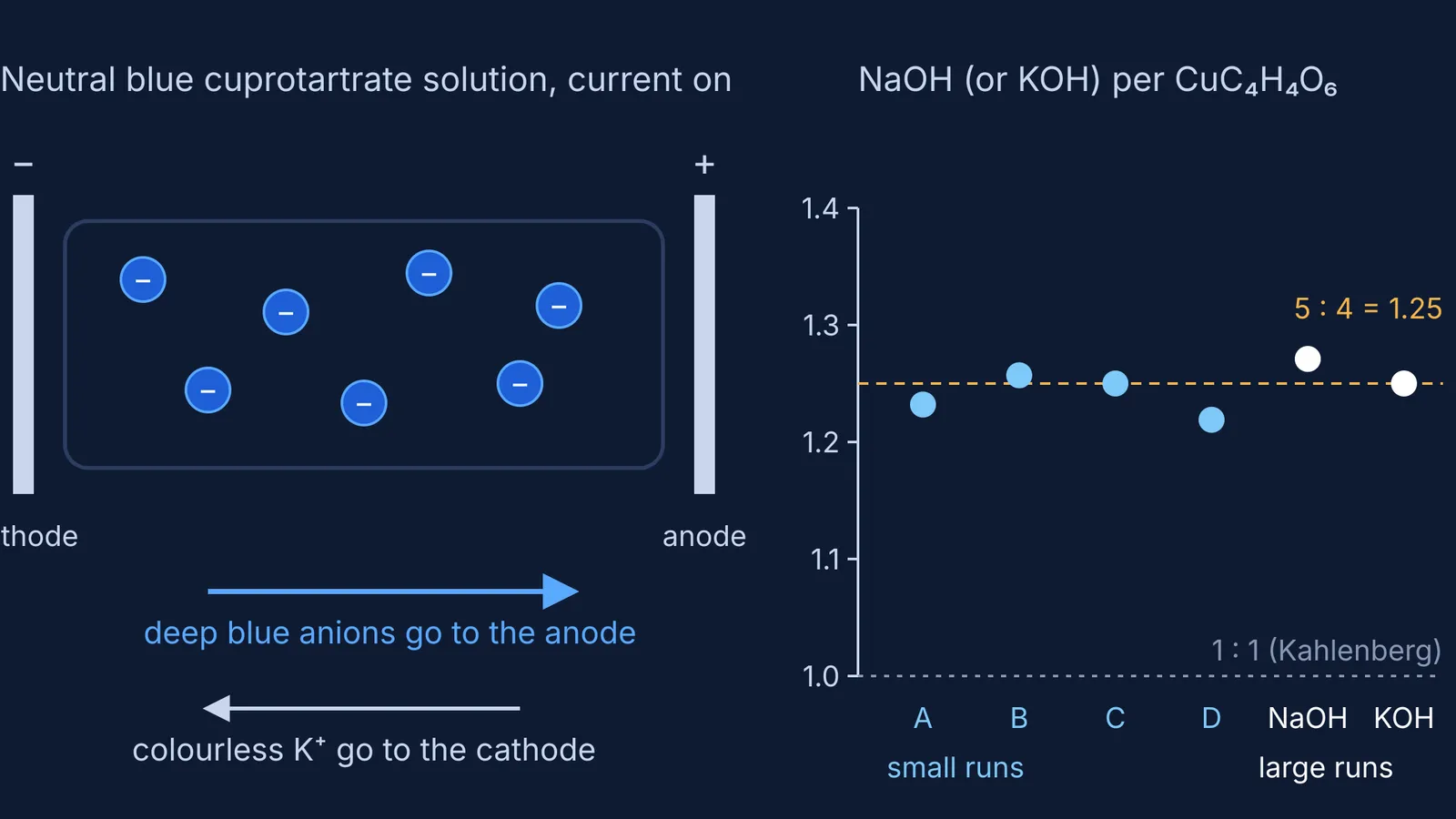
Two flasks of it were joined by a narrow tube filled with a salt jelly, with a platinum electrode in each flask and about 40 volts across them. Their report:
"It soon became manifest that deep blue anions were travelling through the tube, and that the cathions of the solution (presumably K) were colourless."
The cathode still got plated with copper. They put that down to a secondary reaction of the discharged alkali metal, "for the blue ions had been visibly travelling away from the cathode all the time."
They were not first. A footnote credits F. W. Küster (1898) with a similar proof, and Louis Kahlenberg (1895) with less direct evidence.
What did the second electrolysis reveal?
Next they put copper sulphate in the anode flask and the deep blue solution in the cathode flask. Two coloured edges moved towards each other: pale blue Cu²⁺ from the anode side, and the deep blue anion from the cathode side. Their ionic-velocity work said the edges should move at roughly 2 : 3 and meet at a known mark.
They did not. When the pale blue edge reached the mark, a pale blue precipitate formed across the tube while the deep blue edge was still some way off. So the solution also held a faster, colourless anion that makes an insoluble copper salt. Their guess: ordinary tartrate ions. The reaction of copper tartrate with alkali was not a simple one-to-one change.
Worked example: reading an electromigration result
In electrolysis, cations move to the cathode (−) and anions to the anode (+).
Free Cu²⁺ carries its blue colour towards the cathode. The pale blue edge did exactly that.
The deep blue colour moved away from the cathode. So that copper is inside a negative ion.
The early precipitate means a second, colourless anion was running ahead and met Cu²⁺ first.
How much alkali does copper tartrate need?
They added half-normal NaOH to weighed dry copper tartrate until it just dissolved. Their four ratios of NaOH to CuC₄H₄O₆ were 1.23, 1.26, 1.25 and 1.22. On a larger scale, 325.5 mL of 1 N NaOH dissolved 54.18 g, and 331.0 mL of 1 N KOH dissolved 56.02 g. The true ratio, they wrote, is "very close to NaOH : CuC₄H₄O₆ = 1·25 : 1".
Kahlenberg had measured almost the same amount (1.26 KOH per copper) but proposed a 1 : 1 reaction. Masson and Steele wrote, as the probable equation:
5NaOH + 4CuC₄H₄O₆ → Na₂C₄H₄O₆ + Na₃C₁₂H₇Cu₄O₁₈ + 5H₂O
The colourless needles that later crystallised from the liquid were tested and found to be sodium tartrate, the co-product in this equation.
Worked example: from the titration to the equation
Copper tartrate, M = 211.62: 54.18 ÷ 211.62 = 0.2560 mol.
NaOH: 0.3255 L × 1 mol/L = 0.3255 mol.
Ratio: 0.3255 ÷ 0.2560 = 1.27. The KOH run gives 0.3310 ÷ (56.02 ÷ 211.62) = 1.25.
The equation uses 5 NaOH for 4 Cu: 5 ÷ 4 = 1.25.
Atoms: Na 5 = 2 + 3; Cu 4 = 4; C 16 = 4 + 12; H 16 + 5 = 4 + 7 + 10; O 24 + 5 = 6 + 18 + 5. Balanced.
As ions: 5OH⁻ + 4CuC₄H₄O₆ → C₄H₄O₆²⁻ + C₁₂H₇Cu₄O₁₈³⁻ + 5H₂O. Charge −5 on each side.
Where does 3− come from? As bookkeeping only: three tartrate ions (C₁₂H₁₂O₁₈, charge −6) plus four Cu²⁺ (+8) give +2. Remove 5 H⁺, taken by the 5 OH⁻ as water, and you reach −3. This counts atoms and charges; it says nothing about how they are joined.
What did the potassium salt analysis show?
They threw the blue potassium salt out of solution with alcohol, dried it in a vacuum and wrote its formula as K₃C₁₂H₇Cu₄O₁₈ + 5H₂O. With today's atomic masses, M = 900.7.
Calculated: Cu = 4 × 63.546 ÷ 900.7 = 28.22% (paper 28.24%). K = 3 × 39.098 ÷ 900.7 = 13.02% (paper 13.03%).
Found, Experiment III: 0.2804 g copper by electro-deposition from 0.9895 g of salt, so 28.34% Cu. The 0.2944 g of K₂SO₄ from the same sample gives 13.35% K (paper 13.33%).
Mole ratio: Cu : K = 1.31 found, against 4 : 3 = 1.33.
Their silver salt, though "not quite pure", supported the same group. They concluded the cuprotartrates are salts of "a definite trivalent radicle", (C₁₂H₇Cu₄O₁₈)‴ or, with one more H₂O, (C₁₂H₉Cu₄O₁₉)‴. They would "abstain from any discussion of the probable or possible inner constitution" of it. The Cu₄ formula is the 1899 result. This post does not cover the modern structure of the ion.
Why must Fehling's solution be mixed fresh?
The paper gives a direct reason. The pure blue salt reduces itself: Cu₂O forms "when the fresh solution of the pure salt is boiled for a few minutes, or when it is left at the ordinary temperature for a few days." For how Benedict's reagent gets round this, see Benedict vs Fehling solution.
Acid breaks the complex. Check their equation: K₃C₁₂H₉Cu₄O₁₉ + 5HCl → 3KCl + 3CuC₄H₄O₆ + CuCl₂ + H₂O.
Where does this fit in your syllabus?
Fehling's test is in NCERT Class 12 (Aldehydes, Ketones and Carboxylic Acids): R–CHO + 2Cu²⁺ + 5OH⁻ → RCOO⁻ + Cu₂O + 3H₂O, with charge −1 on each side. This paper adds two Class 12 ideas: a complex ion carries its own charge, and a coloured ion shows its sign by which way it moves. A conductivity test for complexes is in Kistiakowsky, 1890.
If complex ions and their charges still feel shaky, the Concept Library on Fermi gives each idea its own lesson and its place in the map.
Quick checklist
1899, Melbourne: Fehling's deep blue moved to the anode, so the copper is in an anion.
Küster published that proof first, and Masson and Steele said so.
A faster, colourless anion (tartrate) was also present.
1.25 NaOH per Cu: 5NaOH + 4CuC₄H₄O₆ → Na₂C₄H₄O₆ + Na₃C₁₂H₇Cu₄O₁₈ + 5H₂O.
Potassium salt: 28.22% Cu and 13.02% K calculated; 28.34% and 13.35% found.
The Cu₄ formula is historical; they declined to guess the structure.