On this page
Your textbook says potash alum falls apart into K⁺, Al³⁺ and SO₄²⁻ in water, while potassium ferricyanide keeps its [Fe(CN)₆]³⁻ ion whole. In 1890 that was still an open question, especially for very dilute solutions. A young Russian chemist in Wilhelm Ostwald's Leipzig laboratory, Vladimir Kistiakowsky (the paper prints "Wl. Kistiakowsky"), settled it with electrical conductivity. He diluted his salts down to 0.00002 normal and asked one question: does the conductivity per equivalent look like an ordinary salt's, or several times bigger?
His paper is "Die wässerigen Lösungen von Doppelsalzen" (the aqueous solutions of double salts), Z. phys. Chem. 6 (1890) 97 onwards (scan on the Internet Archive). Translations are ours. The archive of the American Institute of Physics lists him as at Leipzig University in 1889–1890 (AIP catalogue entry).
What did chemists already know about double salts in 1890?
Kistiakowsky's own summary of the history:
Porret had found that potassium ferricyanide, K₃Fe(CN)₆, splits on electrolysis into K₃ and Fe(CN)₆, just as K₃PO₄ splits into K₃ and PO₄. The Fe(CN)₆ group moves as one unit.
Graham's diffusion experiments of 1851 showed that alums and potassium copper sulphate, K₂Cu(SO₄)₂·6H₂O, separate into their simple salts in solution.
Hittorf, in his 1859 work on ion migration, sorted double salts into two kinds: cyanide and platinum double salts that stay whole, and oxy-salt and halogen double salts that come apart. His transport numbers are explained in Hittorf's transport numbers.
Ostwald had just named the two kinds. A complex salt stays whole in solution; a double salt splits. He also gave the chemical test, which Kistiakowsky quotes: salts that exist as complex molecules give no reaction for their parts, so "in yellow prussiate the iron, in ammonium chromium oxalate the oxalic acid, cannot be detected with the usual reagents." Yellow prussiate is K₄[Fe(CN)₆]; the 1819 puzzle over its formula is told in Robert Porrett's half atom of iron.
Kistiakowsky set out to learn "whether even in extremely dilute solutions the complex salts are present undecomposed as such". Walden had measured some complex salts down to 0.001 normal. Kistiakowsky went to 0.00002 normal.
How can conductivity show that a complex ion stays whole?
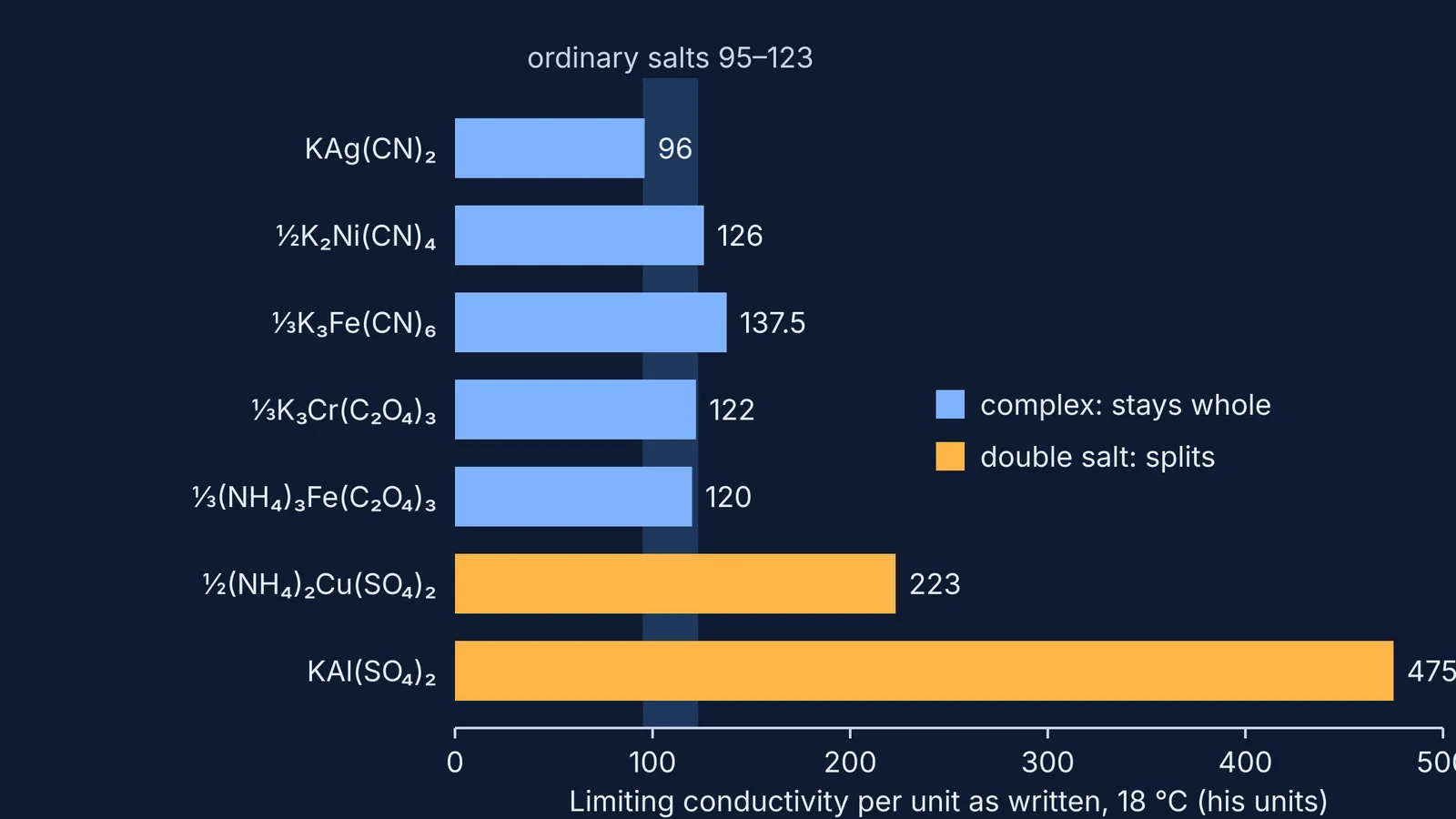
Kohlrausch had found that, at very high dilution, ordinary salts all reach a similar maximum conductivity per equivalent: in Kistiakowsky's units, 95 to 123 at 18 °C and 110 to 150 at 25 °C. If a complex ion broke up as you diluted it, the number of ions would jump and so would the conductivity.
It did not. His complex salts levelled off inside or just above that band. Limiting values per equivalent at 18 °C:
KAg(CN)₂: 96
½K₂Ni(CN)₄: 126
⅓K₃Fe(CN)₆: 137.5
⅓K₃Cr(C₂O₄)₃: 122
⅓(NH₄)₃Fe(C₂O₄)₃: 120
The curves, he wrote, show that "in dilute solutions no decomposition begins", which "amply proves" that complex salts "also remain undecomposed in dilute solutions". His units are not modern S cm² mol⁻¹, so compare ratios, not raw numbers.
Why did alum give four times the conductivity?
He now did the reverse. Pretend alum and ammonium copper sulphate were complexes, work out their conductivity per equivalent on that basis, and see what comes out.
Worked example 1: count the equivalents
If alum were a complex, K⁺[Al(SO₄)₂]⁻, one formula KAl(SO₄)₂ would carry one equivalent. Its limiting conductivity per formula should sit in the 95–123 band.
He measured 475 at 18 °C and 557 at 25 °C. Divide by the band: 475 ÷ 123 = 3.9 and 475 ÷ 95 = 5.0. That is roughly four times.
Count the charges if alum splits completely: KAl(SO₄)₂ → K⁺ + Al³⁺ + 2SO₄²⁻. Charge check: +1 + 3 − 4 = 0. The positive ions carry 1 + 3 = 4 charges, so four equivalents.
Per equivalent: 475 ÷ 4 = 119 at 18 °C and 557 ÷ 4 = 139 at 25 °C. Both are ordinary-salt values.
Ammonium copper sulphate, per half formula, gave 223 at 18 °C. Half of (NH₄)₂Cu(SO₄)₂ splits into ½(NH₄)₂SO₄ + ½CuSO₄, two equivalents, and 223 ÷ 2 = 112. "Almost twice", as he put it.
Ferricyanide the same way: if K₃[Fe(CN)₆] fell apart into 3K⁺ + Fe³⁺ + 6CN⁻, each third of a formula would carry two equivalents, not one, and give about twice the band. He found 137.5, close to one equivalent's worth. The complex ion is intact.
"This proves that these salts are completely decomposed in dilute solutions," he concluded of the double salts.
Worked example 2: modern molar conductivity, alum vs K₄[Fe(CN)₆]
Approximate limiting ionic conductivities at 25 °C from standard tables, in S cm² mol⁻¹: K⁺ 73.5, SO₄²⁻ 160, Al³⁺ about 183, [Fe(CN)₆]⁴⁻ about 442.
Alum, fully split: Λ°m = 73.5 + 183 + 2(160) = 576.5. It has 4 moles of positive charge per mole, so 576.5 ÷ 4 = 144 per mole of charge, close to KCl's 73.5 + 76.3 = 149.8.
K₄[Fe(CN)₆] → 4K⁺ + [Fe(CN)₆]⁴⁻: Λ°m = 4(73.5) + 442 = 735.6, or 184 per mole of charge.
Both numbers are large, because both salts carry many charges per formula. A big molar conductivity alone does not tell you which salt is the complex. You compare the measured value with what each picture of the ions predicts, as Kistiakowsky did, and back it with a chemical test for the "hidden" ion.
What else did he notice along the way?
Two side results make good exam hooks.
KAg(CN)₂'s conductivity drifted with the water used for dilution. Ostwald suggested carbon dioxide, and Kistiakowsky confirmed it: 2KAg(CN)₂ + H₂CO₃ → 2HCN + K₂CO₃ + 2AgCN, a white precipitate that did not darken in diffuse light. (Check: K 2 = 2, Ag 2 = 2, C 5 = 5, N 4 = 4, H 2 = 2, O 3 = 3.) HCN, he noted, conducts "almost not at all".
Ammonium ferrioxalate gave no red colour with ammonium thiocyanate, so no free Fe³⁺. Ammonia still precipitated iron(III) hydroxide, which he read as slight hydrolysis.
He also found that Hittorf's transport data predicted 131 for K₄[Fe(CN)₆] at 25 °C against 162 found (extrapolated from Walden's data). He blamed Hittorf's strong solutions (10 to 30%), where the salt might split in stages, such as K⁺ and K₃Fe(CN)₆⁻. Only in very dilute solution, he argued, should it be simply 4K⁺ + Fe(CN)₆⁴⁻.
Where does this come up in JEE and NEET?
Class 12 Coordination Compounds: double salts vs complexes and Werner's theory, worked with AgNO₃ and conductivity in counting ionisable chlorides. Class 12 Electrochemistry: molar conductivity, dilution and Kohlrausch's law. The basic definitions are in double salt vs complex salt.
To see how ions, charge and conductivity connect, the Concept Library covers every concept in physics, chemistry, biology, mathematics and computing. For JEE practice on these chapters, Fermi Test Prep covers JEE Main and Advanced preparation with an AI tutor.
Quick checklist
Complex: stays whole in solution; double salt: splits into simple ions.
Kistiakowsky measured down to 0.00002 normal; complex salts did not break up.
Alum gave about 4× an ordinary salt's value per formula: K⁺ + Al³⁺ = 4 equivalents.
Compare conductivity per mole of charge, then confirm with an ion test.