On this page
Your textbook says chloroacetic acid is stronger than acetic acid, and that a nitro group makes benzoic acid stronger. In 1889 Wilhelm Ostwald turned those statements into numbers. Once his dilution law gave every weak acid a single constant, he drew on conductivity measurements of roughly two hundred organic acids and asked how each change in structure changed that constant. The paper is "Über die Affinitätsgrössen organischer Säuren und ihre Beziehungen zur Zusammensetzung und Konstitution derselben" (On the affinity constants of organic acids and their relation to composition and constitution), Zeitschrift für physikalische Chemie volume 3 (1889), from page 170. We read it on the scanned pages at the Internet Archive; translations are ours. For Ostwald himself and the law behind this work, see Wilhelm Ostwald and the dilution law.
What did Ostwald measure in 1889?
He measured molar conductivity at 25 °C as he diluted each acid from 16 to 1024 litres per mole. Dividing by the limiting conductivity gave m, the degree of dissociation. Then he calculated
k = m² ÷ ((1 − m) × v)
where v is the volume in litres holding one mole. That k is what you now call Ka. He printed 100k and called it K, so Ka = K ÷ 100. If k stays the same as v changes, the dilution law holds and the acid has one constant. In his words, "this constant is enough to characterise the substance, as regards its affinity properties, through all dilutions".
He re-measured acids he had studied before, partly because his older measurements in Riga had a steady error: the Riga water held a trace of ammonia, and the Leipzig water was largely free of it.
You can check one of his rows yourself. Chloroacetic acid at v = 1024 L was 68.7% dissociated, so 100k = 100 × 0.687² ÷ (1024 × 0.313) = 0.147. His table says 0.147.
How much does each chlorine strengthen acetic acid?
His constants (K = 100 Ka):
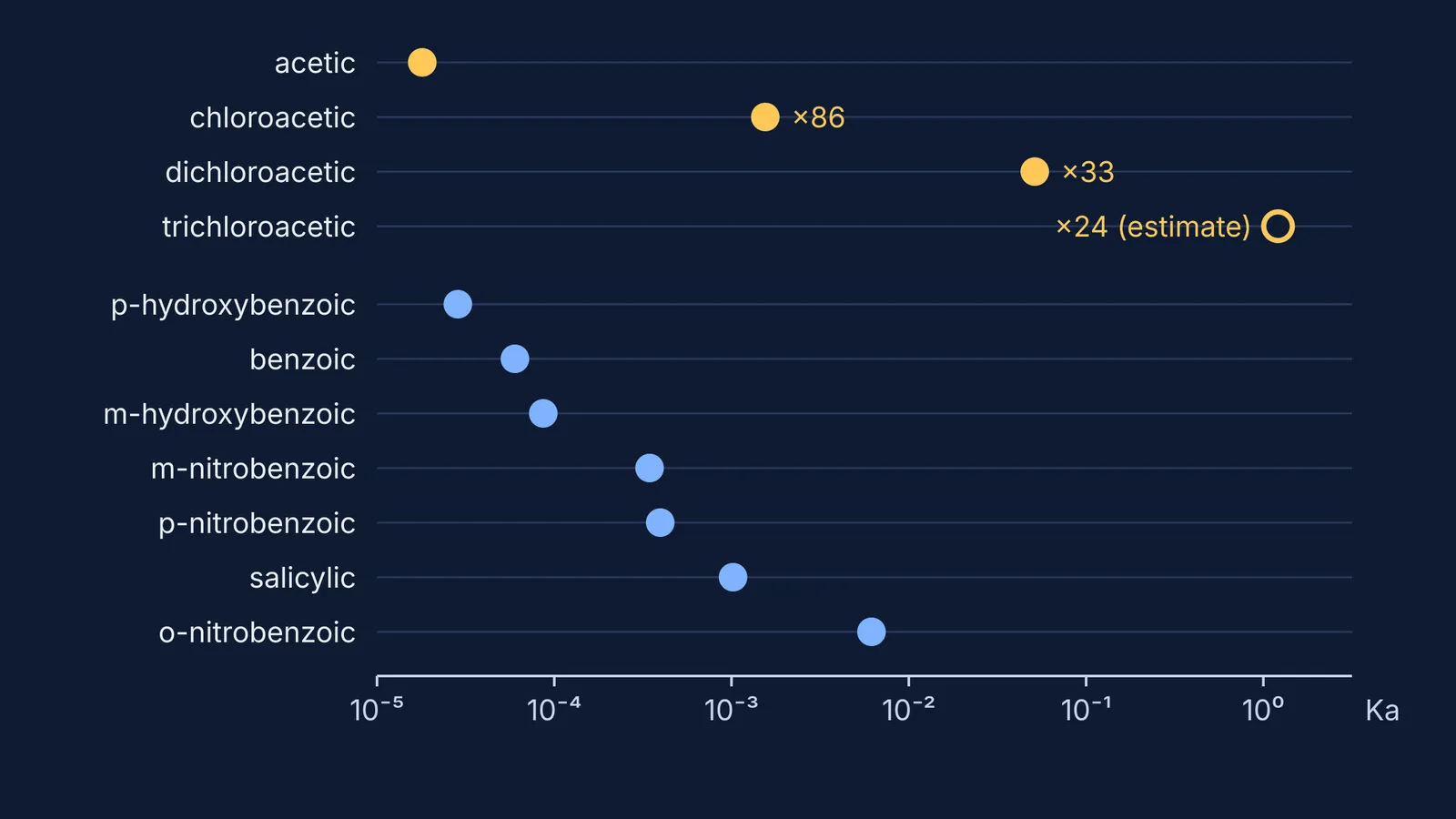
Acetic acid, CH₃COOH: 0.00180
Chloroacetic acid, ClCH₂COOH: 0.155
Dichloroacetic acid, Cl₂CHCOOH: 5.14
Trichloroacetic acid, Cl₃CCOOH: 121, an estimate
Bromoacetic acid, BrCH₂COOH: 0.138
The step factors are 0.155 ÷ 0.00180 = 86, then 5.14 ÷ 0.155 = 33, then 121 ÷ 5.14 = 24. Ostwald wrote that "the influence of each is not equal; there is a steady decrease", though "the ratios 86, 33 and 24 remain of the same order of magnitude". Bromoacetic acid came out "somewhat lower" than chloroacetic acid, the order ClCH₂COOH > BrCH₂COOH that NCERT gives.
Two warnings. First, trichloroacetic acid was already 90% dissociated at v = 32 L and 99.4% at 1024 L, too close to complete for the formula to give a reliable constant. So he estimated K from how fast it inverts cane sugar compared with dichloroacetic acid (rate constants 16.47 and 5.83), taking rates as roughly proportional to conductivity. K = 121 means Ka ≈ 1.2 and pKa ≈ −0.1; modern tables give about 0.7. Use his value for the trend, not as data. Second, he printed the dichloro-to-acetic ratio as "2390 : 1", but his own constants give 5.14 ÷ 0.00180 = 2856. Check printed ratios against the constants.
His fatty acids held a small surprise: butyric acid (0.00149) came out slightly stronger than propionic acid (0.00134). Ostwald repeated it with new samples and wrote, "An error is excluded here."
Why does chlorine make the acid stronger?
The NCERT chapter on aldehydes, ketones and carboxylic acids gives the modern reason: an electron-withdrawing group stabilises the carboxylate ion by spreading its negative charge, here through the −I (inductive) effect. More chlorines pull harder, so the conjugate base is more stable and the acid stronger. Each extra chlorine adds less than the one before, which shows in his shrinking factors. Our chloroacetic acid explainer walks through the inductive effect in more detail.
His numbers still match NCERT. NCERT gives pKa 4.76 for acetic acid, 4.19 for benzoic acid and 3.41 for 4-nitrobenzoic acid. Ostwald's constants give 4.74, 4.22 and 3.40.
What did the benzoic acids show about the ortho effect?
Benzoic acid itself has K = 0.00600, 3.3 times acetic acid. With one substituent added:
o-nitrobenzoic acid 0.616: "more than a hundred times as large" as benzoic acid (103 times)
m-nitrobenzoic acid 0.0345 (5.75 times)
p-nitrobenzoic acid 0.0396 (6.6 times)
salicylic acid (o-hydroxy) 0.102: 17 times
m-hydroxybenzoic acid 0.00867: 1.45 times
p-hydroxybenzoic acid 0.00286: weaker than benzoic acid. "In the para position, by contrast, the hydroxyl, as was pointed out earlier, causes a weakening of the acid; the constant is less than half that of benzoic acid."
Ostwald described the nitro group as the most "negative" substituent. The modern reading is different. Almost any ortho group twists –COOH out of the ring plane, which stops the ring donating electrons to it, and the nearby group's pull is strongest there. In salicylate the –OH also hydrogen-bonds to the carboxylate. At para, –OH donates electrons by resonance, which outweighs its inductive pull, so the acid gets weaker. At meta only the pull acts, so m-hydroxybenzoic acid is slightly stronger than benzoic acid. Our post on the ortho effect in substituted benzoic acids gives the full ranking method.
Worked example: from Ostwald's K to pKa and pH
Ka and pKa. Chloroacetic acid: Ka = 0.155 ÷ 100 = 1.55 × 10⁻³, so pKa = −log(1.55 × 10⁻³) = 2.81. Acetic acid: Ka = 1.80 × 10⁻⁵, pKa = 4.74.
Ratio to pKa difference. log 86 = 1.93, and 4.74 − 2.81 = 1.93. A Ka ratio of 86 is a pKa gap of 1.93.
Degree of ionisation at 0.1 M. Acetic acid: α ≈ √(1.80 × 10⁻⁵ ÷ 0.1) = 0.013, pH 2.88. For chloroacetic acid the shortcut gives 0.124, above 0.05, so solve 0.1α² + 1.55 × 10⁻³α − 1.55 × 10⁻³ = 0. Then α = 0.117 and pH = 1.93.
Ordering. Arrange in decreasing acid strength: benzoic, p-hydroxybenzoic, salicylic, o-nitrobenzoic and m-nitrobenzoic acids. Ostwald's pKa values: o-nitro 2.21 > salicylic 2.99 > m-nitro 3.46 > benzoic 4.22 > p-hydroxy 4.54.
If you want these steps checked line by line, the Fermi Problem Library has a step-by-step solver that explains the reasoning. For JEE-style acidity-order questions, Fermi Test Prep covers JEE Main and Advanced preparation with an AI tutor.
Quick checklist
Ostwald's K is 100 × Ka. Divide by 100 before taking logs.
Each chlorine on acetic acid multiplied K by 86, then 33, then 24 (the last an estimate).
Chloroacetic acid (pKa 2.81) is stronger than bromoacetic acid (2.86).
o-Nitrobenzoic acid is about 100 times stronger than benzoic acid; salicylic acid 17 times.
p-Hydroxybenzoic acid is weaker than benzoic acid; m-hydroxybenzoic acid is slightly stronger.
Do not use 121 for trichloroacetic acid as data: it was an estimate from sugar-inversion rates.