On this page
Radio astronomers in the 1970s saw blobs in the jets of distant quasars that seemed to cross the sky at several times the speed of light. Nothing in them actually beats light. The trick is in when the light reaches us: a blob that moves fast and nearly towards us almost catches up with its own earlier light, so a year of motion is squeezed into a few days of arrival. This post derives the apparent speed with nothing more than Class 11 kinematics, works one example step by step, and uses Hubble's measurement of the M87 jet to show what astronomers can infer from it. Superluminal motion is beyond the NCERT syllabus; treat it as an application of relative motion and the finite speed of light.
Why can a jet seem to move faster than light?
Because we never see where a blob is "now". We see light that left it at different times, and that light has different distances to travel.
Ole Rømer used the same idea in 1676: the eclipses of Jupiter's moon Io seemed to run late when Jupiter was farther away, because their light had further to go. In a jet the distance changes because the blob itself moves towards us.
Picture a blob moving at speed βc (β is the speed as a fraction of c) at an angle θ to our line of sight. It sends out a flash, then another flash a time t later. In that time:
it moves βct sin θ across the sky, the part we can see as motion on the sky;
it also comes βct cos θ closer to us.
The second flash has βct cos θ less distance to travel. So it arrives not t after the first, but
Δt(arrival) = t(1 − β cos θ)
When β is close to 1 and θ is small, that bracket is tiny. A large sideways distance divided by a tiny arrival gap gives a large apparent speed.
What is the formula for the apparent speed?
Divide the sideways distance by the arrival gap:
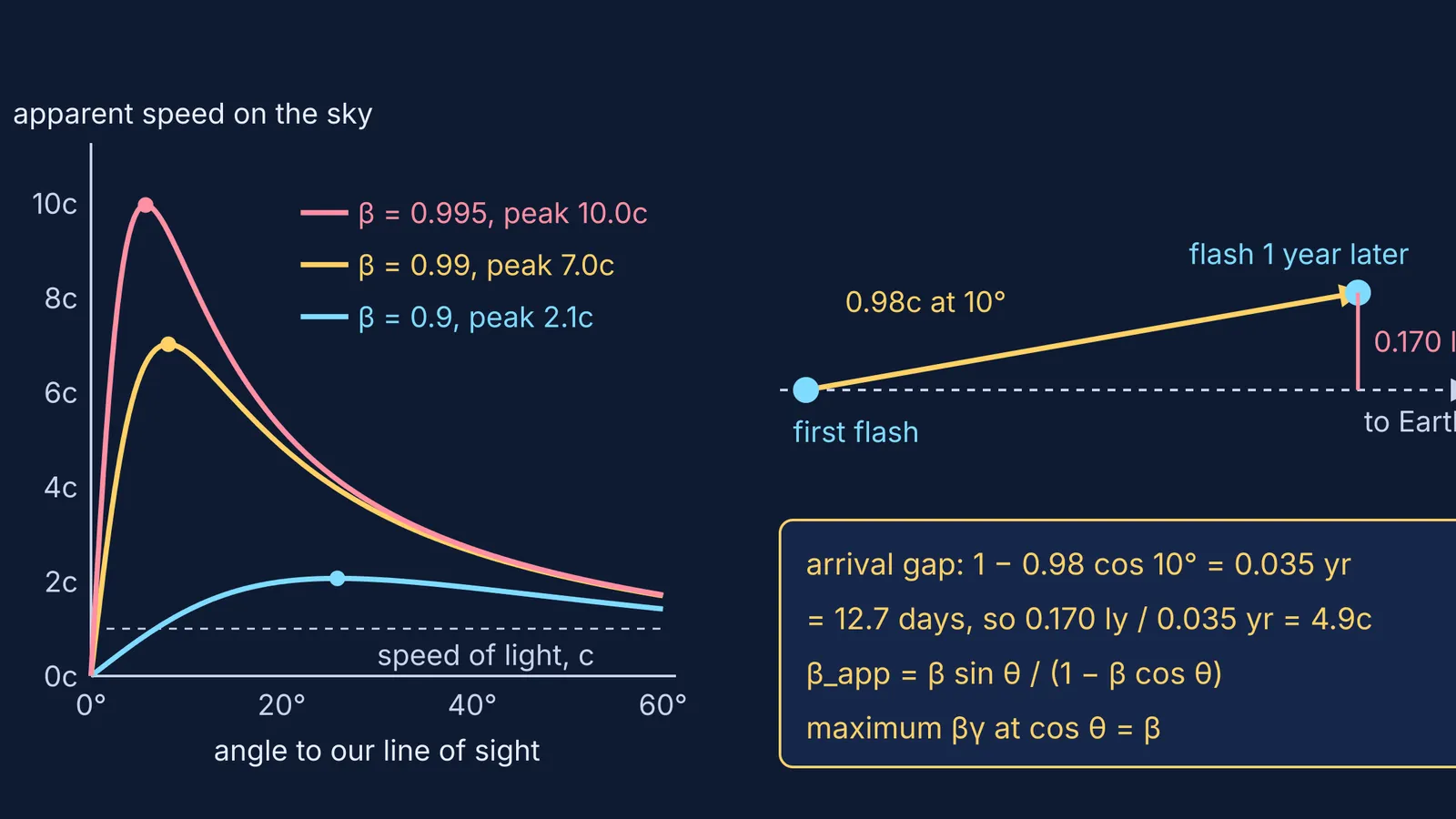
β(app) = β sin θ / (1 − β cos θ), in units of c.
No relativity is used here beyond the fact that β is below 1. It is ordinary distance over time, with the light-travel delay included.
For a given β, the apparent speed is largest at cos θ = β. Substituting, sin θ = √(1 − β²), and the maximum is
β(app, max) = β/√(1 − β²) = βγ
where γ is the same Lorentz factor used in the twin paradox worked at 0.8c. Since γ grows without limit as β approaches 1, apparent speeds can in principle be any size.
Worked example: a blob at 0.98c, 10° from our line of sight
Sideways distance in one year. 0.98 × sin 10° = 0.98 × 0.1736 = 0.170 light-years.
Distance closed in one year. 0.98 × cos 10° = 0.98 × 0.9848 = 0.965 light-years.
Arrival gap. 1 − 0.965 = 0.0349 years = 12.7 days. Light from the end of the year arrives only 12.7 days after light from its start.
Apparent speed. 0.170 ly ÷ 0.0349 yr = 4.88c.
Units check. Light-years per year is a speed in units of c, so 4.88 means 4.88c.
Now vary the numbers:
The same β at the peak angle. cos θ = 0.98 gives θ = 11.5°, and β(app) = βγ = 4.92c. At 10° you are already close to the peak.
β = 0.99. The peak is 7.02c, at θ = 8.1°.
β = 0.9. The peak is only 2.06c, at 25.8°.
Pointing straight at us (θ = 0). No sideways motion at all, so β(app) = 0, even though the blob is very fast.
Pointing away (θ = 170°). β(app) = 0.087c. A receding blob looks much slower than it is, because each flash has further to go.
When was superluminal motion predicted and seen?
Martin Rees worked out how a relativistically expanding radio source should look in a 1966 paper in Nature, before the effect was observed.
In 1971 a team using very-long-baseline interferometry between the Goldstone and Haystack radio dishes reported rapid changes in the fine structure of the quasars 3C 279 and 3C 273. In their Science paper, the data for 3C 279 implied parts of the source separating at an apparent speed about ten times that of light.
What a quasar is, and how 3C 273's distance was found, is covered in the post on quasars.
What does Hubble's M87 measurement tell us?
The galaxy M87 has a jet that the Hubble Space Telescope has followed for years. Biretta, Sparks and Macchetto (1999) reported ten superluminal features in the jet, eight with apparent speeds of 4c to 6c. They concluded that the fastest require a Lorentz factor of at least 6 and a jet within 19° of our line of sight.
You can check both limits with the formula:
Minimum γ. The apparent speed can never exceed βγ. For β(app) = 6 we need βγ ≥ 6. Since (βγ)² = γ² − 1, γ² ≥ 37, so γ ≥ 6.08 and the true speed is at least 0.986c.
Maximum angle. Even with β very close to 1, β(app) = sin θ/(1 − cos θ) = cot(θ/2). Setting cot(θ/2) = 6 gives θ/2 = 9.46°, so θ ≤ 18.9°. Any β below 1 only lowers the apparent speed, so a wider angle cannot give 6c.
Both match the paper. This is how astronomers turn a measured apparent speed into limits on the true speed and the jet's direction, since neither can be measured directly. M87's central black hole, which launches this jet, is the one pictured in the image described in how the first black hole image was taken.
The Simulation Lab has interactive simulations for ideas that are easier to see than read, which helps with relative motion and light-travel delays like these.
Quick checklist
Light emitted later has less distance to travel when the source approaches, so arrivals are squeezed by 1 − β cos θ.
Apparent speed: β(app) = β sin θ/(1 − β cos θ), in units of c.
Maximum β(app) = βγ, at cos θ = β; 0.99c gives 7.0c at 8.1°.
Example: 0.98c at 10° gives 0.170 ly sideways in 12.7 days of arrival time, 4.88c.
An apparent 6c needs γ ≥ 6.1 and θ ≤ 18.9°, as found for the M87 jet.