On this page
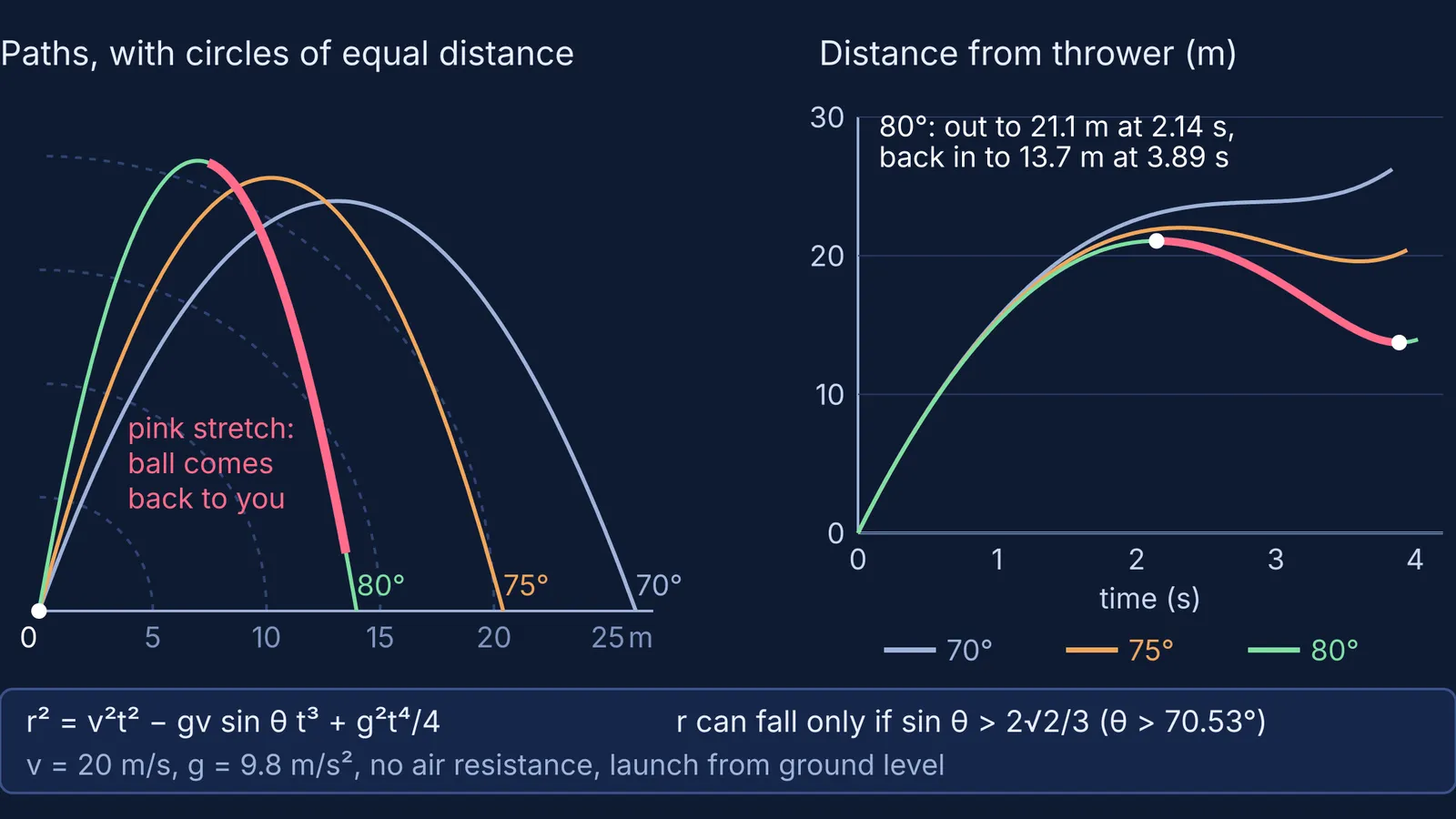
Throw a ball at 20 m/s and 80° above the horizontal, and watch its straight-line distance from your hand. For the first 2.14 s it moves away, to 21.1 m. Then, for almost two seconds, it comes back towards you, down to 13.7 m, before it moves away again just before landing. This happens for every throw steeper than 70.53°, at any speed and on any planet. Below that angle the distance only ever grows.
Does a projectile always move away from the thrower?
No. It feels as if it should, because the horizontal distance x always grows. But the distance from the thrower is r = √(x² + y²), and late in a steep flight the height y falls faster than x grows. The ball is dropping almost straight down, near the vertical line it went up along, so it ends up closer to you than it was at the top.
Another way to see it: r shrinks whenever the velocity points more than 90° away from the line joining you to the ball. On a shallow throw that never happens. On a steep throw, the ball comes down steeply while still well above the ground, and for a while its velocity points partly back towards you.
This is not the range or the height you met in range and height problems. It is the length of the position vector, and it needs its own calculation.
How do you find the critical angle of 70.5°?
Put the thrower at the origin. With launch speed v at angle θ and no air resistance:
x = v cos θ t, y = v sin θ t − ½gt²
Square and add. The v²cos²θ t² and v²sin²θ t² terms combine to v²t²:
r² = v²t² − gv sin θ t³ + ¼g²t⁴
Differentiate with respect to time:
d(r²)/dt = 2v²t − 3gv sin θ t² + g²t³ = t(g²t² − 3gv sin θ t + 2v²)
The factor t is positive after launch, so r falls only when the quadratic in brackets is negative. A quadratic with a positive t² term can be negative only if it has two real roots, which needs a positive discriminant:
9g²v² sin²θ − 8g²v² > 0, so sin²θ > 8/9
That gives sin θ > 2√2/3 = 0.9428, or θ > 70.53°. The speed v and the gravity g have both cancelled, so the same angle holds on the Moon. Between the two roots
t = v(3 sin θ ∓ √(9 sin²θ − 8))/(2g)
the ball is coming back towards you.
Worked example: a ball thrown at 20 m/s and 80°
Take v = 20 m/s, θ = 80° and g = 9.8 m/s².
Components. v sin θ = 19.70 m/s and v cos θ = 3.47 m/s.
Flight time and range. T = 2v sin θ/g = 4.02 s. Range = v² sin 2θ/g = 13.96 m.
Check the angle. 9 sin²θ − 8 = 9(0.9698) − 8 = 0.728. That is positive, so the distance will fall for a while. √0.728 = 0.853.
When the distance stops growing. t₁ = 20(3 × 0.9848 − 0.853)/(2 × 9.8) = 2.14 s. The ball is at x = 7.45 m, y = 19.70 m, so r = 21.1 m. Note this is after the top of the flight, which comes at 2.01 s.
When it starts growing again. t₂ = 20(3 × 0.9848 + 0.853)/(2 × 9.8) = 3.89 s. The ball is at x = 13.49 m, y = 2.55 m, so r = 13.7 m.
The last part. For the final 0.13 s the ball moves away again and lands 13.96 m from you.
So between 2.14 s and 3.89 s the ball closes in by 7.3 m.
Now compare other angles at the same speed:
70°: the bracket's discriminant is negative, so r grows all the way to the landing point at 26.2 m.
75°: r rises to 22.0 m at 2.31 s, falls to 19.6 m at 3.60 s, then grows to 20.4 m at landing.
80°: 21.1 m down to 13.7 m, as above.
90°: the limiting case. The ball goes up 20.4 m and comes all the way back to your hand.
Just above 70.53° the two roots almost coincide at t = √2 v/g, which is 2.89 s for a 20 m/s throw. At exactly 70.53° the distance pauses for an instant at about 23.6 m and then keeps growing.
Where on the path does the ball start coming back?
The physicist James Walker worked this problem out in The Physics Teacher in 1995, in a short paper called "Projectiles: Are they coming or going?". He also noticed a neat geometric fact. Across all launch angles at one speed, the points where dr/dt = 0 lie on an ellipse centred at (0, v²/4g), and this is the same ellipse traced by the tops of all the trajectories.
You can check this for the example. The tops of all paths at speed v lie on x² + 4(y − v²/4g)² = (v²/2g)². For v = 20 m/s the right-hand side is 20.4² = 416.5 m². The point (7.45, 19.70) gives 55.4 + 361.1 = 416.5. The point (13.49, 2.55) gives 182.1 + 234.4 = 416.5. Both turning points of the 80° throw lie on the same ellipse as the tops.
Does air resistance change the angle?
Yes, it lowers it. Drag slows the horizontal motion, so the ball falls back more steeply and comes back towards you on throws that would not do so in a vacuum. Williams Ribeiro and Ricardo de Sousa worked through the case of a drag force proportional to speed in The Physics Teacher in 2021. They found the critical angle falls below 70.5° as the drag grows, and that the turning points no longer lie on the ellipse of the tops. For more on how drag reshapes a path, see projectile motion with air resistance.
What are the common mistakes?
Confusing distance with range. "Distance from the thrower" is r = √(x² + y²), not x.
Rounding the angle to 70°. At 70° the distance never falls. The angle is 70.53°.
Thinking the ball comes back at the top. At the top the velocity is horizontal and r is still growing. The turn comes later, at 2.14 s in the example, not 2.01 s.
Forgetting the last stretch. The distance grows again just before landing.
This is a JEE Advanced-style kinematics question built on one discriminant. If you want to check each step of problems like this, the Fermi Problem Library has a step-by-step solver that explains the reasoning. If you are preparing for JEE Main & Advanced, Fermi Test Prep offers personalised preparation with an AI tutor, live classes, adaptive mocks, mentorship and a study plan that updates based on mastery. For a related timing idea, see complementary angles and flight times.
Quick checklist
r² = v²t² − gv sin θ t³ + ¼g²t⁴.
d(r²)/dt = t(g²t² − 3gv sin θ t + 2v²).
The distance can fall only if sin²θ > 8/9, so θ > 70.53°, for any v and g.
At 20 m/s and 80°: out to 21.1 m at 2.14 s, back to 13.7 m at 3.89 s, landing at 13.96 m.
Drag lowers the critical angle.