

On this page
How do you set up the trajectory equation for a barrier?
In classical kinematics for competitive exams like JEE Main and JEE Advanced, determining whether a projectile clears a barrier begins by eliminating time between horizontal and vertical motion. When a projectile launches from the origin (0, 0) with initial speed u at an angle θ above horizontal ground, horizontal displacement follows x = u cos θ · t and vertical displacement follows y = u sin θ · t − ½ g t². Substituting the time of flight t = x / (u cos θ) into the vertical position equation yields the standard trajectory equation for a projectile:
y = x tan θ − (g x² / (2 u² cos² θ))
Using the identity 1 / cos² θ = 1 + tan² θ transforms this expression into a quadratic in terms of T = tan θ:
(g x² / (2 u²)) T² − x T + [y + (g x² / (2 u²))] = 0
For a vertical wall of height h located at horizontal distance d, the projectile clears the barrier if its height y is at least h when x = d. Setting x = d and y = h establishes the clearance condition, linking obstacle problems to foundational principles of projectile motion on level ground.
What is the minimum speed for a ball to clear a wall?
To determine the minimum speed, evaluate the quadratic in T = tan θ at the wall coordinates (d, h):
(g d² / (2 u²)) T² − d T + [h + (g d² / (2 u²))] = 0
For a real launch angle to clear the wall, this quadratic must have real roots. As shown by N. Hasan in BIOMEJ, setting the discriminant to zero identifies the physical boundary separating reachable targets from unreachable space. For real roots, the discriminant Δ = B² − 4 A C must satisfy Δ ≥ 0:
(−d)² − 4 · (g d² / (2 u²)) · [h + (g d² / (2 u²))] ≥ 0
Dividing by d² and simplifying yields:
1 − (2 g / u²) · [h + (g d² / (2 u²))] ≥ 0
Multiplying by u⁴ produces a quadratic inequality in u²:
u⁴ − 2 g h u² − g² d² ≥ 0
Solving for the positive root of u² gives:
u² ≥ g [h + √(d² + h²)]
Taking the square root yields the minimum launch speed:
u_min = √[g (h + √(d² + h²))]
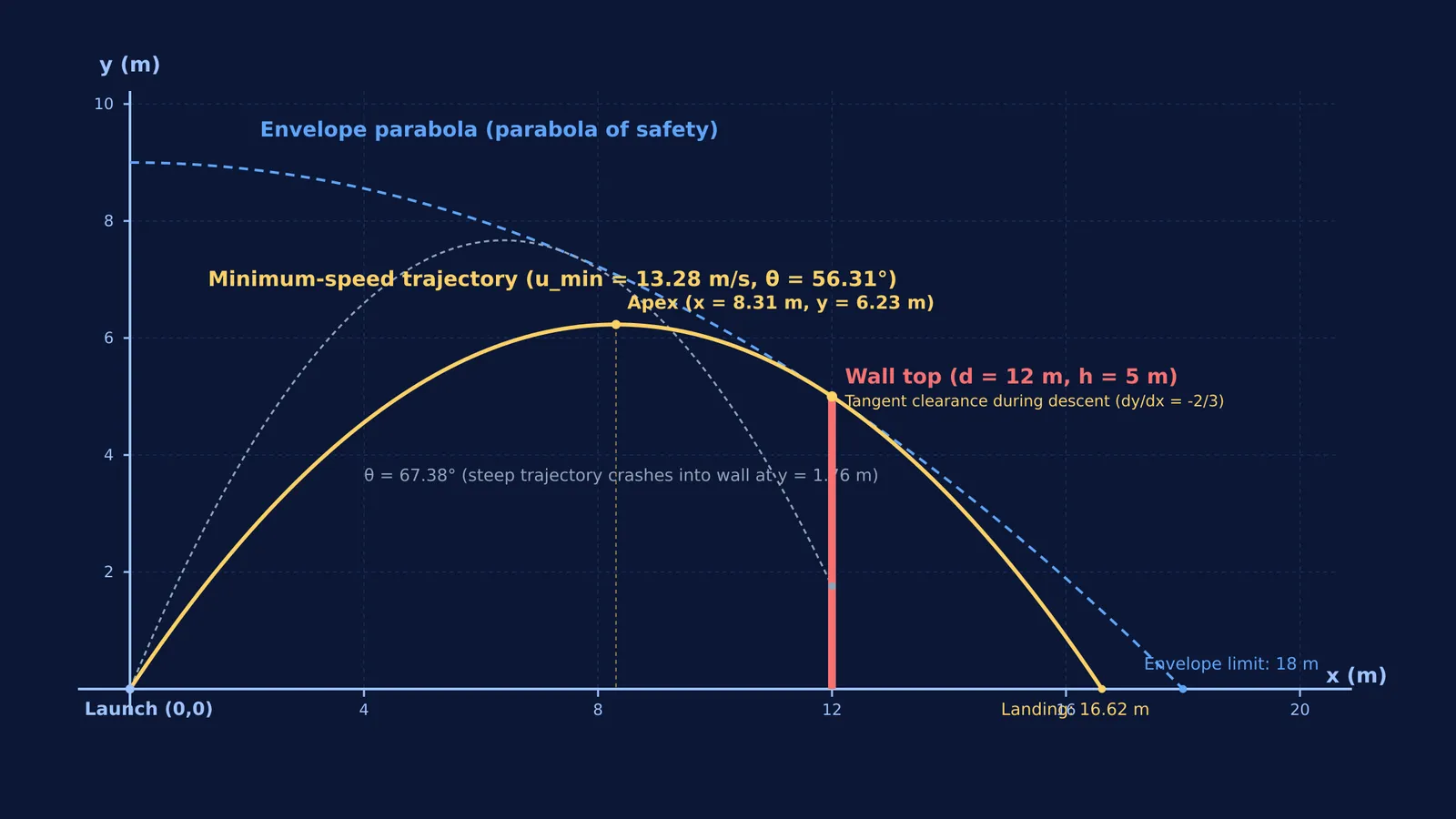
This threshold matches the bounding envelope derived by M. Baće and colleagues in the European Journal of Physics. Known as the parabola of safety, this envelope defines the maximum reach for a given speed. Any initial velocity below u_min cannot clear the wall at any launch angle.
At what launch angle is the minimum speed achieved?
At minimum speed u_min, the discriminant equals zero, producing a single repeated root for the launch angle:
tan θ = −B / (2 A) = d / [2 · (g d² / (2 u²))] = u² / (g d)
Substituting u² = g [h + √(d² + h²)] gives:
tan θ = [h + √(d² + h²)] / d
This result has a direct geometric interpretation. If α is the angle of elevation of the top of the wall from the launch point, so that tan α = h / d, the formula simplifies to tan θ = tan α + sec α = tan(45° + α / 2). Thus, θ = 45° + α / 2. The optimal launch angle exactly bisects the angle between the direct line of sight to the top of the wall and the vertical direction.
In their foundational work on optimizing projectile trajectories across non-level boundaries, D. B. Lichtenberg and J. G. Wills in the American Journal of Physics analyzed how elevation alters launch geometry. For targets elevated above the launch level, the required launch angle is strictly greater than 45°. If wall height h approaches zero, α becomes 0° and θ returns to the textbook 45° flat-ground optimum. When the barrier is adjacent to the launcher (d approaching zero), α approaches 90° and θ approaches 90°.
Why does the minimum-speed projectile clear the wall while falling?
A frequent misconception is that a projectile thrown with minimum speed must reach its peak directly above the wall. In fact, the apex occurs before the barrier.
The horizontal position of the peak is x_peak = (u² sin 2θ) / (2 g) = (u² / g) · sin θ cos θ. Because u² / (g d) = tan θ, substituting u² / g = d tan θ gives:
x_peak = d sin² θ
Because sin² θ < 1 for any non-zero distance d, x_peak is strictly less than d. The ball is always descending when it grazes the barrier. The trajectory slope at x = d is dy/dx = −cot θ. Because launch velocity has slope tan θ, the velocity vector as it clears the wall is perpendicular to the initial velocity, a property analyzed by Ronald A. Brown in The Physics Teacher and tied to the local radius of curvature of a projectile.
How do you calculate the minimum speed for a 5-metre wall at 12 metres?
Applying the trajectory discriminant methods reviewed by N. Hasan in BIOMEJ, consider a projectile launched to clear a 5-metre wall located 12 metres away, using standard gravity g = 9.8 m/s²:
Find the distance to the wall's top: √(12² + 5²) = √(144 + 25) = 13 metres.
Calculate minimum launch speed: u_min = √[9.8 · (5 + 13)] = √[9.8 · 18] = √176.4 ≈ 13.28 m/s.
Determine launch angle: tan θ = (5 + 13) / 12 = 1.5, so θ = arctan(1.5) ≈ 56.31°.
Check the apex: x_peak = 12 · (sin 56.31°)² ≈ 12 · (0.832)² ≈ 8.31 metres, showing the ball peaks at 6.23 metres before descending to 5.00 metres at the wall.
When working through multi-step mechanics problems, the Fermi Problem Library provides a step-by-step solver that explains the reasoning rather than printing an answer.


