

On this page
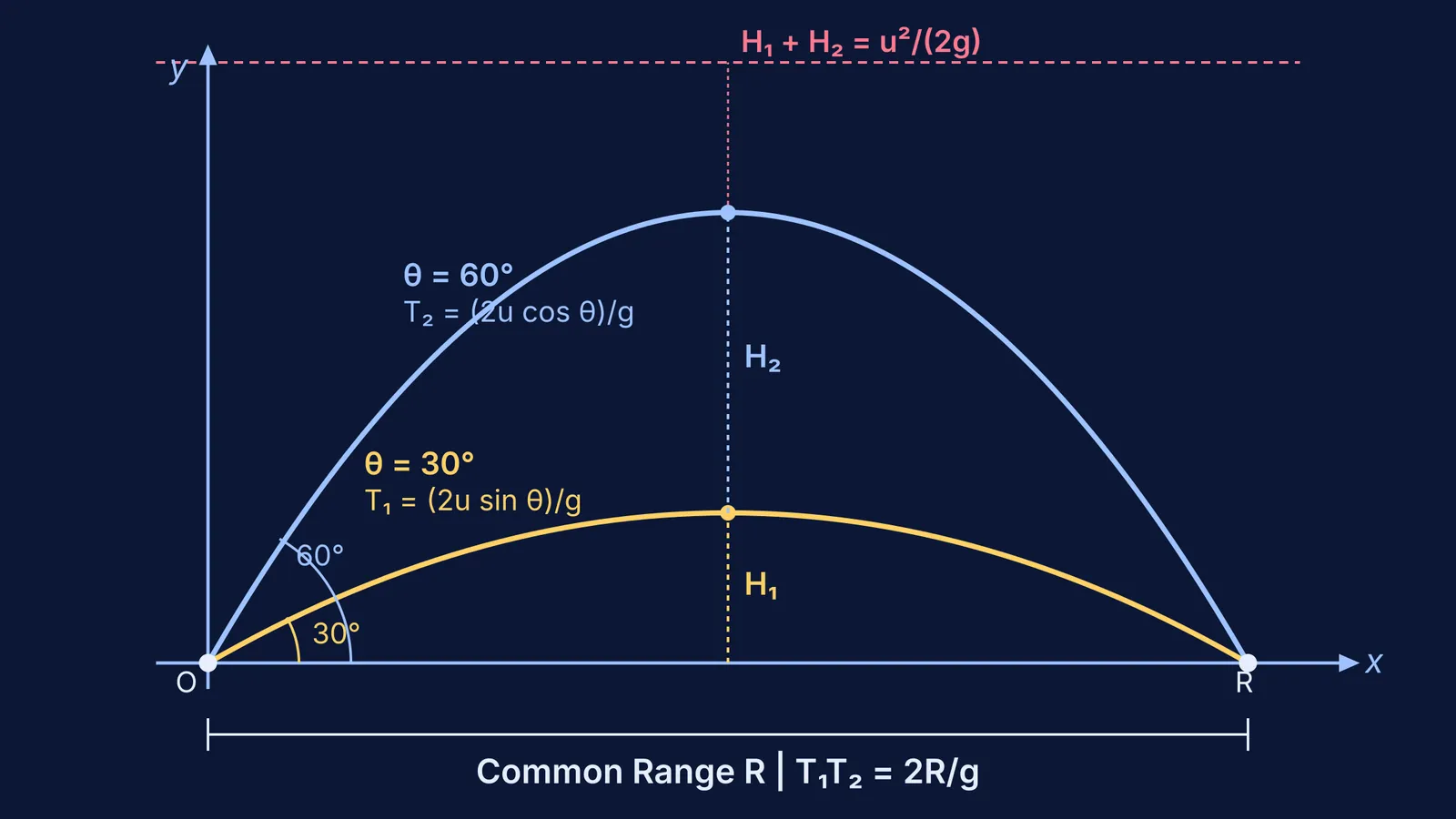
When an object is launched into the air under gravity, a steeper launch angle trades forward speed for time aloft. In introductory kinematics, two distinct launch angles sharing the same initial speed can produce the exact same horizontal range on level ground. These angle pairs, known as complementary angles because their sum equals 90°, create two strikingly different flight paths that land at identical spots.
Why do complementary launch angles produce the same range?
Under gravity g, a projectile launched at speed u and angle θ has horizontal velocity u cos θ and vertical velocity u sin θ. As detailed in OpenStax University Physics Volume 1, setting vertical displacement to zero gives the flight time T = (2u sin θ) / g.
The horizontal range is the product of horizontal speed and flight time: R = (u cos θ) × (2u sin θ / g) = (u² sin 2θ) / g.
Now consider launching the projectile at the complementary angle 90° − θ with the same initial speed u. Substituting this angle into the range formula yields: R(comp) = [u² sin(2(90° − θ))] / g = [u² sin(180° − 2θ)] / g.
Using the trigonometric identity sin(180° − 2θ) = sin 2θ, the expression simplifies back to R = (u² sin 2θ) / g. This proves that complementary launch angles, such as 30° and 60° or 15° and 75°, reach the exact same distance. Galileo Galilei first demonstrated this equal-range property mathematically in the Fourth Day of his 1638 treatise *Discourses and Mathematical Demonstrations Relating to Two New Sciences*, as detailed in Galileo's Two New Sciences. While both trajectories land at the same distance, the lower angle (θ < 45°) travels along a flat, fast path, whereas the higher angle (90° − θ > 45°) climbs steeply, as explored in our guide to projectile motion on level ground.
How do you prove that T₁T₂ equals 2R/g?
Although the horizontal ranges match, the flight times differ because airtime depends solely on vertical velocity. As outlined in Physics LibreTexts/Book%3A_University_Physics_I_-_Mechanics_Sound_Oscillations_and_Waves_(OpenStax)/04%3A_Motion_in_Two_and_Three_Dimensions/4.04%3A_Projectile_Motion), the times of flight for two complementary angles are:
For launch angle θ: T₁ = (2u sin θ) / g
For launch angle 90° − θ: T₂ = [2u sin(90° − θ)] / g = (2u cos θ) / g
Multiplying these two flight times together produces: T₁T₂ = [(2u sin θ) / g] × [(2u cos θ) / g] = (4 u² sin θ cos θ) / g².
Factoring out 2/g isolates the formula for horizontal range: T₁T₂ = (2 / g) × [(2 u² sin θ cos θ) / g] = 2R / g.
Rearranging this result gives the horizontal range directly from the two flight times: R = (1/2) g T₁T₂.
Dividing the two flight times also gives their ratio: T₁ / T₂ = (sin θ) / (cos θ) = tan θ.
What is the relation between maximum heights H₁ and H₂?
At the top of each trajectory, vertical velocity reaches zero. Using the kinematic relation v(y)² = u(y)² − 2gH, the maximum heights attained are:
H₁ = (u² sin² θ) / (2g)
H₂ = [u² sin²(90° − θ)] / (2g) = (u² cos² θ) / (2g)
Adding these two maximum heights gives: H₁ + H₂ = [u² (sin² θ + cos² θ)] / (2g).
Because sin² θ + cos² θ = 1, the sum simplifies to: H₁ + H₂ = u² / (2g).
This sum is independent of launch angle θ and equals the peak height of a pure vertical launch at speed u. Multiplying the two heights yields another classic identity: H₁H₂ = [u⁴ sin² θ cos² θ] / (4g²) = (1/16) × [(2u² sin θ cos θ) / g]² = R² / 16, which means R = 4 √(H₁H₂).
In The Physics Teacher, physicist M. I. Molina analysed projectile observables, noting that relative range errors remain identical across complementary angles. Furthermore, research by Radhakrishnamurty Padyala in The Physics Teacher showed that the apexes of all constant-speed projectile paths lie along an ellipse whose semi-major axis is u² / (2g) and vertical semi-minor axis is u² / (4g).
When practicing kinematics numericals, the Fermi Problem Library offers worked problems with a step-by-step solver that explains the reasoning rather than printing an answer.
How do flight times and heights compare for 30° and 60° launches?
Consider a projectile launched on level ground with initial speed u = 49 m/s at complementary angles θ = 30° and 60°, taking standard acceleration g = 9.8 m/s² from OpenStax College Physics.
For the 30° launch:
Flight time: T₁ = (2 × 49 × sin 30°) / 9.8 = 5.0 s
Maximum height: H₁ = [49² × (sin 30°)²] / (2 × 9.8) = 30.625 m
For the 60° launch:
Flight time: T₂ = (2 × 49 × sin 60°) / 9.8 = 8.660 s (or 5√3 s)
Maximum height: H₂ = [49² × (sin 60°)²] / (2 × 9.8) = 91.875 m
Horizontal range for both angles:
R = [49² × sin 60°] / 9.8 = 212.18 m (or 122.5√3 m)
Testing the theoretical relations confirms each identity:
Product of flight times: T₁T₂ = 5.0 s × 8.660 s = 43.30 s². Evaluating 2R / g gives (2 × 212.18 m) / 9.8 m/s² = 43.30 s², matching exactly.
Sum of heights: H₁ + H₂ = 30.625 m + 91.875 m = 122.5 m. Evaluating u² / (2g) gives 49² / 19.6 = 122.5 m, confirming the invariant height sum.
Geometric mean: 4 √(H₁H₂) = 4 √(30.625 × 91.875) = 212.18 m, which matches R.
Ratio of times: T₁ / T₂ = 5.0 / 8.660 = 0.577 = tan 30°.
How to spot complementary angle shortcuts in exam problems?
In competitive exams like JEE Main and NEET-UG, recognizing complementary symmetry eliminates lengthy kinematic algebra:
When both flight times T₁ and T₂ are known, compute the horizontal range directly with R = (1/2) g T₁T₂.
When both peak heights H₁ and H₂ are given, find the range using R = 4 √(H₁H₂) and initial speed via u = √(2g(H₁ + H₂)).
When asked for the launch angle from flight times or heights, use tan θ = T₁ / T₂ = √(H₁ / H₂).
To relate these trajectory properties back to coordinate graphs, see our guide on the equation of trajectory of a projectile. For broader practice across two-dimensional kinematics, students can explore the Fermi Concept Library, where every concept in physics has its own lesson and its place in the map, or explore the Fermi Simulation Lab for interactive simulations of ideas that are easier to see than to read.


