On this page
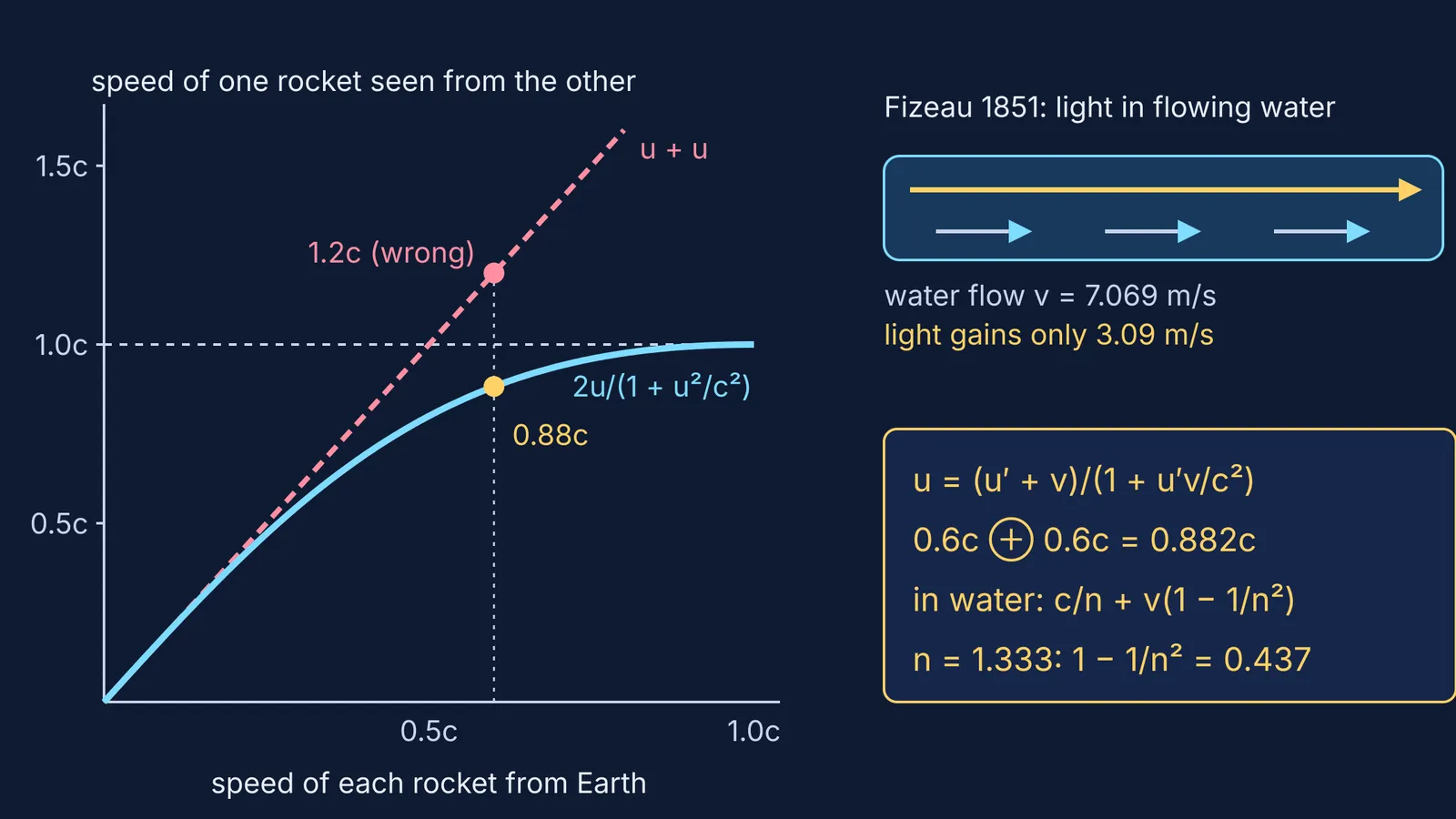
Two rockets leave Earth in opposite directions, each at 0.6c. Common sense says each sees the other moving away at 1.2c, faster than light. Special relativity says 0.88c. The rule that gives this, Einstein's velocity addition formula, takes three lines to derive from the Lorentz transformation, and it also explains a puzzle from 1851: why water flowing through a tube drags light along with only part of its own speed. Special relativity is beyond the NCERT syllabus and is not in the JEE Main or NEET syllabus, so treat this as enrichment.
What is the relativistic velocity addition formula?
Suppose frame S′ moves at speed v along x relative to frame S. An object moves along the same line at speed u′ measured in S′. Its speed in S is
u = (u′ + v) / (1 + u′v/c²)
The numerator is the everyday answer, u′ + v. The denominator is the correction. When both speeds are small compared with c, u′v/c² is tiny and the formula reduces to plain addition.
Two conditions matter. Both velocities must be along the same line; sideways components transform differently. And each speed is measured in its own frame: u′ relative to S′, v of S′ relative to S.
How does it follow from the Lorentz transformation?
Start from the Lorentz transformation, which the post on Minkowski's spacetime works through for a pair of events:
x′ = γ(x − vt)
t′ = γ(t − vx/c²)
Take small steps. For a moving object, dx′ = γ(dx − v dt) and dt′ = γ(dt − v dx/c²).
Divide. u′ = dx′/dt′ = (dx − v dt)/(dt − v dx/c²). The γ factors cancel.
Divide top and bottom by dt. With u = dx/dt, u′ = (u − v)/(1 − uv/c²).
Solve for u and you get the formula above. Notice that time is transformed as well as distance. Galilean addition fails because it assumes both frames share the same clock.
Worked example: why is 0.6c plus 0.6c only 0.88c?
Rocket A moves at +0.6c and rocket B at −0.6c, both measured from Earth. What speed does A measure for B?
Choose frames. S is Earth. S′ is rocket A, so v = +0.6c.
Known speed in S. Rocket B has u = −0.6c.
Use the inverse form. u′ = (u − v)/(1 − uv/c²) = (−0.6 − 0.6)/(1 − (−0.6)(0.6)) c.
Arithmetic. u′ = −1.2/1.36 c = −0.882c. The minus sign means B moves away from A in the −x direction.
Sense check. 0.882c is less than c, and more than 0.6c, as it must be.
Push the speeds up and the answer creeps towards c without reaching it:
0.9c and 0.9c combine to 1.8/1.81 = 0.9945c.
0.99c and 0.99c combine to 1.98/1.9801 = 0.99995c.
Light sent forward from a ship moving at 0.5c: (0.5 + 1)/(1 + 0.5) = exactly c. Every observer measures the same speed for light, which is Einstein's second postulate.
At everyday speeds the correction disappears. For two cars at 100 km/h each, uv/c² = 8.6 × 10⁻¹⁵, so their closing speed falls short of 200 km/h by about one part in 10¹⁴. No speedometer could see that.
Can two speeds below c ever add up to more than c?
No. Write u′ = a c and v = b c with a and b between 0 and 1. Then
c − u = c(1 − a)(1 − b)/(1 + ab)
which is positive whenever a and b are both less than 1. So the combined speed is always below c. If either speed equals c, the result is exactly c. "Nothing goes faster than light" here means no object or signal, in any inertial frame, and the addition formula is how the theory keeps that promise.
How does Fizeau's moving water fit in?
In 1851 Hippolyte Fizeau sent light through water flowing at 7.069 m/s, one beam with the flow and one against it, and compared them by interference. His fringe shift, his apparatus and the three ether theories he tested are described in the post on Armand Fizeau; the original figures are in his Comptes rendus note of 29 September 1851. The result matched Augustin Fresnel's earlier idea that a moving medium drags light by only a fraction, 1 − 1/n², of its speed. Fresnel had built that fraction on a partly dragged ether.
Velocity addition gives the same fraction with no ether at all:
In the water's frame light moves at u′ = c/n.
The water moves at v in the lab, so u = (c/n + v)/(1 + v/(nc)).
v is tiny compared with c, so 1/(1 + v/(nc)) ≈ 1 − v/(nc).
Multiply out and drop the v² term: u ≈ c/n + v − v/n².
So u ≈ c/n + v(1 − 1/n²). The last bracket is Fresnel's drag coefficient.
As Lahaye and colleagues describe in the American Journal of Physics (2012), Max Laue derived Fresnel's coefficient this way in 1907, in Annalen der Physik, two years after Einstein's 1905 paper.
Put in numbers for water, n = 1.333, with Fizeau's flow speed:
Drag coefficient: 1 − 1/1.333² = 1 − 0.5628 = 0.437.
Speed added to light: 0.437 × 7.069 m/s = 3.09 m/s.
Light in still water moves at c/n = 2.249 × 10⁸ m/s, so the change is about 1 part in 7 × 10⁷.
Water moving at 7 m/s speeds the light by only 3.1 m/s, not 7 m/s. Fizeau could see that because interference compares the two beams to a fraction of a wavelength. The exact formula gives the same 3.09 m/s; the approximation in step 3 changes nothing at this precision. A small extra correction for the way n depends on wavelength exists, but it is a few per cent of the effect.
Why does this matter if it is not in the exam?
The formula is the quickest way to see that the Lorentz transformation is not a curiosity about clocks. It changes how you combine motion, and it explains an 1851 measurement that ether theories could match only with a special assumption. It also builds on ideas you do study: relative velocity in Class 11 is the low-speed limit of this rule, and the twin paradox worked at 0.8c uses the same γ.
To practise relative-velocity problems first in their everyday form and then with relativity, the Fermi Problem Library has a step-by-step solver that explains the reasoning.
Quick checklist
u = (u′ + v)/(1 + u′v/c²) for speeds along the same line, each measured in its own frame.
Derive it by dividing dx′ by dt′ from the Lorentz transformation.
0.6c and 0.6c give 0.882c; 0.9c and 0.9c give 0.9945c; c with anything gives c.
Two speeds below c always combine to less than c.
For light in moving water: u ≈ c/n + v(1 − 1/n²); 7.069 m/s of flow adds 3.09 m/s.