

On this page
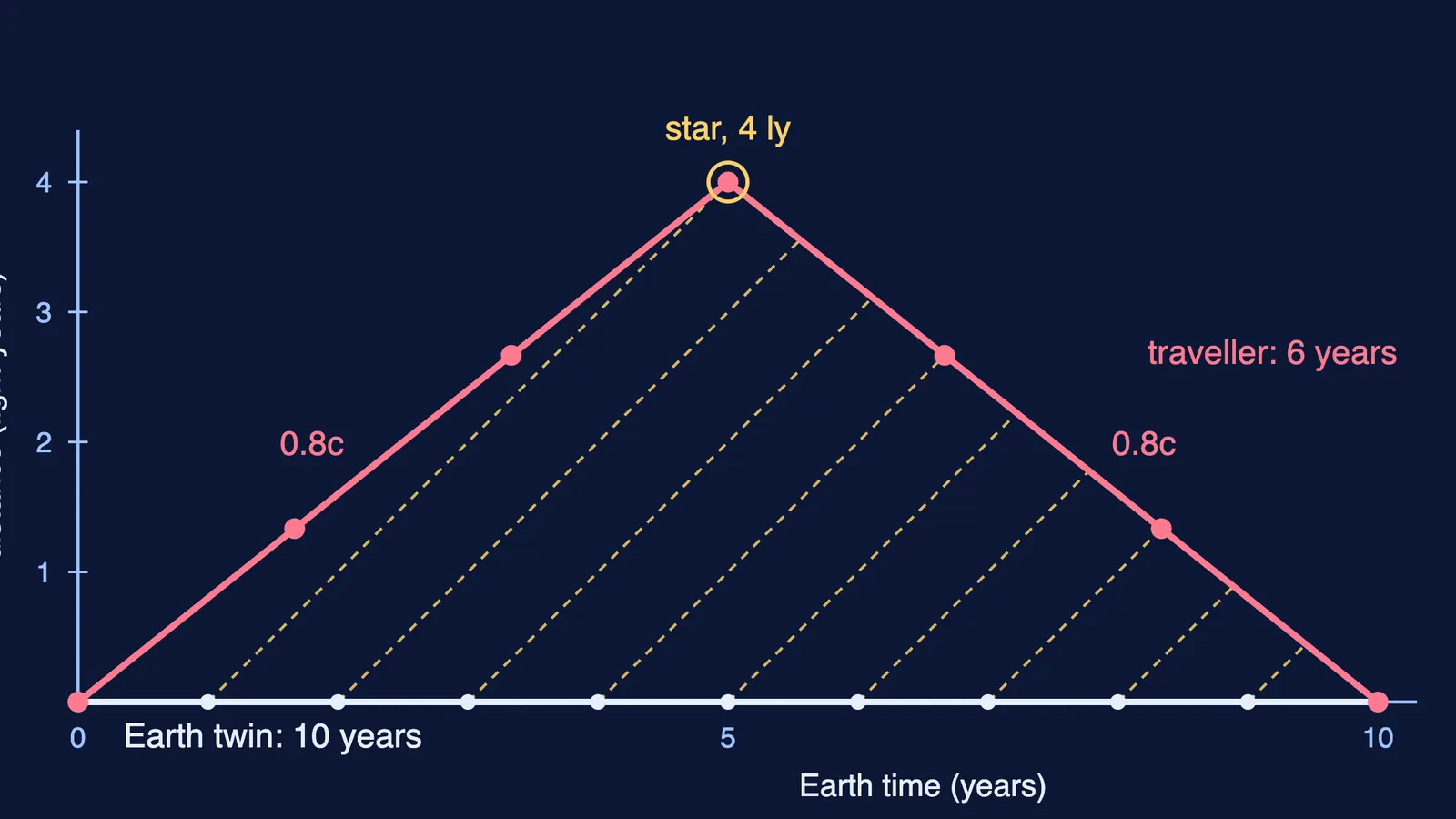
Two twins are 20 years old. One stays on Earth. The other flies to a star 4 light-years away at 0.8 times the speed of light, turns round and flies back. When they meet again, who is older? Special relativity gives a definite answer, and you can work it out with one square root.
What is the twin paradox?
The twin paradox is the puzzle of which twin ages more after one makes a fast round trip, given that each sees the other's clock running slow (OpenStax University Physics, Volume 3, section 5.3). The textbook answer is that the travelling twin ages less.
The "paradox" is the objection: motion is relative, so the traveller could say Earth moved away and came back, and the Earth twin should be younger. Both cannot be right.
How much younger is the travelling twin at 0.8c?
Time dilation says a clock moving at speed v ticks slower by the factor γ = 1/√(1 − v²/c²), and the time it records is the proper time (OpenStax, section 5.3). Here is the trip, step by step, all in Earth's frame.
Lorentz factor: v²/c² = 0.8² = 0.64, so √(1 − 0.64) = √0.36 = 0.6 and γ = 1/0.6 = 5/3.
Earth time: each leg is 4 light-years at 0.8 light-years per year, so 4 ÷ 0.8 = 5 years. The round trip takes 10 years.
Traveller time: the ship's clock runs at 0.6 of Earth's rate, so it records 10 × 0.6 = 6 years.
Result: the Earth twin is 30 and the traveller is 26. The traveller is 4 years younger.
Check it from the ship. In the traveller's frame the distance to the star is length-contracted to 4 × 0.6 = 2.4 light-years, and 2.4 ÷ 0.8 = 3 years per leg, 6 years in all. Same answer.
Why is the travelling twin the younger one?
The two twins are not in the same situation. The Earth twin stays in one inertial frame the whole time. The traveller accelerates away, turns round and decelerates home, so they change inertial frames, and the simple time dilation formula cannot be applied from the ship as if it never turned (OpenStax, section 5.3).
You can see the asymmetry with birthday signals. Suppose each twin sends a light flash on every one of their own birthdays. For a source moving away at 0.8c, the relativistic Doppler effect stretches the gap between flashes by √((1 + 0.8)/(1 − 0.8)) = √9 = 3; coming closer, it shrinks it by 3 (OpenStax, section 5.7).
The traveller spends 3 ship years going out and receives 1 Earth flash. On the 3 years home they receive 9. Total: 10 Earth birthdays in 6 years.
The Earth twin does not see the turnaround until its light gets home, 4 years after it happened in year 5, so in year 9. For 9 years they receive slow flashes, 9 ÷ 3 = 3 of them. In the last year they receive fast ones, 1 × 3 = 3. Total: 6 traveller birthdays in 10 years.
The counts agree: 10 years against 6. The switch from slow to fast flashes happens halfway through the traveller's trip, but only in year 9 of the Earth twin's 10-year wait. That lopsided switch is the turnaround, and only the traveller makes it.
If moving clocks still feel slippery, the Fermi Simulation Lab has interactive simulations for ideas that are easier to see than read.
Has anyone tested the twin paradox for real?
Yes, with atomic clocks instead of twins. In October 1971 Joseph Hafele and Richard Keating flew four caesium-beam atomic clocks around the world on commercial jets, once eastward and once westward (Hafele and Keating, Science, 1972).
Relative to the atomic time scale of the U.S. Naval Observatory, the flown clocks lost 59 ± 10 nanoseconds going east and gained 273 ± 7 nanoseconds going west, in good agreement with relativity (Hafele and Keating, Science, 1972). The authors called this an empirical resolution of the clock "paradox" with macroscopic clocks. Gravity mattered too, so they needed general as well as special relativity (OpenStax, section 5.3).
How do you practise problems like this?
Try the same steps at 0.6c to the same star: γ = 1.25, Earth time 13.3 years, ship time 10.7 years. If relative speed itself is shaky, start with the relative speed rule for two passing trains. For the other famous result of special relativity, see where 1 amu = 931.5 MeV comes from, and read about early relativity physicist Ali Moustafa Mosharafa.
If you get stuck on a step, Fermi's AI tutor works out what you already know and builds a plan for the session, so you can rebuild the idea from frames up.


