On this page
Ali Moustafa Mosharafa was an Egyptian theoretical physicist, born in Damietta on 11 July 1898 and died in Cairo in January 1950, according to his MacTutor biography. He took a BSc (Honours) at the University of Nottingham in 1920, then a PhD at King's College London in 1923 under Owen Willans Richardson, with a thesis titled *The Quantum Theory of Spectral Series*. The University of London gave him a DSc a year later, and his Wikipedia biography describes him as the first Egyptian to receive it.
What did Mosharafa discover in quantum theory?
The Stark effect is the shifting and splitting of spectral lines of atoms and molecules in an external electric field, discovered by Johannes Stark in 1913 (Stark effect, Wikipedia). In the early 1920s it was a test for the Bohr–Sommerfeld version of quantum theory. For a refresher on that model, read what each of Bohr's postulates fixes.
Mosharafa's first paper, *On the appearance of unsymmetrical components in the Stark effect*, appeared in the Philosophical Magazine in May 1922, signed from King's College London (doi:10.1080/14786442208633948). It predicted that in fields stronger than Stark's, the split lines would no longer sit symmetrically, and called for experiments to test this. He followed it with papers on the Zeeman effect, where lines split in a magnetic field (MacTutor).
His bolder idea came in the Proceedings of the Royal Society A in June 1924: half-integral quantum numbers in the theory of the Stark effect, and a general hypothesis of fractional quantum numbers (doi:10.1098/rspa.1924.0044). The abstract notes that Kratzer and Curtis had already seen hints of fractional quantum numbers in band spectra.
By December 1929 he was writing from Cairo, as Professor of Applied Mathematics at the Egyptian University, on *Wave mechanics and the dual aspect of matter and radiation*, building on the wave mechanics of de Broglie and Schrödinger (doi:10.1098/rspa.1929.0202). That theory was only a few years old, a rival to the matrix mechanics Heisenberg built in 1925.
Did Mosharafa work on relativity?
Yes. His MacTutor biography says that in his later years he worked on generalising Einstein's equations, especially the path of an electrically charged particle. In 1929 he published *The Motion of a Lorentz Electron as a Wave Phenomenon* in Nature (doi:10.1038/124726b0), joining relativity and waves. Near the end of his life came *The metric of space and mass deficiency* in the Philosophical Magazine in 1948 (doi:10.1080/14786444808521790) and *Mass-Defect Curves* in Nature in 1949 (doi:10.1038/164662b0). Mass defect is the gap between a nucleus's mass and the sum of its parts. For background, read how Einstein's general relativity showed gravity bends spacetime.
How did he lead science at Cairo University?
According to MacTutor, he joined the re-founded Egyptian University (now Cairo University) in 1925 as an associate professor. In 1926 he became Professor of Applied Mathematics at 28, although the rule required professors to be 30. In 1936 he became Dean of the Faculty of Science and founded the Mathematical and Physical Society of Egypt. He argued for translating scientific classics into Arabic, and in 1937 co-wrote a Nature paper with M. Mokhtar on modes in modern Egyptian music.
His Wikipedia biography says he stayed dean until his death in 1950, and credits him with 25 original papers and 12 scientific books on relativity and mathematics.
How big is a Stark shift? A worked example
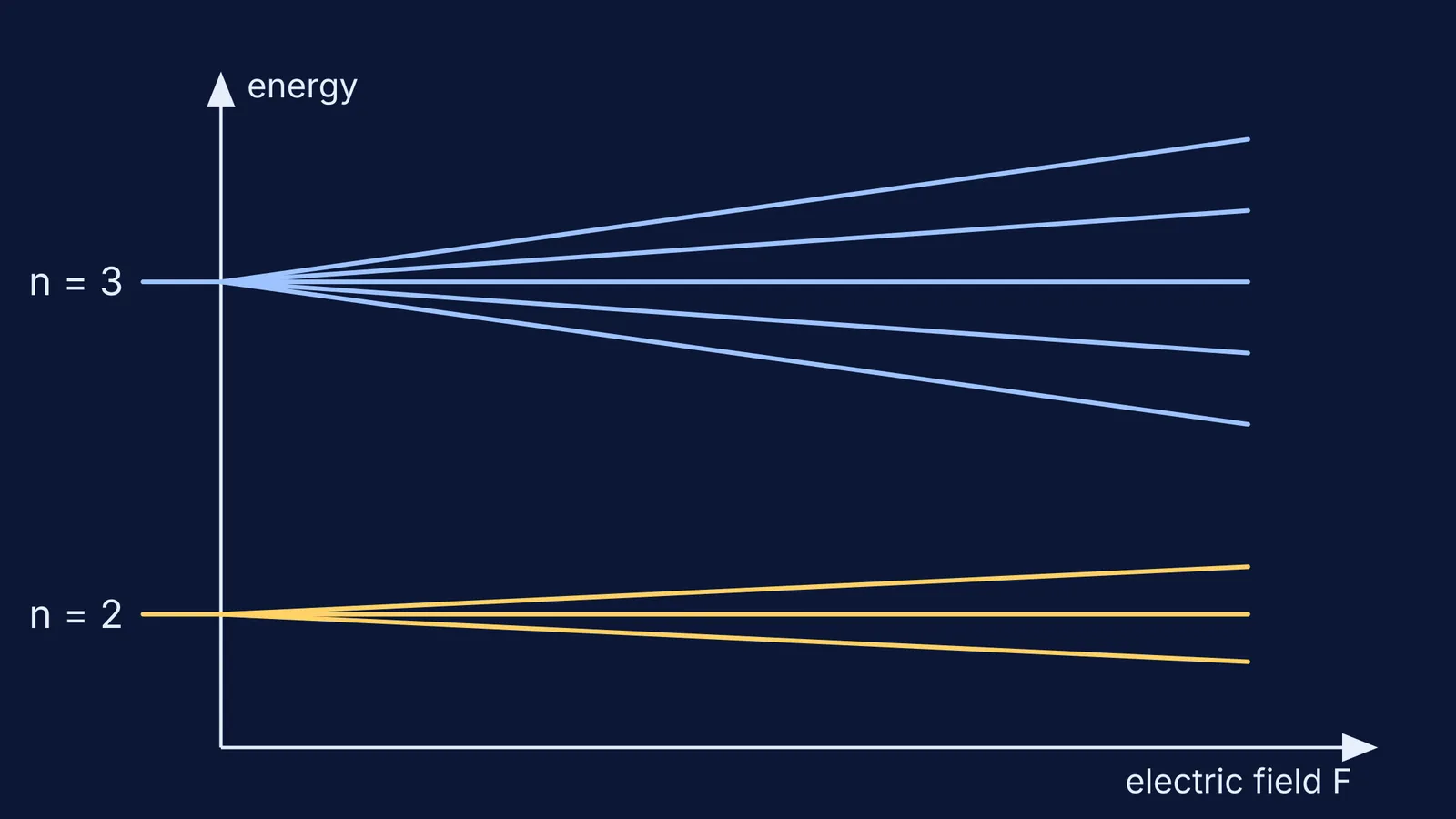
For hydrogen, the first-order Stark shift is ΔE = (3/2) n (n₁ − n₂) e a₀ F, where n₁ and n₂ are parabolic quantum numbers and F is the field (arXiv:physics/9807036). The Bohr radius a₀ is 5.29 × 10⁻¹¹ m (NIST), and hydrogen's levels sit at −13.6 eV/n² (NIST).
For n = 2, n₁ − n₂ can be −1, 0 or +1, so the level splits into three: shifts of −3, 0 and +3 times e a₀ F.
Take F = 1.0 × 10⁷ V/m. Then e a₀ F = 5.29 × 10⁻¹¹ m × 10⁷ V/m = 5.29 × 10⁻⁴ eV.
The outer n = 2 levels move by 3 × 5.29 × 10⁻⁴ ≈ 1.6 × 10⁻³ eV.
Compare that with the n = 2 energy of −3.40 eV: the shift is about 0.05%.
For n = 3, n₁ − n₂ runs from −2 to +2, giving five levels; the outermost move by 9 e a₀ F ≈ 4.8 × 10⁻³ eV.
The shifts are tiny, but a spectroscope can resolve them, and his 1922 paper called for experiments in stronger fields as a test of quantum theory.
What can a student take from Mosharafa?
Start from a measurement. His theory began with real spectral lines.
Question a rule when the data push back, as he did with whole-number quantum numbers.
Explain physics in your own language, as he argued for Arabic.
Energy-level fans are easier to see than to read, so try the Fermi Simulation Lab. If quantum numbers are the gap, the Fermi Concept Library gives each physics concept its own lesson.