

On this page
In June 1925, a 23-year-old Werner Heisenberg retreated to the rocky North Sea island of Helgoland. Suffering from a severe attack of hay fever, he sought refuge from the pollen of the mainland and the academic bustle of Göttingen. There, in isolation, he made a mathematical breakthrough that would change physics forever.
Heisenberg's work on Helgoland dismantled the visualizable models of the atom that physicists had relied on for over a decade. By abandoning unobservable electron orbits and focusing strictly on measurable quantities, he built the first complete framework of quantum mechanics.
Why did the old quantum theory fail?
By 1925, the existing atomic models were in a deepening crisis. Niels Bohr's atom model, introduced in 1913, pictured electrons orbiting a nucleus like planets around the Sun, jumping between fixed paths to emit or absorb light. This framework worked perfectly for predicting the spectral lines of the simple hydrogen atom.
However, the "old quantum theory" of Bohr and Arnold Sommerfeld struggled when applied to anything more complex. It could not accurately explain the spectrum of helium, which has two electrons, nor could it predict how bright the spectral lines of various elements would be. Worse still, it failed to account for the anomalous Zeeman effect, where spectral lines split in complex ways when an atom is exposed to a magnetic field.
The core problem, Heisenberg realized, was that physicists were building theories on unobservable concepts. No one had ever seen an electron orbiting a nucleus, nor could they measure an electron's exact position and velocity within that continuous orbit. Heisenberg decided that a true physical theory should be built using only what could be measured in a laboratory: the frequencies and intensities of the light that atoms emit and absorb.
What did Heisenberg discover on Helgoland?
On Helgoland, free from distractions and focusing entirely on these observable transitions, Heisenberg began to construct a new mathematics. Instead of writing a single classical equation for a continuous, unobservable electron path, he arranged the observable properties—the frequencies and amplitudes of light—into tables of numbers.
He applied this new mathematical approach to a simplified model called the anharmonic oscillator. As he worked through the complex calculations, he stumbled upon a strange and unexpected rule: the order in which he multiplied these tables of numbers mattered. In classical physics, variables commute, meaning A × B is always equal to B × A. In Heisenberg's new mechanics, multiplying an array for position by an array for momentum yielded a different result depending on the order.
Despite the mathematical strangeness, the theory worked.
How did matrix mechanics become a complete theory?
When his hay fever subsided, Heisenberg returned to Göttingen and showed his results to Max Born. Born, a brilliant theoretical physicist, immediately recognized that Heisenberg's strange multiplication rule was actually matrix algebra. While matrices were a mathematical tool well known to pure mathematicians, they were largely unfamiliar to physicists at the time.
In July 1925, Heisenberg submitted his groundbreaking findings to the journal *Zeitschrift für Physik* (10.1007/BF01328377). Soon after, he collaborated with Born and Pascual Jordan to quickly formalize the theory. Their joint effort became known as the "Three-Man Paper" (Dreimännerarbeit), establishing matrix mechanics as the first rigorous and complete formulation of quantum theory.
How do observable frequencies become a matrix?
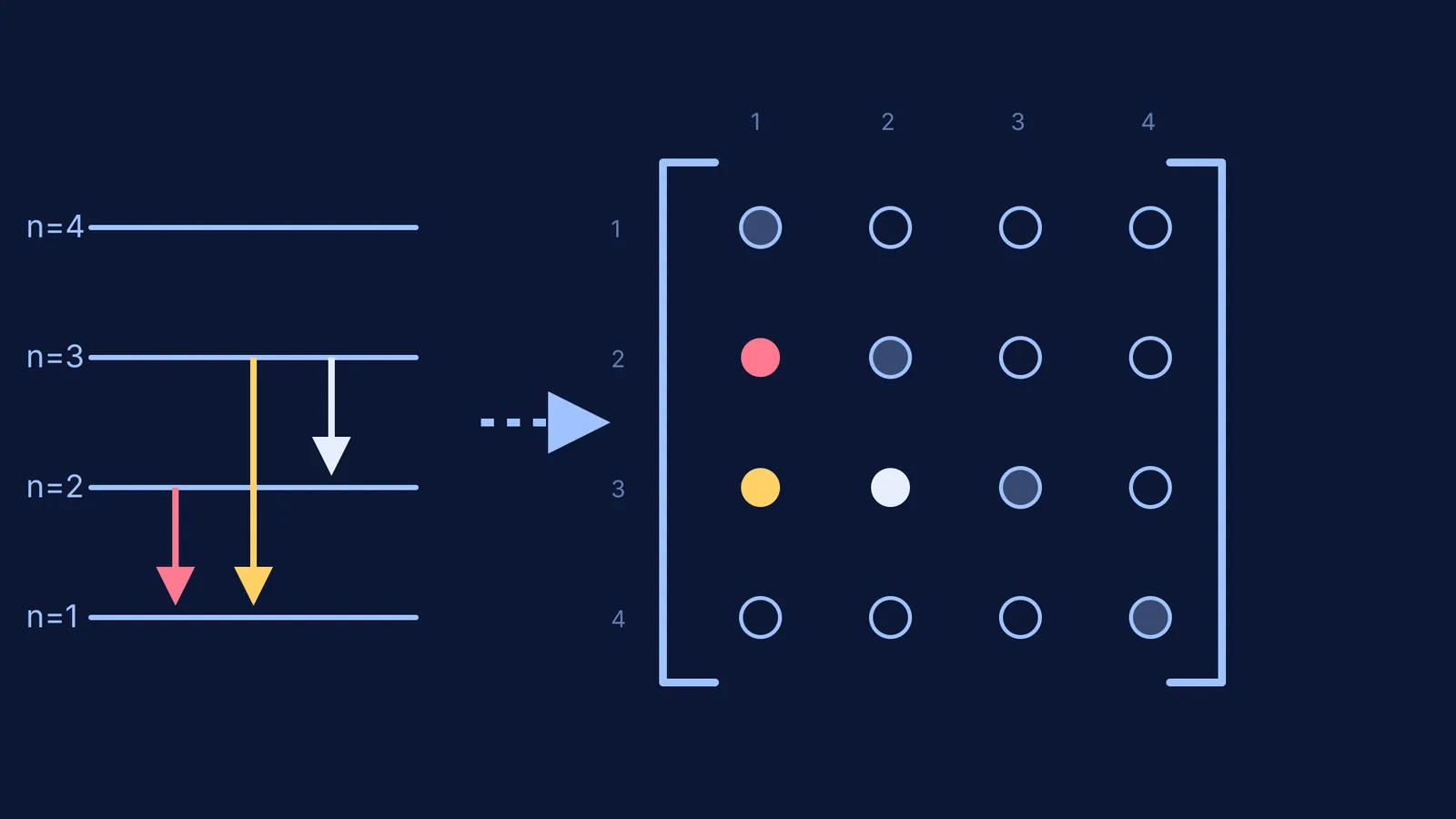
To see why Heisenberg used a grid of numbers instead of a continuous equation, consider a simple atom with three energy levels (n = 1, 2, 3). An electron dropping from level 2 to level 1 emits light at a specific frequency, while an electron dropping from 3 to 1 emits a different frequency.
Instead of trying to calculate an impossible continuous path for a quantum jump, you can write these discrete transition frequencies systematically in a table:
Row 2, Column 1 holds the transition between levels 2 and 1.
Row 3, Column 1 holds the transition between levels 3 and 1.
Row 3, Column 2 holds the transition between levels 3 and 2.
This grid format is exactly what mathematicians call a matrix. The old theory failed because it tried to map a continuous journey between states; matrix mechanics succeeded because it simply tabulated the measurable starting and ending states.
This historic shift from visualizable orbits to abstract matrices can be conceptually difficult to grasp when you first encounter it. If you have concept gaps, the Fermi Concept Library covers every concept in physics, chemistry, biology, mathematics and computing, helping you build a clear foundation in quantum states and operators.
Heisenberg's insistence on using only measurable quantities paved the way for modern physics, eventually leading to his famous Uncertainty Principle in 1927. His mathematical arrays laid the groundwork for future visionaries, including John von Neumann, who built the rigorous mathematical foundations of quantum mechanics that scientists and engineers still use today.


