

On this page
Before 1849, every estimate of the speed of light came from astronomy, from watching moons or stars. Armand-Hippolyte-Louis Fizeau, usually called Hippolyte, measured it across the rooftops of Paris with a lamp, two telescopes, a mirror and a spinning wheel. This post explains how his method works, walks through the arithmetic so you can check his number yourself, and looks at the second experiment that tested what light does inside moving water.
Who was Hippolyte Fizeau?
Fizeau was born in Paris on 23 September 1819 and died on 18 September 1896, according to his MacTutor biography. His family expected him to become a doctor, but severe migraines made him leave medical school. He turned to physics instead, attending Arago's lectures and studying his brother's lecture notes from the École Polytechnique.
With his school friend Léon Foucault he improved early photography and, in 1845, took the first photograph of the Sun. The two later fell out and each chased the speed of light on his own. Foucault's most famous work is in our post on the pendulum that showed Earth rotating. Fizeau was elected to the Academy of Sciences in 1860 and received the Royal Society's Rumford Medal in 1866.
How does a toothed wheel measure the speed of light?
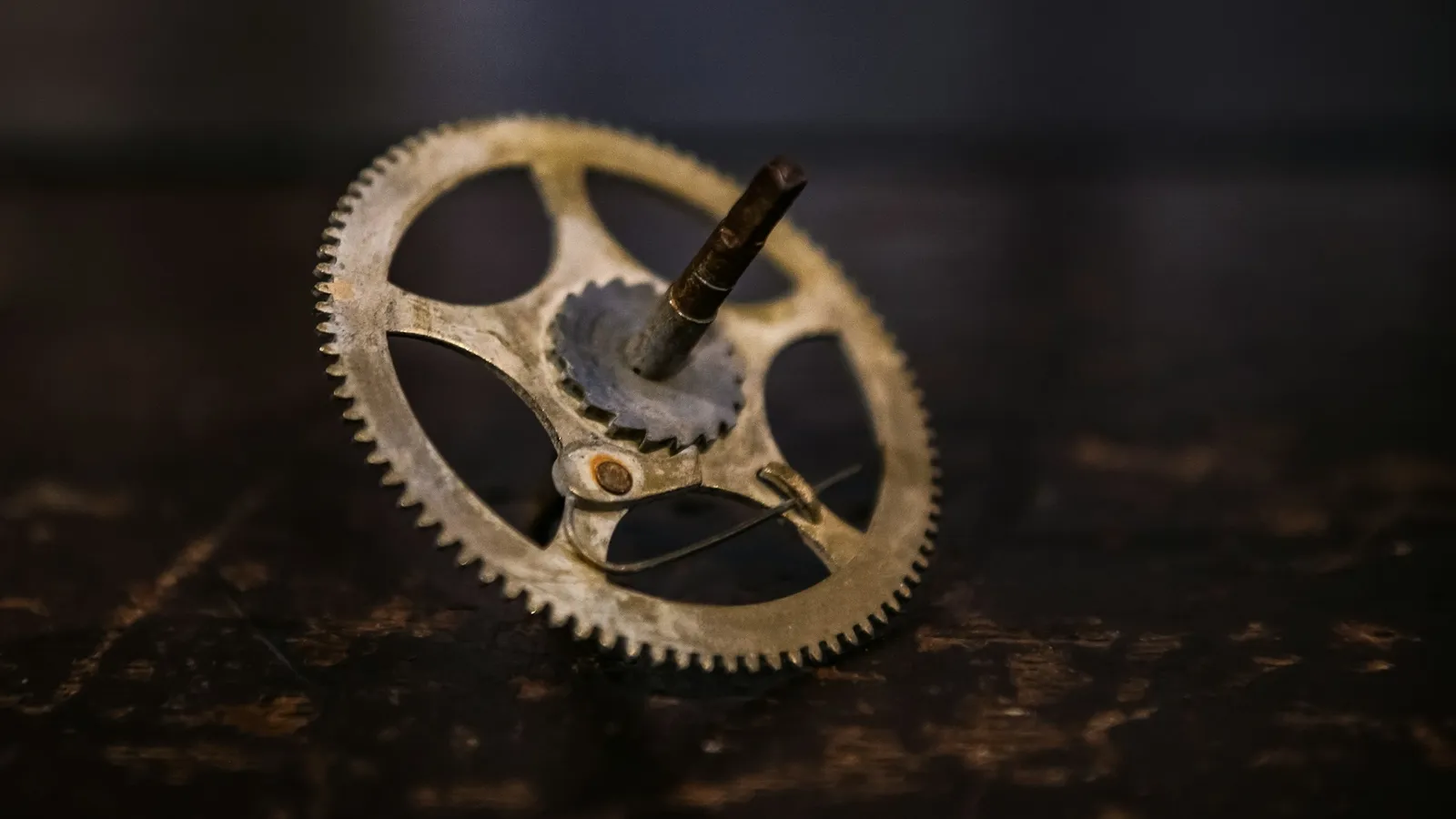
Fizeau described the method in a short note in the Comptes rendus of 23 July 1849. Light from a lamp passes through a gap at the rim of a spinning toothed disc, travels to a distant mirror, comes back, and meets the disc again at the same point. If the disc has turned just enough for a tooth to fill that point, the returning light is blocked.
His set-up used two telescopes pointed at each other. One stood in the belvedere of a house in Suresnes, the other on the hill of Montmartre, at a distance he gave as approximately 8,633 metres. The returning light looked like a star and had travelled about 16 kilometres before reaching his eye.
The disc, built by the instrument maker Froment, had 720 teeth and was driven by weights, with a counter to measure its speed. Fizeau reported the pattern clearly:
at about 12.6 turns per second the bright point vanished completely, the first eclipse;
at double that speed it shone again;
at triple speed came the second eclipse, and so on.
The mean of the 28 observations he could make gave 70,948 leagues of 25 to the degree. A degree of Earth's meridian is about 111 km, so one such league is about 4.445 km, and his value works out to about 315,000 km/s. Today the speed of light is fixed by definition at 299,792,458 metres per second, so Fizeau was about 5% high.
Can you check Fizeau's number yourself?
Here is the worked example.
Count the slots. 720 teeth and 720 gaps make 1,440 equal spaces around the rim. Light that leaves through a gap is blocked on return if the wheel has turned by one space.
Time for one space. The wheel makes f turns per second, so one space passes in t = 1 / (2Nf) = 1 / (2 × 720 × 12.6) = 1 / 18,144 s = 55.1 microseconds.
Distance in that time. The light goes there and back: 2d = 2 × 8,633 = 17,266 m.
Speed. c = 2d / t = 4dNf = 4 × 8,633 × 720 × 12.6 = 3.13 × 10⁸ m/s.
That is slightly lower than his published mean, because 12.6 turns per second was his round figure ("vers 12,6") and each observation had its own speed. At today's value of c, the round trip takes 57.6 microseconds.
Common mistakes in exam versions of this problem:
Using d instead of 2d. The light makes a round trip.
Using a full tooth period. A gap is replaced by a tooth after half of one tooth-plus-gap period, which is where the factor 2 in 2N comes from.
Getting the second eclipse wrong. It comes at three times the first speed, not twice. At twice the speed the next gap lines up, and the light gets through.
What did Fizeau find with moving water?
In 1851 he asked a harder question: does moving water drag light along with it? His Comptes rendus note of 29 September 1851 describes two tubes, each 1.487 m long and 5.3 mm wide, with water running through them at 7.07 m/s, and two light beams travelling with and against the flow. The beams were combined to form interference fringes.
From 19 observations, reversing the flow shifted the fringes by 0.46 of a fringe width. He compared this with three ideas about the ether, the medium light was then thought to travel in:
ether completely free of the water: shift 0;
ether carried fully by the water: shift 0.92;
Fresnel's partial dragging: shift 0.40.
The measurement sat close to Fresnel's prediction. A similar test with air moving at 25 m/s showed no visible shift, which also matched Fresnel. MacTutor notes that Michelson repeated the water experiment in 1886; his story is in our post on Albert Michelson and measuring the speed of light.
What can a student learn from Fizeau's way of working?
Turn an impossible measurement into a possible one. He could not time 57 microseconds, but he could count wheel turns.
Use a pattern as a check. Eclipse, light, eclipse at one, two and three times the speed told him the effect was real and not a fault in the wheel.
Put every hypothesis into numbers. 0, 0.40 or 0.92 against an observed 0.46 is far more convincing than "the fringes moved".
Say how good your data is. He called his distance approximate and promised a fuller memoir once every circumstance had been studied.
If you set up problems like the toothed wheel but stall on the method, the Fermi Problem Library has worked problems with a step-by-step solver that explains the reasoning rather than printing an answer.
Try it now: work out the wheel speed Fizeau would have needed for the first eclipse if he had known today's value of c.


