On this page
On the night of 13 December 1920, Francis Pease pointed the 100-inch Hooker telescope on Mount Wilson at Betelgeuse, the red star at Orion's shoulder. Two mirrors on a steel beam across the top of the telescope were set 121 inches apart. On other stars, the eyepiece showed a neat set of bright and dark interference fringes. On Betelgeuse, the fringes were gone. From that one missing pattern, Albert Michelson and Pease worked out the angle the star covers in the sky: 0.047 arcseconds. It was the first measured angular diameter of a star other than the Sun, and it uses exactly the wave optics of Young's double slit that you study in Class 12.
Why can't a telescope simply see the size of a star?
Every star looks like a point because its disc is far smaller than the blur a telescope makes. A circular aperture of diameter D cannot separate details finer than 1.22λ/D, as covered in the post on resolving power of microscopes and telescopes. For the 100-inch (2.54 m) mirror at λ = 575 nm, that limit is 0.057″, already larger than Betelgeuse's 0.047″. And the air above the telescope smears star images far more than that.
Michelson's trick was to stop trying to form an image. Interference fringes record angles in a way that the air disturbs much less. Michelson and Pease reported that the fringes stayed visible across the full 100-inch aperture "even when the seeing is poor" (Michelson and Pease, PNAS, 1921).
How do two mirrors act like Young's two slits?
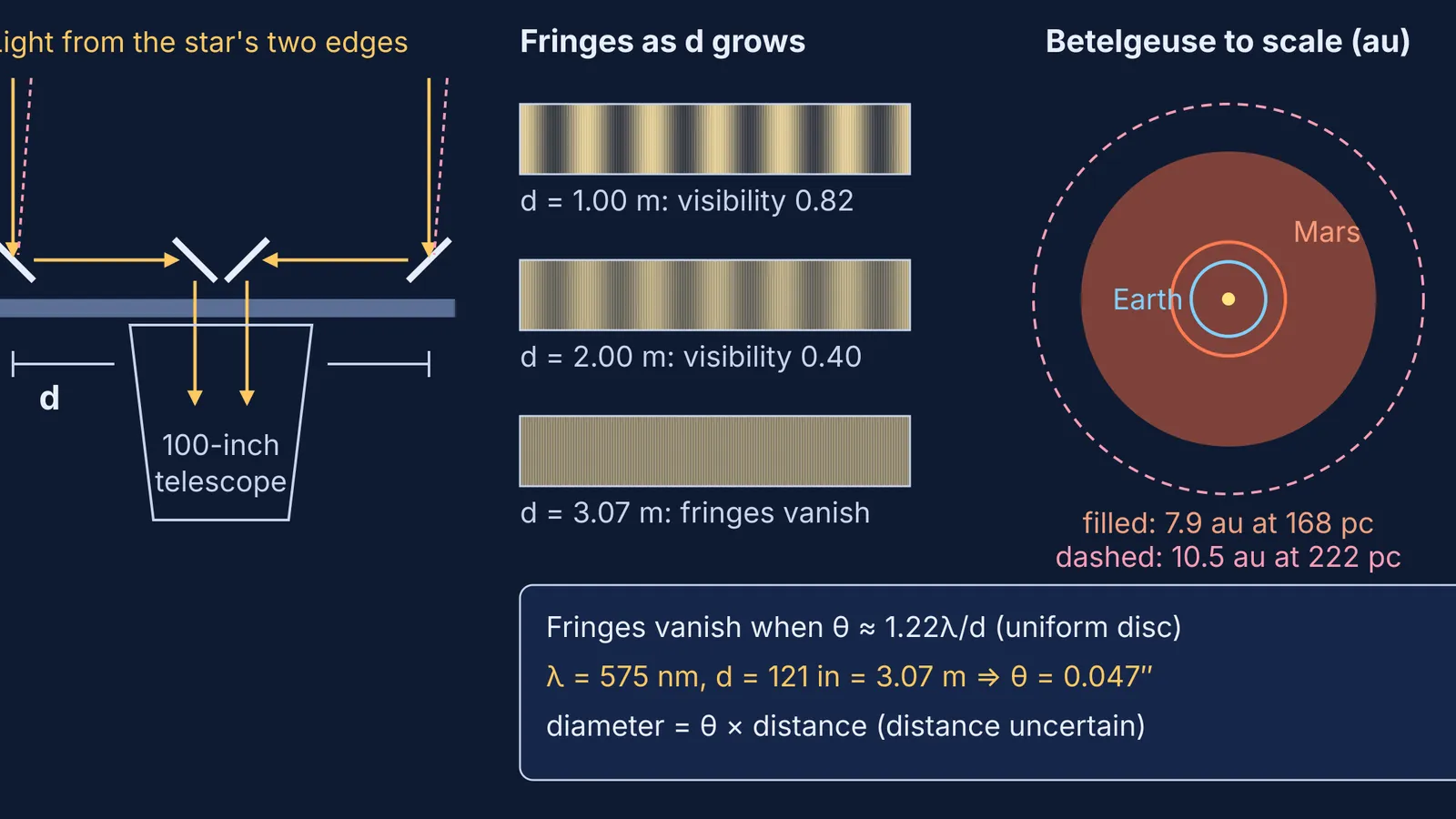
The instrument had four flat mirrors on a steel beam fixed across the top end of the telescope. The two outer mirrors could slide apart to a separation d of up to 20 feet (6.1 m). They caught starlight and sent it sideways to two fixed inner mirrors 45 inches apart, which passed it down the telescope to one eyepiece. The two outer mirrors play the part of the two slits. The light from them meets at the focus and makes straight fringes, just as in Young's experiment.
Because the inner mirrors stay fixed, the fringe spacing in the eyepiece does not change as the outer mirrors move. What changes is how clearly the fringes show.
Why do the fringes vanish at θ ≈ 1.22λ/d?
A star is not one point of light. It is a disc, and each point on the disc sends light from a slightly different direction. Each point makes its own set of fringes, and the sets do not interfere with each other.
Start with two points a small angle α apart. Light from the second point arrives tilted, so it reaches one outer mirror earlier than the other. The extra path is d × α, and its fringe pattern shifts by that much. When d × α = λ/2, the bright fringes of one point fall on the dark fringes of the other, and the screen goes evenly lit. This is the same washing-out you see in the post on a wide or shifted source slit in YDSE, turned round: there, the source width spoils the fringes; here, the vanishing fringes measure the source.
A uniformly bright disc is a spread of many such points. Adding up all their patterns gives a fringe visibility that falls as d grows and first reaches zero when
θ = 1.22λ/d
where θ is the disc's full angular diameter. The 1.22 is the same factor as in the resolving-power formula, and for the same reason: both come from a circular shape. Widen the mirrors step by step, note the d at which the fringes first vanish, and you have θ.
Worked example: Betelgeuse in December 1920
All figures are from Michelson and Pease's paper in PNAS; the full account is in The Astrophysical Journal, vol. 53.
Step 1. Mirror separation at which the fringes vanished: d = 121 inches = 121 × 0.0254 m = 3.07 m.
Step 2. Effective wavelength assumed for Betelgeuse's yellow-red light: λ = 575 nm.
Step 3. Angle for a uniform disc: θ = 1.22 × 575 × 10⁻⁹ / 3.07 = 2.28 × 10⁻⁷ rad.
Step 4. Convert to arcseconds. One radian is 206,265″, so θ = 2.28 × 10⁻⁷ × 206,265 = 0.047″, the value in the paper.
To feel how small that is, a coin 2 cm across would cover 0.047″ from about 88 km away.
Step 5. Check the instrument. The same night, the fringes showed clearly on Procyon (α Canis Minoris) at the same setting, so the mirrors were still aligned and Betelgeuse's missing fringes were real.
How big is Betelgeuse?
That last step is where the uncertainty lives. In 1921, Michelson and Pease used a mean parallax of 0.018″, a distance of about 56 parsecs. That gives 0.047 × 56 ≈ 2.6 au, or 240 million miles, which they described as "slightly less than" the diameter of Mars's orbit.
Betelgeuse turned out to be farther away, and its distance is still uncertain today. Two peer-reviewed estimates:
222 pc (+48, −34) from radio positions combined with Hipparcos data (Harper and colleagues, The Astronomical Journal, 2017).
168 pc (+27, −15) from models of the star's evolution and pulsations (Joyce and colleagues, The Astrophysical Journal, 2020).
With 0.047″, these give 0.047 × 168 = 7.9 au and 0.047 × 222 = 10.5 au. Mars's orbit has a semimajor axis of 1.52 au, so it is about 3.0 au across. Placed where the Sun is, Betelgeuse would swallow the orbits of Mercury, Venus, Earth and Mars.
For contrast, the Sun (radius 695,700 km, NASA Sun fact sheet) seen from 10 parsecs would be only 0.0009″ across, about 50 times smaller than Betelgeuse looks from Earth.
What did Michelson and Pease warn about?
Their paper is careful about its own limits:
The mirror setting was uncertain by "at least 10 per cent".
The wavelength was assumed, not measured for this star.
The formula assumes a uniformly bright disc. Real stars are darker near the edge (limb darkening). They estimated that limb darkening like the Sun's would raise the diameter by about 17 per cent.
The method itself held up. Today's long-baseline interferometers still use the same idea, with telescopes up to hundreds of metres apart instead of mirrors 3 m apart.
The Simulation Lab has interactive simulations of double-slit interference, where you can change the slit spacing and watch the fringes change. The Concept Library covers coherence and fringe visibility if the washing-out step still feels unclear.
Safety: never point a telescope or binoculars at the Sun, even for a moment. They focus enough sunlight to cause permanent eye damage instantly. Betelgeuse and other stars are safe to look at.
Quick checklist
Two outer mirrors d apart act as Young's two slits for starlight.
Each point on the star's disc makes its own fringes, shifted by its angle.
For a uniform disc, the fringes first vanish when θ = 1.22λ/d.
Betelgeuse: d = 3.07 m, λ = 575 nm, θ = 0.047″.
The diameter needs the distance: about 8 to 10 au, wider than Mars's orbit.