On this page
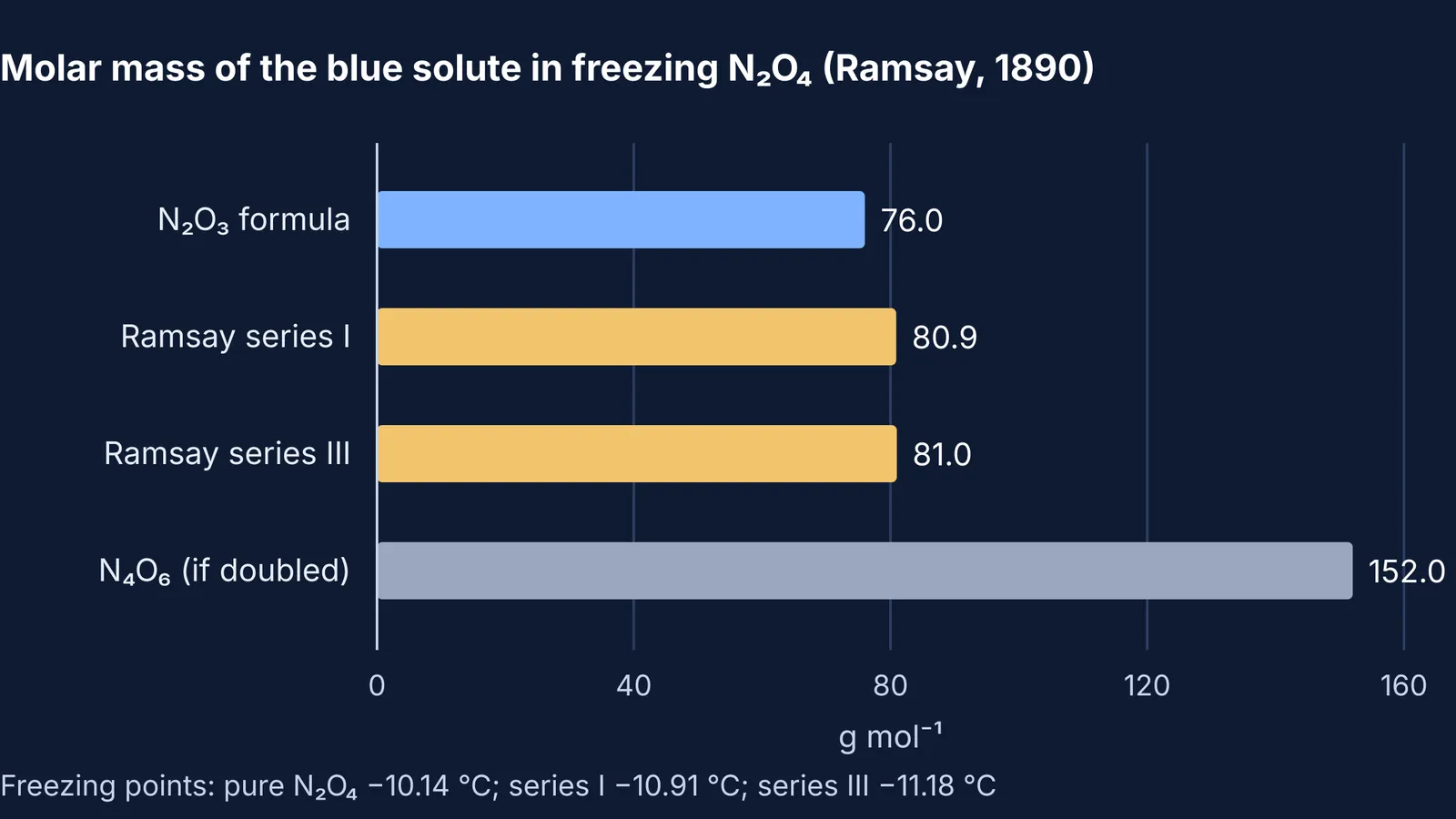
In 1890 William Ramsay, then professor at University College London, asked a question that every textbook table now skips: is N₂O₃ a real molecule, or only a mixture of NO and NO₂? He could not weigh it as a gas, because it falls apart. So he dissolved it in ice-cold liquid N₂O₄, measured how far the freezing point fell, and got a molar mass of about 81, against 76 for N₂O₃.
This post is about that one paper: W. Ramsay, "Über Stickstofftrioxyd und -tetroxyd", Z. phys. Chem. 5 (1890) 221–226 (scan on the Internet Archive). Translations from the German are ours. For his life and the noble gases, read how a tiny density gap led Ramsay to argon.
Safety: NO, NO₂ and N₂O₄ are toxic. This is history, not a procedure.
Why was N₂O₃ so hard to weigh?
The blue liquid called "nitrogen trioxide" was, Ramsay wrote, "in reality a mixture of this oxide with tetroxide or peroxide." Its vapour is NO and NO₂, so a vapour density would only weigh the pieces.
His fix used the idea we now call Le Chatelier's principle. N₂O₃ ⇌ NO + NO₂, so a solvent full of NO₂ should hold the molecule together. In his words: "since the peroxide is a dissociation product of the trioxide, there is a particular advantage in using the peroxide as the solvent for the trioxide, because dissociation is, as is known, reduced by the presence of one of the dissociation products."
He called NO₂ "peroxide" and N₂O₄ "tetroxide"; liquid N₂O₄ always holds some NO₂ (see why NO₂ dimerises to N₂O₄).
How did he find the freezing-point constant of N₂O₄?
From four runs he found that N₂O₄ freezes at −10.14 °C. Then he dissolved known solutes:
0.5269 g CHCl₃ in 17.3046 g N₂O₄: depression 1.06 °C.
0.4931 g C₆H₅Cl in 16.7650 g N₂O₄: depression 1.09 °C.
He used the old unit: the depression for one mole in 100 g of solvent. Our recalculation gives 41.6 and 41.7 (his printed product for the first run, 41.0, is an arithmetic slip), and he adopted 41. Per mole in 1000 g that is ten times smaller: Kf ≈ 4.1 K kg mol⁻¹.
Raoult had claimed that this constant divided by the solvent's molar mass is always about 0.63. For N₂O₄, 41 ÷ 0.63 = 65, not 92. Ramsay wrote that either N₂O₄ "is an exception to the rule" or it is really a mix of NO₂ and N₂O₄, and he rejected the second because it clashed with his 1888 molar mass of 90.3–95.9 in acetic acid. There is no universal ratio: Kf depends on each solvent's freezing point and heat of fusion.
What molar mass did the blue solute give?
NO passed into N₂O₄ at −20 °C "soon changed the orange colour to a blue one." The NO joins NO₂ already present:
NO + NO₂ → N₂O₃, or in the NCERT form, 2NO + N₂O₄ → 2N₂O₃ (4 N and 6 O on each side).
Two of his three series (the middle one is internally inconsistent, so we leave it out):
Series I: 1.497 g N₂O₃ per 100 g N₂O₄, freezing point −10.91 °C, molar mass 80.9.
Series III: 2.000 g N₂O₃ per 100 g N₂O₄, freezing point −11.18 °C, molar mass 81.0.
He set these against the formula value, 76.0.
Worked example 1: molar mass from ΔTf
Series I in modern units.
NO absorbed: 0.1063 g. N₂O₃ formed: 0.1063 × 76.01 ÷ 30.01 = 0.2693 g.
NO₂ used up: 0.1063 × 46.01 ÷ 30.01 = 0.1630 g, so solvent left = 18.1482 − 0.1630 = 17.9852 g.
ΔTf = −10.14 − (−10.91) = 0.77 K.
M = 1000 × Kf × w₂ ÷ (ΔTf × w₁) = 1000 × 4.1 × 0.2693 ÷ (0.77 × 17.9852) = 79.7 g mol⁻¹.
Series III the same way: 0.520 K per 1 g in 100 g, so M = 41 ÷ 0.520 = 78.8 g mol⁻¹.
He printed 80.9 and 81.0, perhaps from a slightly different constant. Either way the answer is near 76, not 152 for a doubled N₄O₆. The full method is in how to find molar mass from depression in freezing point.
Can you get Kf from the heat of fusion?
Yes. Ramsay used van 't Hoff's formula, w = 0.02T² ÷ t, where w is the heat of fusion in cal per gram, T the freezing point in kelvin and t the constant per 100 g. The 0.02 is just R ÷ 100 in calories (1.987 ÷ 100). With T = 262.86 K and t = 41 he got w = 33.7 cal g⁻¹.
Then he measured it in a calorimeter. After subtracting the heat from the flask and the liquid (specific heat 0.477), two runs gave two equations in two unknowns: the solid's specific heat came out as 1.0 and the heat of fusion as 32.2 cal g⁻¹. He called 1.0 "very unlikely" and blamed experimental error; with 0.5 instead, the runs give 37.2 and 36.7. He concluded the true value lies "between 32.2 and 37.2", which agrees well enough with 33.7.
Worked example 2: Kf from ΔfusH
Data source: Ramsay's own heats of fusion above.
Convert 33.7 cal g⁻¹: 33.7 × 4.184 × 92.01 = 12.97 kJ mol⁻¹.
Kf = R × M₁ × Tf² ÷ (1000 × ΔfusH), with M₁ = 92.01 g mol⁻¹ and Tf = 263.01 K.
Kf = 8.314 × 92.01 × 263.01² ÷ (1000 × 12970) = 4.08 K kg mol⁻¹, matching the 4.1 from the solutes.
His range, 32.2 to 37.2 cal g⁻¹, gives Kf from 4.27 down to 3.70.
Is N₂O₃ real, or just NO and NO₂ together?
Cooled with liquid N₂O, the solution dropped white crystals of N₂O₄, but a blue liquid could always be pressed out: "The trioxide was thus still liquid at −90°." With more NO it stayed blue to −99 °C. He described a "pure blue colour, like cobalt glass."
After driving off free NO, he let in oxygen and the tube turned red at the top: NO was still being released, so even at −90 °C the trioxide splits. His conclusion: N₂O₃ is "a very unstable body" that can exist "only in the presence of its decomposition product, N₂O₄."
His blue liquid was a solution, so it does not contradict NCERT's "blue solid". Unlike As₄O₆, Sb₄O₆ and P₄O₆, it does not double up. Its long N–N bond is in oxides of nitrogen: structures and oxidation states.
Where does this come up in JEE and NEET?
Class 12 Solutions: ΔTf = Kf·m, molar mass from freezing point, and Kf from ΔfusH (a JEE favourite).
Oxides of nitrogen: N₂O₃ is blue, made from NO and N₂O₄ near 250 K, and is the anhydride of HNO₂. The JEE Advanced syllabus names oxides of nitrogen.
For ΔTf numericals, the Fermi Problem Library has a step-by-step solver that explains the reasoning. For exam practice, Fermi Test Prep covers JEE Main and Advanced preparation with an AI tutor.
Quick checklist
Ramsay dissolved N₂O₃ in N₂O₄ so that NO₂ would suppress its dissociation.
N₂O₄ freezes at −10.14 °C; Kf ≈ 4.1 K kg mol⁻¹.
Series I and III gave 80.9 and 81.0; N₂O₃ is 76, not 152.
Kf = RM₁Tf²/(1000 ΔfusH) links the constant to the heat of fusion, about 13 kJ mol⁻¹.