On this page
Shine a flash of light across a closed box floating in space and the box moves. It moves backwards, by about 10⁻¹⁷ m for a 1 J flash in a 1 kg box, which is less than a hundredth of the width of a proton. But in 1906 Albert Einstein used this imaginary box to show that light carries mass, and that the mass is E/c². You need only two ideas from Class 11 and 12: the centre of mass of an isolated system stays put, and light carries momentum p = E/c. The full argument goes beyond the NCERT syllabus, which states E = mc² without deriving it, so read this as an extension of the Class 12 Nuclei chapter.
What was Einstein's 1906 box argument?
The argument is in a short paper, "The principle of conservation of motion of the centre of gravity and the inertia of energy", Annalen der Physik, volume 20 (1906), pages 627 to 633. It is a different route from his 1905 paper, which compared the energy of a body before and after it emits light, as seen from two frames. The 1905 result is covered in our post on Einstein's 1905 papers.
The 1906 version uses a hollow, closed cylinder. We will call it a box. Light is sent from one end to the other inside it. Nothing outside touches the box, so the centre of mass of the box and everything in it must stay where it is. Einstein showed that this is only possible if the light carries mass from one end to the other.
The physicist Eugene Hecht reviewed all of Einstein's demonstrations of mass-energy equivalence in the American Journal of Physics in 2011. His conclusion: each one has limits, and Einstein never produced a general proof. Treat the box as a clear sketch, not a proof.
How does a flash of light move the box?
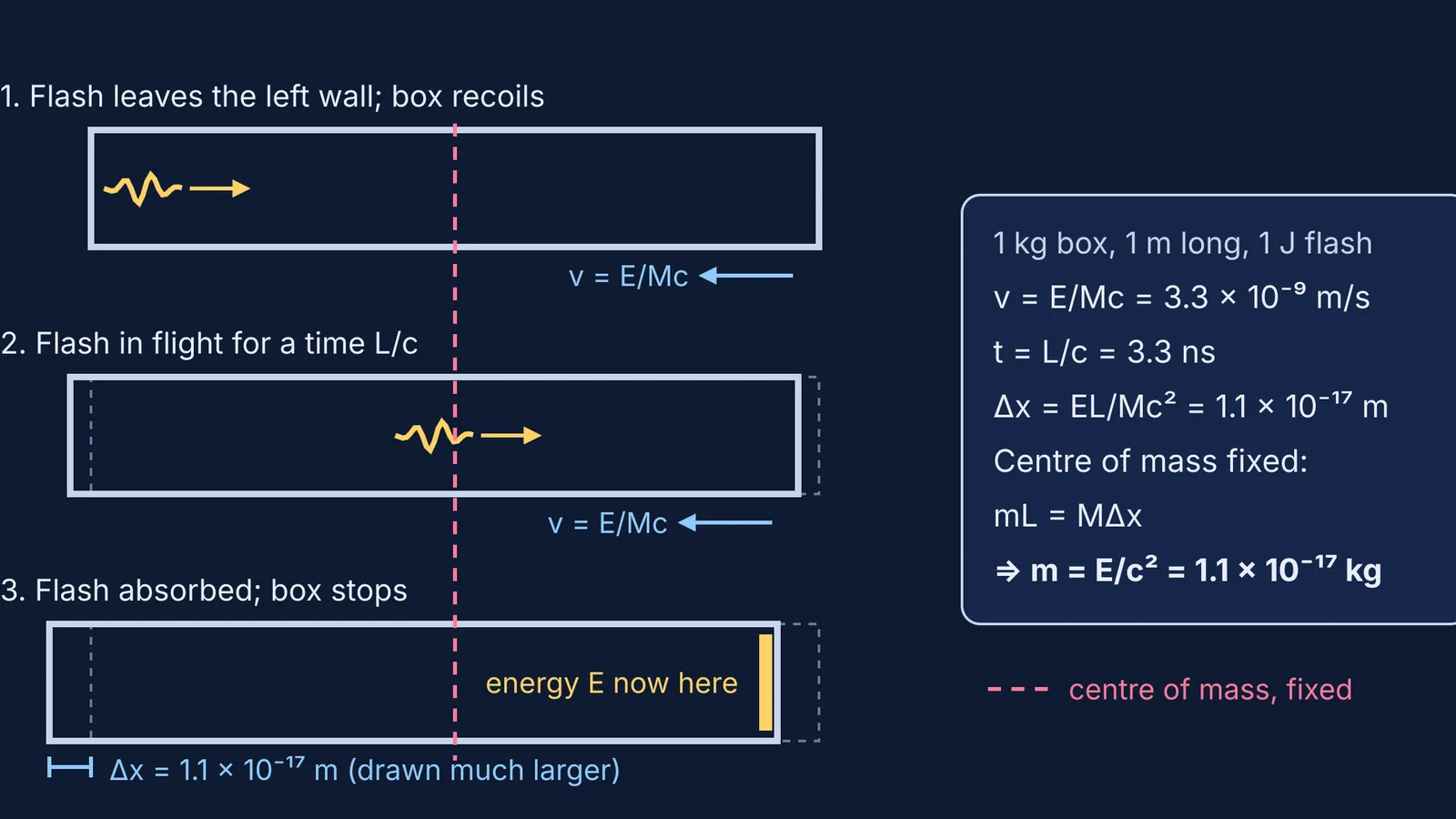
Take a box of mass M and length L, at rest in space. A lamp on the left wall sends a short flash of energy E towards the right wall.
The flash leaves. Light of energy E carries momentum E/c, as covered in photon momentum and radiation pressure. The total momentum was zero, so the box must recoil to the left with momentum E/c. Its speed is v = E/(Mc).
The flash travels. The light needs a time t = L/c to cross the box.
The flash is absorbed. At the right wall the light gives up its momentum E/c, now pushing to the right. That cancels the box's momentum, and the box stops.
So the box has moved to the left by
Δx = vt = (E/Mc)(L/c) = EL/(Mc²)
Then it sits still again. Nothing has left the box. Only energy has moved from the left wall to the right wall.
Why does that mean light has mass?
The box is isolated. No outside force has acted on it, so the centre of mass of the whole system cannot have moved. Yet the box itself has shifted left. The only way out is that something with mass went from left to right.
Say the flash carried a mass m across the length L, while the box (mass M) moved back by Δx. For the centre of mass to stay fixed, the two moments must balance:
m × L = M × Δx
Put in Δx = EL/(Mc²):
m × L = M × EL/(Mc²), so m = E/c²
The box length and the box mass both cancel. Every joule of energy moved from one wall to the other carries 1/c² kilograms with it.
Worked example: a 1 J flash in a 1 kg box
Take M = 1 kg, L = 1 m and E = 1 J, with c = 2.998 × 10⁸ m/s (CODATA values from NIST).
Step 1. Momentum of the flash: p = E/c = 1 ÷ 2.998 × 10⁸ = 3.34 × 10⁻⁹ kg m/s.
Step 2. Recoil speed of the box: v = p/M = 3.34 × 10⁻⁹ m/s.
Step 3. Flight time: t = L/c = 1 ÷ 2.998 × 10⁸ = 3.34 × 10⁻⁹ s, or 3.3 ns.
Step 4. Shift of the box: Δx = vt = 3.34 × 10⁻⁹ × 3.34 × 10⁻⁹ = 1.11 × 10⁻¹⁷ m.
Step 5. Mass carried by the flash: m = MΔx/L = 1 × 1.11 × 10⁻¹⁷ ÷ 1 = 1.11 × 10⁻¹⁷ kg. Check: E/c² = 1 ÷ (2.998 × 10⁸)² = 1.11 × 10⁻¹⁷ kg. The two agree, as they must.
Units check: EL/(Mc²) has units J m ÷ (kg m²/s²) = (kg m²/s²) m ÷ (kg m²/s²) = m. Good.
How small is that shift? NIST's CODATA value for the proton's charge radius is 0.841 × 10⁻¹⁵ m, so a proton is about 1.7 × 10⁻¹⁵ m across. The box moves about 1/150 of that. A 1 kJ flash moves it 1.1 × 10⁻¹⁴ m, still smaller than an atomic nucleus. That is why the argument stays a thought experiment. The evidence that E = mc² is right comes from elsewhere, such as the masses of nuclei before and after a reaction, which you can see in the energy from one gram of mass.
Where does the simple argument cut corners?
Three places.
The box is not rigid. We assumed the whole box starts moving the moment the flash leaves. In reality the push at the left wall travels through the box at the speed of sound, far slower than light. Careful treatments that allow for this reach the same m = E/c²; the simple version skips that step.
Δx is assumed tiny. We used L for the distance the light travels and ignored the box's motion during the flight. With Δx about 10⁻¹⁷ m against L = 1 m, that is a safe approximation.
It assumes p = E/c. The momentum of light comes from Maxwell's equations. The box argument uses it; it does not prove it.
None of this changes the result, but call the box a sketch, not a derivation from first principles.
How does this connect to NCERT?
NCERT's Class 12 Nuclei chapter states E = mc² and uses it for the mass defect. The box answers the question that follows: why should energy have mass at all? To practise the centre of mass rule first, the Concept Library covers each concept on its own, and the Simulation Lab has interactive simulations for ideas that are easier to see than read.
Quick checklist
Flash of energy E leaves with momentum E/c; box recoils at v = E/(Mc).
Flight time L/c; box shifts Δx = EL/(Mc²) and then stops.
No outside force, so the centre of mass is fixed: mL = MΔx.
That gives m = E/c², whatever the box's size or mass.
1 J in a 1 kg, 1 m box: shift 1.1 × 10⁻¹⁷ m, mass carried 1.1 × 10⁻¹⁷ kg.
The argument is Einstein's 1906 paper; it assumes a rigid box and is a sketch, not a proof.