On this page
Radio telescopes tuned to 115.27 GHz pick up a faint glow from cold gas clouds across the Milky Way. That signal comes from carbon monoxide molecules dropping from their first rotating state to rest. From that one frequency, plus the masses of carbon and oxygen, you can work out the distance between the two atoms: 1.13 Å. The tools are Class 11 rotational dynamics (I = μr², L = Iω) and the idea that rotation, like an orbit, comes in steps. Rotational spectra are beyond the NCERT syllabus. Treat this post as an extension of the Class 11 chapter on rotational motion.
How does a spinning molecule give off a radio line?
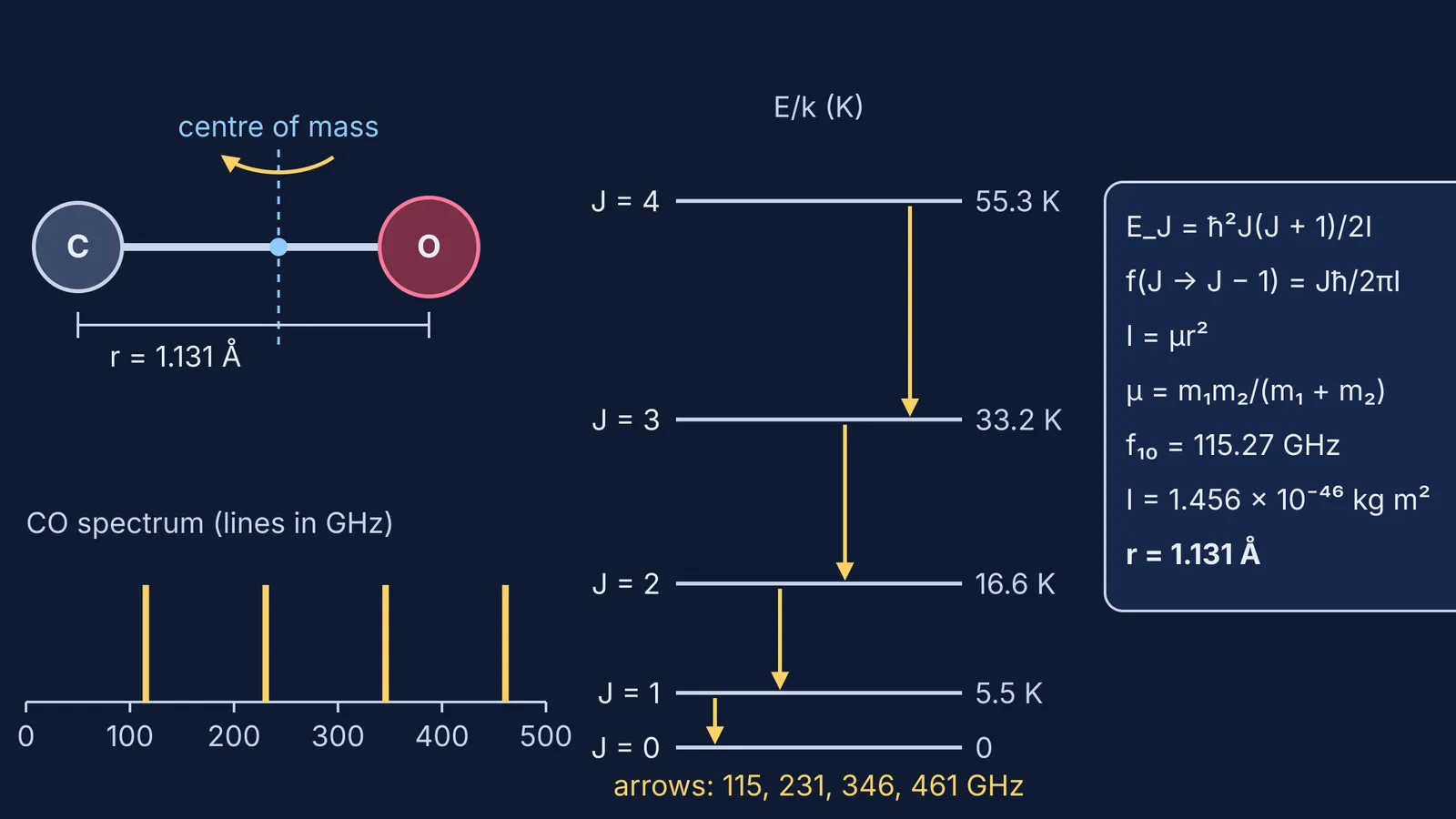
A diatomic molecule such as CO is a tiny dumbbell. It can tumble end over end about an axis through its centre of mass. Classically it could spin at any rate. Quantum mechanics allows only certain values of angular momentum, labelled by J = 0, 1, 2, ...:
L² = J(J + 1)ħ², so E_J = L²/2I = ħ²J(J + 1)/2I
Our post on how fast an oxygen molecule spins uses these levels for O₂. Here we follow what happens when the molecule changes level.
When the molecule drops from level J to J − 1, it emits a photon carrying the difference:
ΔE = ħ²[J(J + 1) − (J − 1)J]/2I = ħ²J/I
So the photon frequency is f = ΔE/h = Jħ/(2πI). The lines form an evenly spaced ladder: f, 2f, 3f, 4f, ... where f is the J = 1 → 0 line.
There is a catch. A molecule can only emit this way if it has an electric dipole: one end slightly positive, the other slightly negative, so that the spinning charge radiates. CO has one. O₂, N₂ and H₂ are symmetric and have none, so they give no rotational lines like these. That is why the oxygen post stops at the energy levels.
Why not use Bohr's rule L = nħ?
It is tempting to copy Bohr and write L = nħ, so E = n²ħ²/2I. Then the line from n to n − 1 has energy (2n − 1)ħ²/2I, and the lines would sit in the ratio 1 : 3 : 5 : 7.
The measured CO lines sit in the ratio 1 : 2 : 3 : 4. The CDMS catalogue at the University of Cologne lists the first four as 115.2712, 230.5380, 345.7960 and 461.0408 GHz (the JPL catalogue gives the same values). Divide by 115.2712 and you get 1, 2.000, 3.000 and 4.000 to within 0.01%. That evenly spaced ladder is direct evidence for J(J + 1) and against n². So do not derive rotational levels from Bohr's rule.
Worked example: the C–O bond length from 115.27 GHz
Take the J = 1 → 0 line of ¹²C¹⁶O at f = 115.2712 GHz, from the CDMS catalogue above. Constants are CODATA values from NIST.
Step 1. Wavelength. λ = c/f = 2.998 × 10⁸ ÷ 1.1527 × 10¹¹ = 2.60 mm. This is a millimetre-wave radio line.
Step 2. Moment of inertia. For J = 1, f = ħ/(2πI), so I = ħ/(2πf) = 1.0546 × 10⁻³⁴ ÷ (2π × 1.1527 × 10¹¹) = 1.456 × 10⁻⁴⁶ kg m².
Step 3. Reduced mass. The two atoms turn about their common centre of mass, which acts like one mass μ = m₁m₂/(m₁ + m₂) at the bond length r. Use isotope masses, not 12 and 16: carbon-12 is 12 u exactly, and NIST lists oxygen-16 as 15.99491 u.
μ = (12 × 15.99491) ÷ (12 + 15.99491) = 191.939 ÷ 27.995 = 6.856 u = 6.856 × 1.6605 × 10⁻²⁷ = 1.1385 × 10⁻²⁶ kg
Step 4. Bond length. I = μr², so r = √(I/μ) = √(1.456 × 10⁻⁴⁶ ÷ 1.1385 × 10⁻²⁶) = √(1.279 × 10⁻²⁰) = 1.131 × 10⁻¹⁰ m = 1.131 Å.
Step 5. Where is the centre of mass? It sits 1.131 × 16/28 = 0.65 Å from the carbon and 0.48 Å from the oxygen, nearer the heavier atom.
Units check: ħ/f has units J s × s = kg m², a moment of inertia. Dividing by kg and taking the square root gives metres. Good.
Why is the answer slightly larger than the textbook bond length?
The NIST Chemistry WebBook gives the equilibrium bond length of CO as r_e = 1.1283 Å. Our 1.131 Å is about 0.2% larger. Both are right; they measure different things.
The molecule is never still. Even in its lowest vibrational state it stretches and squeezes, and its bond is easier to stretch than to compress. So the average size seen by the rotation is a little larger than the bottom of the energy well. The 115.27 GHz line measures that vibration-averaged size. NIST's r_e is the bottom of the well, found by combining many lines.
You can also see the molecule stretch as it spins faster. A perfectly rigid rotor would put the J = 4 → 3 line at 4 × 115.2712 = 461.085 GHz. The measured line is 461.041 GHz, 44 MHz lower. Faster spin pulls the atoms slightly apart, which raises I and lowers the frequency.
Why do astronomers map gas clouds with CO?
The coldest gas in a galaxy is mostly molecular hydrogen, H₂, and it is where stars form. But H₂ has no electric dipole, so it emits almost nothing at these low temperatures. CO is far less common, yet it does have a dipole, and its first excited level is very low.
How low? E₁ = hf = 6.626 × 10⁻³⁴ × 1.1527 × 10¹¹ = 7.64 × 10⁻²³ J. Divided by Boltzmann's constant, that is 5.5 K. Even in very cold clouds, collisions with H₂ have enough energy to lift CO into J = 1, and it then radiates at 115.27 GHz. A review in the Annual Review of Astronomy and Astrophysics by Bolatto, Wolfire and Leroy (2013) calls CO emission the most accessible and widely used tracer of molecular gas, and discusses how astronomers convert CO brightness into H₂ mass.
This is a different kind of line from hydrogen's 21 cm radio line, which comes from a flip of the electron's spin, not from rotation. See how van de Hulst predicted the 21 cm line.
If the step from L = Iω to quantised rotation feels shaky, the Concept Library covers moment of inertia and angular momentum one concept at a time, and the Fermi Problem Library has a step-by-step solver that explains the reasoning for reduced-mass problems.
Quick checklist
Rotational levels: E_J = ħ²J(J + 1)/2I, not Bohr's n².
Line J → J − 1: f = Jħ/(2πI), an evenly spaced ladder.
Only molecules with an electric dipole (CO yes; O₂, N₂, H₂ no) show these lines.
CO: f = 115.2712 GHz gives I = 1.456 × 10⁻⁴⁶ kg m².
μ = m₁m₂/(m₁ + m₂) with isotope masses: 6.856 u.
r = √(I/μ) = 1.131 Å, slightly above r_e = 1.128 Å because the molecule vibrates.
First level is 5.5 K up, so cold clouds still glow in CO.