

On this page
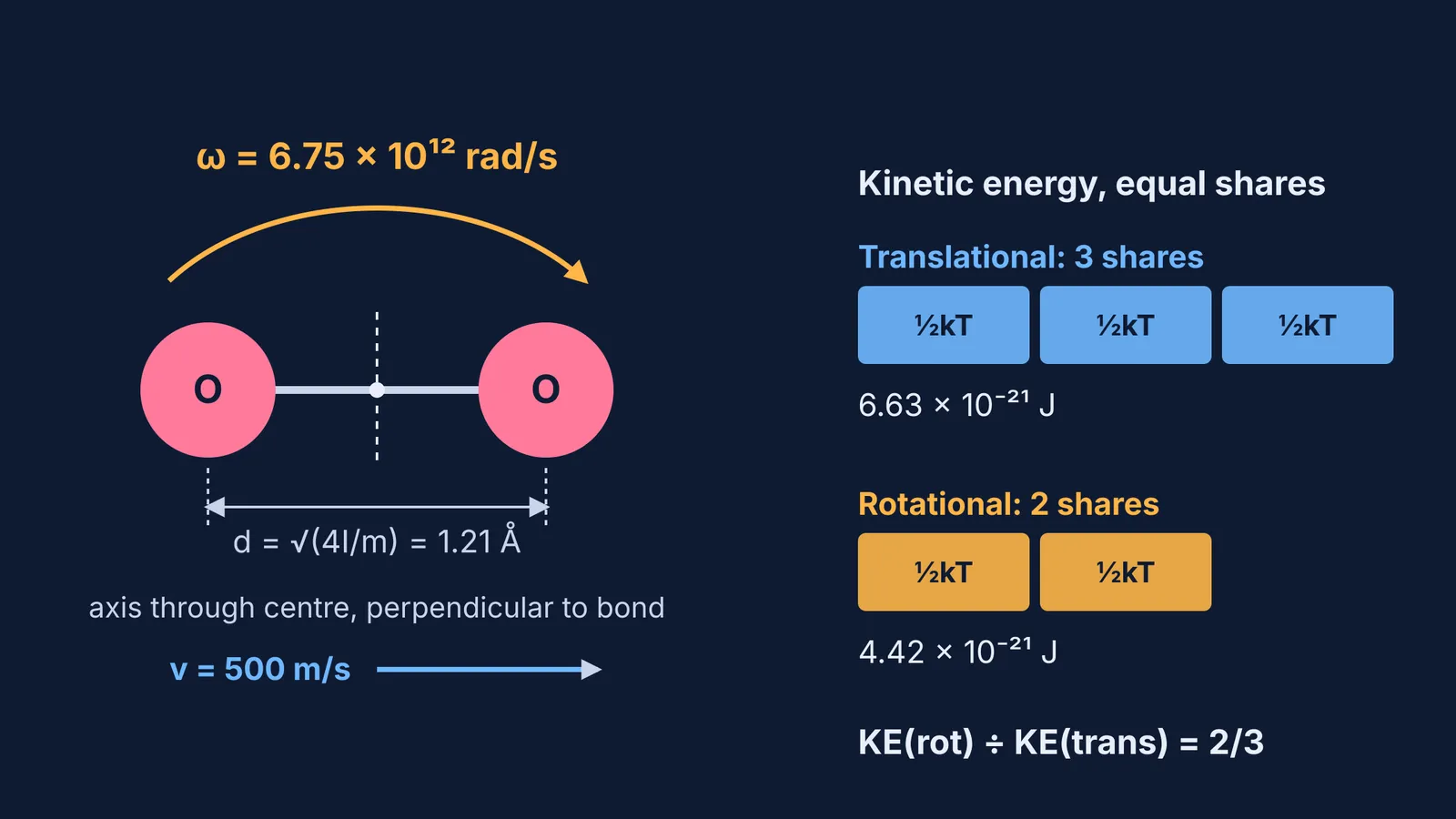
An oxygen molecule in the air around you is not just flying in a straight line. It is also tumbling end over end. A standard Class 11 rotational motion exercise asks you to estimate how fast. The data: an O₂ molecule has mass 5.30 × 10⁻²⁶ kg and a moment of inertia of 1.94 × 10⁻⁴⁶ kg m² about an axis through its centre, perpendicular to the bond. Its centre of mass moves at 500 m/s, and its rotational kinetic energy is two-thirds of its translational kinetic energy. Find its average angular velocity.
The answer is about 6.75 × 10¹² rad/s, or more than a trillion turns every second. Here is how to get it, and how the same numbers give you the length of the O=O bond.
How do you find the angular velocity of an O₂ molecule?
Write the two kinetic energies and use the ratio the question gives.
Translational kinetic energy: KE(trans) = ½mv²
Rotational kinetic energy: KE(rot) = ½Iω²
The condition is KE(rot) = (2/3) × KE(trans):
½Iω² = (2/3) × ½mv²
Cancel the halves and solve for ω:
ω² = 2mv² ÷ 3I, so ω = v × √(2m ÷ 3I)
Units check: m ÷ I has units kg ÷ (kg m²) = 1/m². Its square root is 1/m, and multiplying by v in m/s gives 1/s, which is rad/s. Good.
Worked example: the numbers, step by step
Translational KE. ½ × 5.30 × 10⁻²⁶ × 500² = 6.63 × 10⁻²¹ J.
Rotational KE. (2/3) × 6.63 × 10⁻²¹ = 4.42 × 10⁻²¹ J.
ω². ω² = 2 × KE(rot) ÷ I = 2 × 4.42 × 10⁻²¹ ÷ 1.94 × 10⁻⁴⁶ = 4.55 × 10²⁵ rad²/s².
ω. ω = √(4.55 × 10²⁵) = 6.75 × 10¹² rad/s.
Turns per second. f = ω ÷ 2π = 1.07 × 10¹² rev/s.
Time for one turn. T = 1/f = 9.31 × 10⁻¹³ s, under a picosecond.
Check with the one-line formula: 500 × √(2 × 5.30 × 10⁻²⁶ ÷ (3 × 1.94 × 10⁻⁴⁶)) = 6.75 × 10¹² rad/s. Both routes agree.
Why is rotational KE two-thirds of translational KE?
This is the law of equipartition of energy. In a gas at temperature T, each quadratic term in the energy gets ½kT on average. A molecule moves in three directions, so it has three translational degrees of freedom and an average translational energy of (3/2)kT.
A diatomic molecule like O₂ can also rotate about two axes, both perpendicular to the bond. That gives two rotational degrees of freedom, with an average rotational energy of kT. The ratio is 2 : 3, which is the two-thirds in the question.
Rotation about the bond axis itself does not count. Almost all the mass sits in the nuclei on that axis, so the moment of inertia about it is tiny, and the energy steps for that rotation are far too large to be reached at room temperature. The full argument is in the law of equipartition of energy and degrees of freedom. How these degrees of freedom set the heat capacity of a diatomic gas, and how vibration joins in when it gets hot, is covered in why Cv of a diatomic gas rises from 5R/2 to 7R/2.
Is 500 m/s a sensible speed? For O₂ at 300 K, with molar mass 0.032 kg/mol, the rms speed is √(3RT/M) = √(3 × 8.314 × 300 ÷ 0.032) = 484 m/s. So 500 m/s is a round value close to room temperature. If you use equipartition directly at 300 K, KE(rot) = kT = 4.14 × 10⁻²¹ J and ω = √(2kT ÷ I) = 6.53 × 10¹² rad/s, close to the textbook answer.
Can you get the O=O bond length from the moment of inertia?
Yes, and it is a good check that the data are realistic. Model O₂ as two equal point masses, each m/2, separated by the bond length d. The axis passes through the centre, so each atom is d/2 from it:
I = 2 × (m/2) × (d/2)² = md² ÷ 4
Solve for d:
d = √(4I ÷ m) = √(4 × 1.94 × 10⁻⁴⁶ ÷ 5.30 × 10⁻²⁶) = 1.21 × 10⁻¹⁰ m = 1.21 Å
The measured value listed by NIST's computational chemistry database is an O–O bond length of 1.2075 Å for the ground state of O₂. The simple dumbbell model, fed with the textbook moment of inertia, lands within about 0.2% of it.
A quick consistency check on the mass, too: 0.032 kg/mol ÷ 6.022 × 10²³ mol⁻¹ = 5.31 × 10⁻²⁶ kg, matching the 5.30 × 10⁻²⁶ kg given.
Watch the factor in I. If you put the whole mass m at d/2 on each side, you get I = md²/2 and d = √(2I ÷ m) = 0.856 Å, too small by a factor of √2. Each atom carries only half the molecule's mass.
Is a classical answer valid for a molecule?
Rotational energy of a molecule is quantised. For a rigid rotor the levels are E = ħ²J(J + 1) ÷ 2I, with J = 0, 1, 2 and so on. For O₂, the spacing scale ħ²/2I is 2.87 × 10⁻²³ J, which corresponds to a temperature of only about 2 K. At room temperature, kT is about 140 times larger, so many rotational levels are occupied and the classical average works well.
Another way to see it: the angular momentum Iω = 1.94 × 10⁻⁴⁶ × 6.75 × 10¹² = 1.31 × 10⁻³³ J s, which is about 12ħ. The molecule is in a fairly high rotational state, where the classical picture is a reasonable approximation.
Two limits still apply. The answer is an average; molecules in a gas have a spread of speeds and spin rates, just as they have a spread of translational speeds. And the oxygen molecule has a vibration too, though at room temperature it barely contributes.
How does this compare with rolling bodies?
In mechanics you meet a similar split for a rolling ball or ring, where the ratio of rotational to translational energy depends on the shape, as worked out in rolling bodies: how much kinetic energy is rotational. For a rolling body, the ratio is fixed by the no-slip condition v = ωR. For a gas molecule there is no such link between v and ω. The 2/3 ratio comes from statistics, from sharing energy equally among degrees of freedom, not from any contact condition.
If picturing a tumbling dumbbell helps, the Simulation Lab has interactive simulations for ideas that are easier to see than to read.
Quick checklist
Set ½Iω² = (2/3) × ½mv², then ω = v√(2m ÷ 3I).
O₂ at 500 m/s: ω = 6.75 × 10¹² rad/s, about 1.07 × 10¹² turns per second.
KE(trans) = 6.63 × 10⁻²¹ J; KE(rot) = 4.42 × 10⁻²¹ J.
The 2/3 is energy, not speed: 2 rotational against 3 translational degrees of freedom.
I = md²/4 for two atoms of m/2 at d/2, so d = √(4I/m) = 1.21 Å.
Rotation about the bond axis does not count.
The result is a classical average; quantisation would matter only at a few kelvin for O₂.


