

On this page
Why is γ 5/3 for helium but 7/5 for nitrogen? Both come from one idea: energy is shared equally among every independent way a molecule can move. Count those ways correctly and Cv, Cp and γ follow.
What is the law of equipartition of energy?
The law of equipartition of energy says that in thermal equilibrium at absolute temperature T, each energy mode of a molecule carries an average energy of ½kBT (NCERT Class 11 Physics, Chapter 12, Kinetic Theory, Section 12.5). A degree of freedom is an independent way a molecule can move, such as translation along x, y or z (OpenStax University Physics Volume 2, Section 2.3).
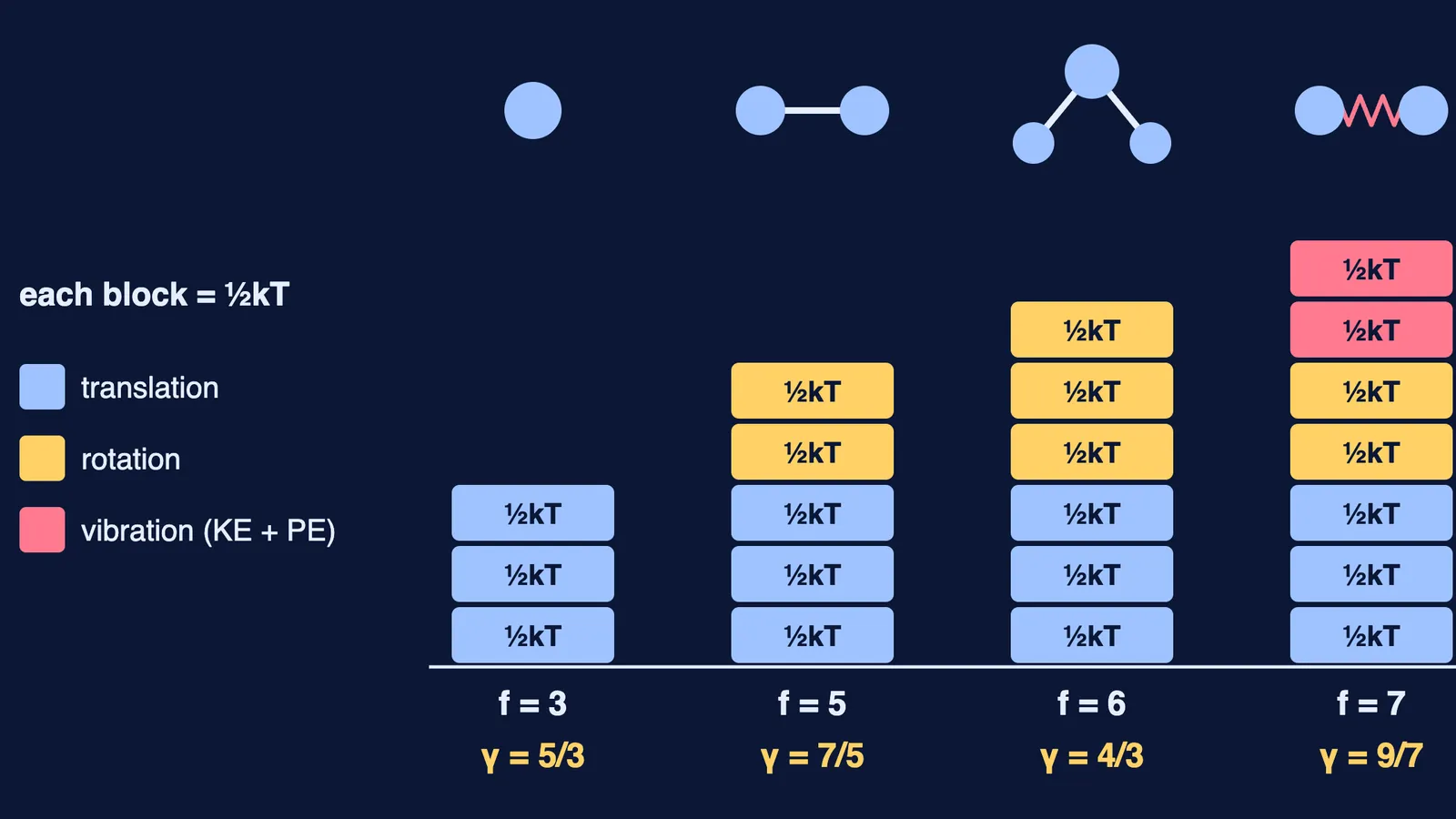
NCERT's counting rule: each squared term in a molecule's energy is one mode. Translation and rotation give one per degree of freedom; a vibration gives two, kinetic energy and the potential energy of the spring-like bond, so a vibrational mode carries 2 × ½kBT = kBT (NCERT Chapter 12).
It belongs to NCERT Class 11 Physics Part 2, Chapter 12, Kinetic Theory. The Syllabus for JEE (Main) 2027 lists "degrees of freedom, law of equipartition of energy and applications to specific heat capacities of gases" under Unit 9, and the NEET (UG) 2026 syllabus lists the same ideas under its Kinetic Theory of Gases unit.
How do you derive Cv, Cp and γ from degrees of freedom?
Kinetic theory gives the average translational energy of a molecule: ½m⟨v²⟩ = (3/2)kBT.
No direction is special, so ½m⟨vx²⟩ = ½m⟨vy²⟩ = ½m⟨vz²⟩ = ½kBT. Each translational degree of freedom gets ½kBT.
Equipartition extends this to every mode. With f modes, one molecule has (f/2)kBT, and one mole has U = (f/2)RT, since NA·kB = R.
Molar heat capacity at constant volume: Cv = dU/dT = (f/2)R.
At constant pressure the gas also does work P∆V = R∆T per mole, so Cp = Cv + R = (f/2 + 1)R.
Divide: γ = Cp/Cv = 1 + 2/f.
The values students need, all from NCERT Sections 12.6.1 to 12.6.3:
Monatomic (He, Ar): 3 translational, f = 3. Cv = 3R/2, Cp = 5R/2, γ = 5/3.
Rigid diatomic (O2, N2 at moderate temperature): 3 translational + 2 rotational, f = 5. Cv = 5R/2, Cp = 7R/2, γ = 7/5.
Diatomic with its vibration active: one vibrational mode adds kBT, so f = 7. Cv = 7R/2, Cp = 9R/2, γ = 9/7.
Rigid polyatomic (atoms not in a line): 3 translational + 3 rotational, f = 6. Cv = 3R, Cp = 4R, γ = 4/3.
Cp − Cv = R holds for every ideal gas, whatever its atomicity (NCERT Chapter 12).
When does equipartition apply, and when does it fail?
Equipartition is a classical result for systems in thermal equilibrium (OpenStax, Section 2.3). It works only when every mode you count can actually take energy.
Rotation about the bond axis does not count. NCERT notes that rotation along the line joining two atoms has a very small moment of inertia and does not come into play, for quantum mechanical reasons (NCERT Chapter 12, Section 12.5 footnote). The same reasoning means any molecule whose atoms lie in a straight line has 2 rotational degrees of freedom, not 3.
Vibrations are often frozen. NCERT treats O2 as a rigid rotator at moderate temperatures but notes that molecules like CO have a vibrational mode even at moderate temperatures. OpenStax describes hydrogen: below about 60 K only translation is active, from about room temperature to about 600 K translation and rotation are active (f = 5), and above about 3000 K vibration is fully active as well (f = 7) (OpenStax, Section 2.3).
Some gases deviate. NCERT reports measured specific heats of Cl2, C2H6 and similar gases above the no-vibration prediction; including vibration improves the agreement.
Why vibration switches on gradually is quantum physics, beyond NCERT and JEE Main; our post on why Cv of a diatomic gas rises from 5R/2 to 7R/2 when hot works through it. In exams, assume rigid molecules unless the question says "non-rigid", "vibrating" or "very high temperature".
Two worked examples: one NEET, one JEE Main
These use R = 8.314 J mol⁻¹ K⁻¹ (NIST CODATA value).
Example 1 (NEET style). A container holds 2 mol of helium and 3 mol of nitrogen (rigid) at the same temperature. What is the ratio of the internal energy of the helium to that of the nitrogen?
Helium: U = 2 × (3/2)RT = 3RT. Nitrogen: U = 3 × (5/2)RT = 7.5RT. Ratio = 3/7.5 = 2/5.
If the question asked for translational kinetic energy only, each gas has (3/2)RT per mole and the ratio is the mole ratio, 2/3. Read which energy is asked.
Example 2 (JEE Main style). 2 mol of an ideal gas made of rigid nonlinear triatomic molecules is heated at constant pressure from 300 K to 350 K. Find (a) the heat supplied, (b) the change in internal energy, and (c) the work done by the gas.
f = 6, so Cv = 3R and Cp = 4R.
(a) Q = nCp∆T = 2 × 4 × 8.314 × 50 = 3325.6 J.
(b) ∆U = nCv∆T = 2 × 3 × 8.314 × 50 = 2494.2 J.
(c) W = Q − ∆U = 831.4 J. Check: W/Q = 1 − 1/γ = 1 − 3/4 = 1/4, and 831.4/3325.6 = 0.25.
What is the main trap with degrees of freedom?
The trap is counting a vibrational mode as one degree of freedom worth ½kBT. It carries kBT, because it has both kinetic and potential energy (NCERT Chapter 12, Points to Ponder). Miss this and a vibrating diatomic comes out as Cv = 3R instead of 7R/2.
A related slip is giving a straight-line molecule 3 rotational degrees of freedom. A safe routine: draw the molecule, write the energy as a sum of squared terms, count them, then use U = (f/2)RT. Want to see a molecule's modes rather than only read about them? The Fermi Simulation Lab has interactive simulations for the ideas that are easier to see than to read.
For the chapter plan and practice, see our Kinetic Theory of Gases for NEET guide or the Kinetic Theory of Gases for JEE Main guide.


